
Search: Google images eBay wikipedia YouTube
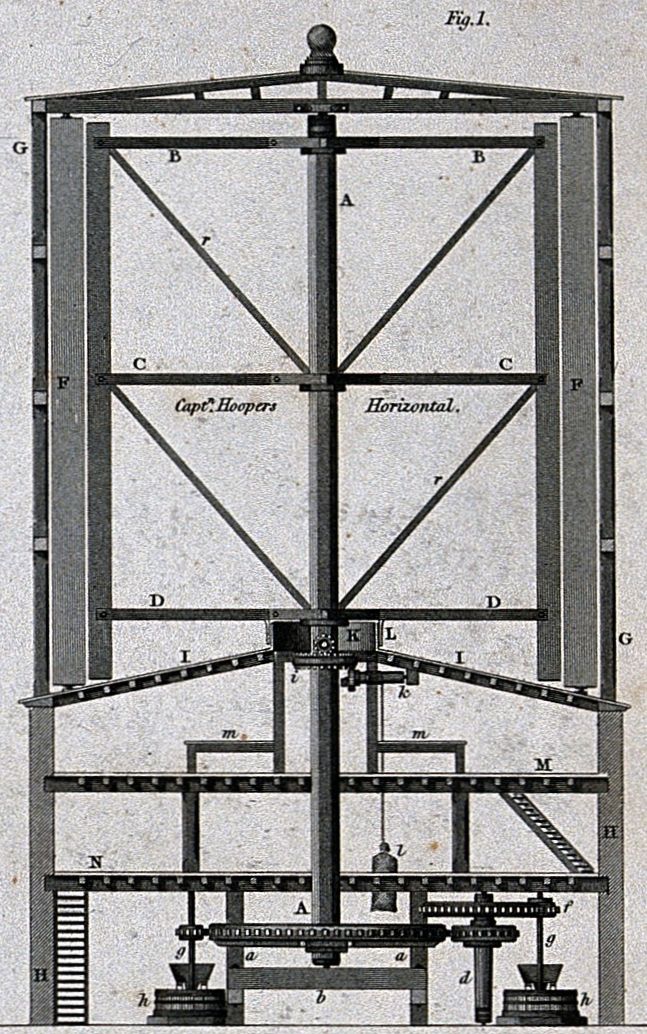
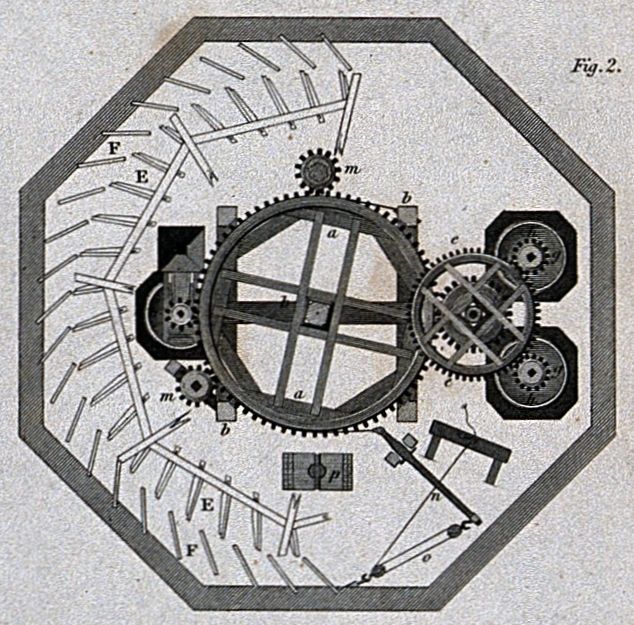
Hooper's horizontal mill: Horizontal windmill function:Corn mill
Whilst largely demolished after a storm in 1825, the base actually survived till the 1960's, completely ignored and unrecorded by molinologists, till it was too late. Almost universally, descriptions of Hooper's mill apply the word "curious".
LETTER IX.
Sept. 10,
... I have given you a description of the different roads or walks, and places of public resort in and near Margate; now then to conclude, permit me to mention a few things I omitted in my account of the town itself :- there are several boarding-houses about the town, for the accommodation of small families or single persons ... The principal boarding-houses are Lautier's and Regeri's in Cecil-square; Humble's in the High-street, opposite Surflen's Coffee-room : Sacket's, called the Royal Mansion near the Fort, and one lately established upon Hooper's Hill, late Dr. Forbs's house; near the latter is a curious horizontal windmill erected upon a new principle to grind corn, or raise water: it was invented by a. Mr. Hooper, for which he has got a patent.
After bathing it is customary to walk. The places most frequented for this purpose are, the square, the fort, Hooper's Hill, where there is an horizontal windmill, of a curious construction, for grinding corn; and the rope-walk ; though when the tide is ebbed, the company go often on the sands, to collect shells, pebbles, sea-weeds, &c. many of which are to be met with in and about Margate.
MARGATE, March 6. Tuesday, at twelve o'clock, arrived at Benson's Royal Hotel, from Deal, his Royal Highness the Duke of York, attended by Col. Fox, Col. Hewgill, of the Guards, and Capt. Crawford, his Royal Highness's Aides du Camp, and several other Officers. His Royal Highness, soon after his arrival, went and inspected Capt. Hooper's curious horizontal air mill; and after visiting several other parts of the town, returned to Benson's, where his Royal Highness and his suite dined, and about six o'clock embarked from the Pier, in the Vestal's barge, under a royal salute of 21 guns, from the Fort and Pier, accompanied by many loyal cheers from some thousand spectators.
When the barge and other boats reached the Vestal, she and the three other men of war which were in the road, returned the salute with 21 guns each.
And early on Wednesday morning the above ships, with the transports containing the 750 Guards, sailed with a fair wind for Ostend.
His Royal Highness seemed much pleased with the loyalty and patriotic behaviour of the inhabitants of this town, who in the evening further testified their gratitude for his partiality to this place for embarkation by a brilliant illumination.
A short description of the Isle of Thanet, Robert Edward Hunter, 1799
Near the Fort, on Hooper's Hill, is Prospect coffee-house, an exceeding good tavern and hotel; and adjoining it, is a good bowling green with alcoves, where the company often breakfast and drink tea, and in the evening fire-works are sometimes exhibited: the prospect from hence is delightful; every vessel sailing to and from London, the whole commerce of the Thames, passes within a short distance, and gratifies the English eye with a magnificent floating picture, beautiful beyond description: at opposite corners of this bowling green are two octagon tea rooms to accommodate the company, and several pleasant boxes fronting the sea; the the tenant is civil and attentive, and gives general satisfaction.
Turning from this scene of pleasure, we behold a stupendous machine more immediately employed for use; a vast horizontal windmill, the plan of that mechanical Thanet genius, Captain Hooper, who has here employed his powers, we trust profitably to himself, as it has been beneficial to the public. Those who delight in seeing an extraordinary display of mechanical contrivance, will not think an hour ill employed, whilst they are admiring this magnificent and useful production of our modern Margate Archimedes.
Extract from a memoir of Captain Steven Hooper, Mechanics Magazine, Volume 5, No 117 SATURDAY NOVEMBER 19, 1825 (See Fowler's Mill, Battersea for full memoir).
In his horizontal mill he found more solid advantage for having left the sea and built a mill of this kind at Margate, he and his sons carried on for many years an extensive business in the flour trade.
In the time of scarcity which occured about the year 1801 Mr Hooper met with some very unpleasant circumstances from the unquiet spirit which is always manifested by John Bull when he is either hungry or fears he shall be. On one occasion it was only by the prompt exertions of a body of cavalry that Mr H and his family were preserved from destruction. Upon this he offered the use of his mills to the Magistrates for the convenience of the town but declined business on his own account as having become both unprofitable and dangerous. Shortly after this he sold his property at Margate and went to reside at Walworth near London where for some time he pursued his mechanical amusements and formed many very ingenious and interesting models which from his situation and time of life he never had the opportunity of applying to any useful purpose. He died at a very advanced age leaving in the breasts of all who knew him a most pleasing remembrance not only of his mechanical genius but of the more important qualities of ardent piety and genuine benevolence.
...
By a very ingenious contrivance Mr Hooper at first enabled the mill to regulate its own velocity by closing or opening the shutters as the wind increased or diminished its force. But as this machinery was apt to get out of order he discontinued the use of it in his own mill and left the regulation of the speed to the vigilance of the workmen.
...
The mill at Margate has recently been pulled down after having been materially injured by the gales to which it was exposed, from its elevated situation on the cliff.
On the opposite hill, north-eastward of the New Town, stands an assemblage of houses, called Hooper's Hill, where a curious horizontal windmill, for grinding corn, has been erected at the back of Prospect Tavern bowling-green, on the west side of the buildings denominated Prospect Academy. It was purchased of Captain Hooper, who obtained the king's patent for the invention.
The three mills here represented, are objects of considerable attraction, and from standing on very high ground, are seen at a considerable distance by sea and land: they are situate near Dane or Hooper's Hill, where once stood the horizontal mill invented by Captain Hooper, and called by his name. This mill was pulled down a few years ago, and is now remembered only as an ingenious piece of machinery; and on account of the following curious occurrence, which, while it proves the extraordinary violence, and the irresistable power of the wind, is deserving of relation from its singularity. During the dreadful gale by which the old pier was destroyed, the top of this mill, with the upper tier of sweeps, fliers, &c., weighing more than four tons, was torn from its iron fastenings; and after being blown a distance of several hundred feet, was lodged in a field near the present mills, without sustaining or doing any mischief.Maidstone Journal and Kentish Advertiser, 6 February 1896
Thursday, February 6th, 1896.
Notes.
A CURIOUS WINDMILL.
In a Guide to Margate, published in the year 1809, there is a description of a curiously-constructed windmill, which stood, at that date, just outside the town of Margate. The particulars are as follows :-
"North eastward of the new town, is built a hamlet of houses, called "Hooper's Hill," on which there is a curious horizontal windmill for grinding corn. The construction is on a peculiar and very curious principle, for which Mr Hooper obtained the king's patent. Its sweeps, or fliers, move horizontally, and are enclosed with shutters, that exactly regulate the degree of wind necessary for carrying on the manufactory. But this stupendous machine is not so lofty as formerly; for in a violent gale of wind, on Sunday, the 9th November, 1800, its upper tier of sweeps or fliers, with the cap and timber attached to it, was taken off in a horizontal direction, and carried over the Prospect house, to the distance of more than 200 yards: and the weight of the timber thus carried was thought to be about five tons. This ingenious mechanic likewise invented sweeps to the common windmill, which take in the sail in proportion to the velocity of the wind, so that they are in no danger from hasty gales, and may be left for hours without injury to the mill or detriment to the business. For this also Mr H. obtained a patent."
ESSJAY.
SALES BY AUCTION
To Millers and Others .- Three capital and most substantial Windmills, with Storehouses and Granaries, seven Cottages, and a convenient Residence, at Margate.
By WINSTANLEY and SONS.
At the AUCTION MART, near the Bank of England,
On FRIDAY, Oct. 29, at One, in Lots,
VERY Valuable and Desirable FREEHOLD and small part LEASEHOLD PROPERTY, consisting of three capital commodious and exceedingly substantial windmills, containing seven pair of stones and all the excellent going geer, capable of doing near 8000 quarters per annum; together with three brick cottages for the men, workshops, storehouses, and granaries, &c. most desirably situate for business, being immediately contiguous to the town of Margate, from whence four can be shipped for the London market. Also a convenient family dwelling house, with a garden and fore court, in a pleasant situation, a short distance from the above; four cottages, let at 26 guineas per annum, and the brick part of the building formerly the horizontal mill, now used as a storehouse or granary, with extensive stabling, sheds, coachhouse, piggeries, yard, &c.
To be viewed by applying on the Premises: Printed Particulars may be had at the several Hotels and Libraries, Margate, Ramsgate, and Broadstairs; the Inns at Dover, Deal, and Canterbury; of Mr. Edward Dering, Solicitor, Margate; of Messrs. Corcoran and Son, 30, Mark-lane, at the Corn Exchange Coffee Houses, Mark.lane; at the Mart; and of Winstanley and Sons, Paternoster row, where a Plan may be seen.
Entry in Mills Archive database - #11010 - Hooper's Horizontal Mill, Margate (has photos)
| Last generated 15/09/2026 | Text and images © Mark Berry, 1997-2026 - |
 (
(

