
Millstones in Trent Park 🌍
Trent Park
Trent Park is a large country park, just on the edge of London's Green Belt, at Cockfosters, Enfield.
It used to be the main campus site for Middlesex University,
but has now been sold for housing development.
It has a long and varied history, and a the Trent Park House of Secrets museum is due to open there in July 2026.
Originally part of the Royal Enfield Chase (a hunting forest),
it was worked upon by the landscape gardner Humphry Repton (1752-1818), and subsequent
owners left their mark on the estate. Chiefly responsible for much of the current appearance of Trent Park mansion, and of the grounds,
was Sir Philip Sassoon, who inherited the house from his father in 1912. Sir Philip Sassoon turned the house into the party venue of the
day, hosting elaborate society parties for large numbers of guests including politicians, nobility and royalty.
The mansion house itself was largely remodelled using much of the stonework from the demolished Devonshire House in Piccadilly. The estate
grounds were similarly decorated using items relocated from other estates, as the many obelisks and statues in the park confirm.
The Rustic Water Garden
Amongst the park landscaping, there is a a rustic water garden, found in the wooded area at the east end of the park's main fishing lake.
Whilst designed to look to some extent natural, with small ponds and a stream with bridges, this garden is certainly the results of
deliberate design. As a feature of the design, there are a fair number of millstones to be found placed at particular points of the garden.
Whilst it is possible to imagine that there might once have been a mill on this "stream", and that these are all that remains as evidence
of that, I think (given the provenance of many of the other architectural features of the park) that these stones have been moved here
from some other unknown locations.
The millstones have generally been placed as paving slabs at junctions in the paved path to the south of the garden. They all appear to be
millstone grit - there are certainly no french burr stones present.
In order, following the south path from west to east, then crossing over the stream, and back along the north path from east to west,
I found the following millstones:
1
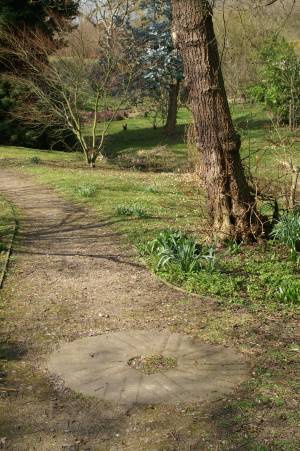
4ft stone, with 11 inch round centre hole, dressed with 10 segments (included as part of the path)
2,3
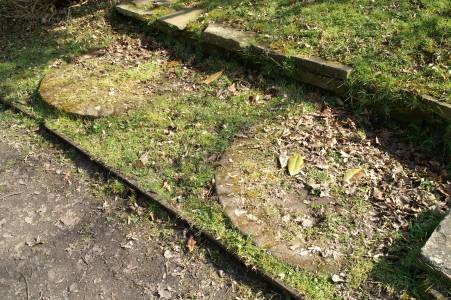
A pair of approximately 4ft diameter stones, placed to one side of the path in a specially built enclosure -
this looks as if it may well have been the base for a park bench at one time. Too covered in moss and earth to
find further details on these stones
4
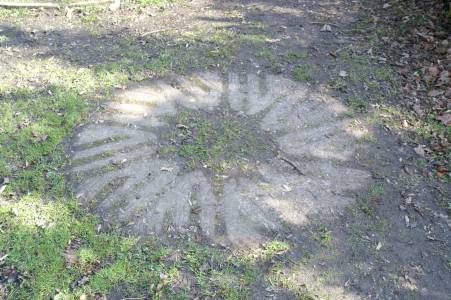
4ft stone, too buried to be sure of centre shape, dressed with 10 segments (included as part of the path)
5
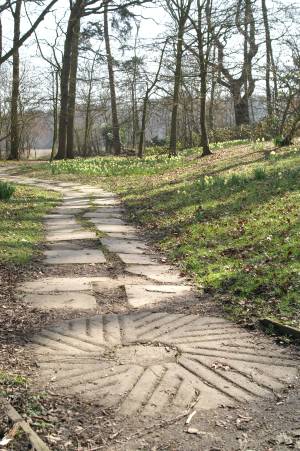
4ft stone, with 1ft round centre hole, and a well defined dressing pattern, 9 segments (included as part of the path)
6
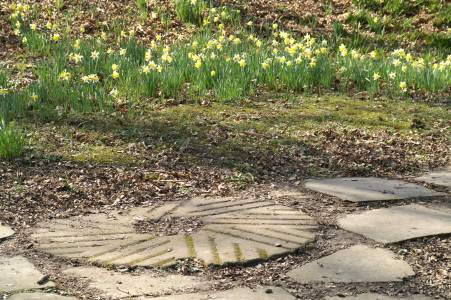
4ft stone, with approx 10 inch star shaped centre hole, well defined dressing pattern, with 9 segments (included as part of the path)
7
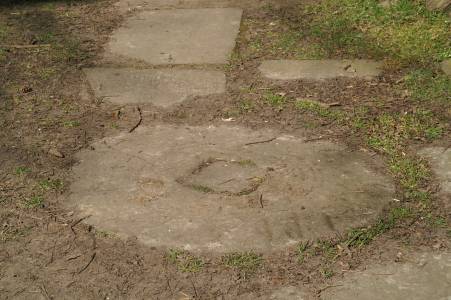
3ft stone, with 8 inch square hole, worn and indistinct dressing pattern (included as the eastern most extent of the path)
8
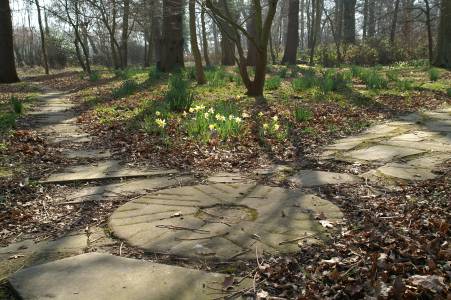
3ft stone, with approx 9 inch 8 pointed star centre hole, worn dressing pattern with 9 segments (included as part of the path)
9,10
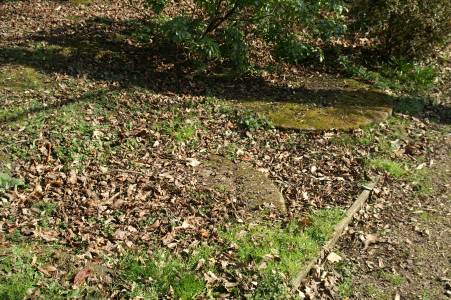
A pair of approx 4ft millstones, again set to one side of the path, perhaps to provide a base for a bench to be placed upon, but
now very moss and earth covered
11
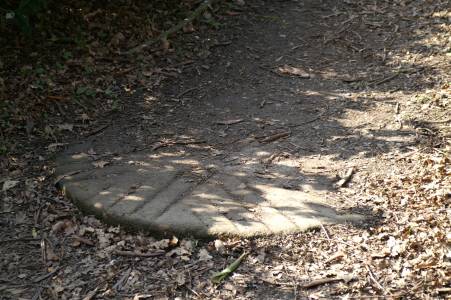
4ft stone, part buried, providing a step in the gentle slope of the path
It is clear that stones within the path, at 1 and 4 are paired, as are 5 and 6, and 7 and 8. The two pairs of stones at the side of the
path are assumed to be matched pairs. There is just a single unpaired stone, at location 9. It's possible that I missed some stones -
especially if they are not part of the main paved path. All pictures were taken 19th March 2005.
| Last generated 30/06/2026 |
Text and images © Mark Berry, 1997-2026 -
|