[Waymarking] [Waymarking]
ostensibly a mock mill, but I believe that it does have milling equipment installed in it
[homepage] [info]The Diary of William Bentley, September 12, 1795:
Rode in company with the Southern Gentlemen to Derby's Farm & to Chipman's at Beverly. This Gentleman entertained us with his Tannery, & particularly with his Horizontal Windmill which he is constructing to grind Bark. Possessing the resources of a good mechanic genius he is determined to repeat an experiment which has hitherto proved unsuccessful. He has made only one alteration as yet, & his works not being ready for trial, we knew not with what success. He observed that the Leeward Vanes trembled first, & that on the present construction they were not fixed to receive the air, & observing how ships trim to windward, he has made a model which receives all the wind which escapes through the windward vanes on the Leeward before it escapes, & so as to assist the motion. His Stone is less heavy than Richardson's in this Town. His gudgeons are brass. His Vanes are supported by arms without braces. He shew us a farm in good order. A well contrived stye, a fine pigeon house, the doves chiefly white, a convenient barn, excellent stone wall, & provision for greater improvements. He does not wish for the Mill to break his hides. This shave has blunted teeth on the inside, which he has introduced & which breaks the inner skin effectually in twice drawing. His bark house is properly secured. All his Vats convenient. His lime holes emptied by a drain below. He informed us that he contrived the pumps which deliver a bucket at a stroke with great ease. We passed to the Factory, surveyed the Jennies for spinning, the cording machines, the roping, the twisting, the winding, &c. They make excellent bed ticks in the Factory. Mr Chipman thinks the power might easily be made greater in Kindley's machine for making brick, which would give a greater ease in managing it.
Henry Wansey's Journal, Sunday May 11 1794
Mr, Freeman is the minister of the Unitarians, who meet in what was called the King's Chapel, before the revolution. ... I went with Mr. Freeman to that pleasant suburb, Charleston, called the mother of Boston. It is now entirely rebuilt, since it was burnt in the war, and is a very neat, clean, well-built town. ... In this town, Mr. Freeman took me to see a curious wool-card manufactory, worked by an horizontal air mill, like that at Battersea, though not so large. Of this mechanical application they claim the invention. The manufactory itself is curious and well worth attention. It is a trade well encouraged here, for every housewife keeps a quantity of these cards by her, to employ her family in the evenings, when they have nothing to do out of doors. The glass-house, and the duck or sail cloth manufactory, I did not see.
Diary of William Bentley, February 27, 1793
Talk of using wind mills for grinding bark in the Tan yards. A competition arising in this Trade.Diary of William Bentley, June 1794:
Richardson's, new Windmill for Bark on the CommonFrom Diary of William Bentley, 12th July 1794:
Wind. And tried our new Wind mill without success. Either from the construction, or friction, the mill would not go. [Editors footnote: Probably Richardson's on East street.]
From The Diary of William Bentley, April 4th 1791:
Mr Robert Hooper aet. [aged] 62, at the corner of Ferry Lane, told me that the wind mill, formerly standing on that point was brought from Boston in 1733. It stood on Cop's Hill in the north part of that Town, & was struck with Lightning. Mr Clough the father of the present generation came with it, who was by trade a mason, & afterwards a Sexton in the East Meeting House. Mr Hooper attended it in person, for sometime.
Approximate years 1794-1800. A strange mill in many respects, being one of very few horizontal windmills built in the USA. It provided the power to a woollen factory, but (like pretty much all horizontal windmill) it was unsuccessful, and soon went out of use.
Powered the estate by generating electricity 1894-1938.
In the 1860's, Thomas B Field came up with a patented design for a horizontal windmill which he later installed on a residential building on N. Liberty Street, that became known as Field's Folly. The mill was not a success, and the vanes were removed leaving just the tower on the roof. Before long the building fell into disrepair, and was demolished in 1897. George E Morris painted a watercolour of the building in 1888.
THOMAS B. FIELD, IMPROVEMENT IN WIND-WHEELS, Patent No. 43625, August 2, 1864.:
This invention relates to a new and improved horizontal wind-wheel of that class in which the Wings or sails are turned automatically from an upright to a horizontal position, and vice versa, as the wheel is rotated in a horizontal plane under the action of the wind. The object of the invention is to obtain a Wind-wheel of the class specified which will operate with certainty and precision, and will be capable of turning in either direction-that is to say, either to the right or left, as may be desired.
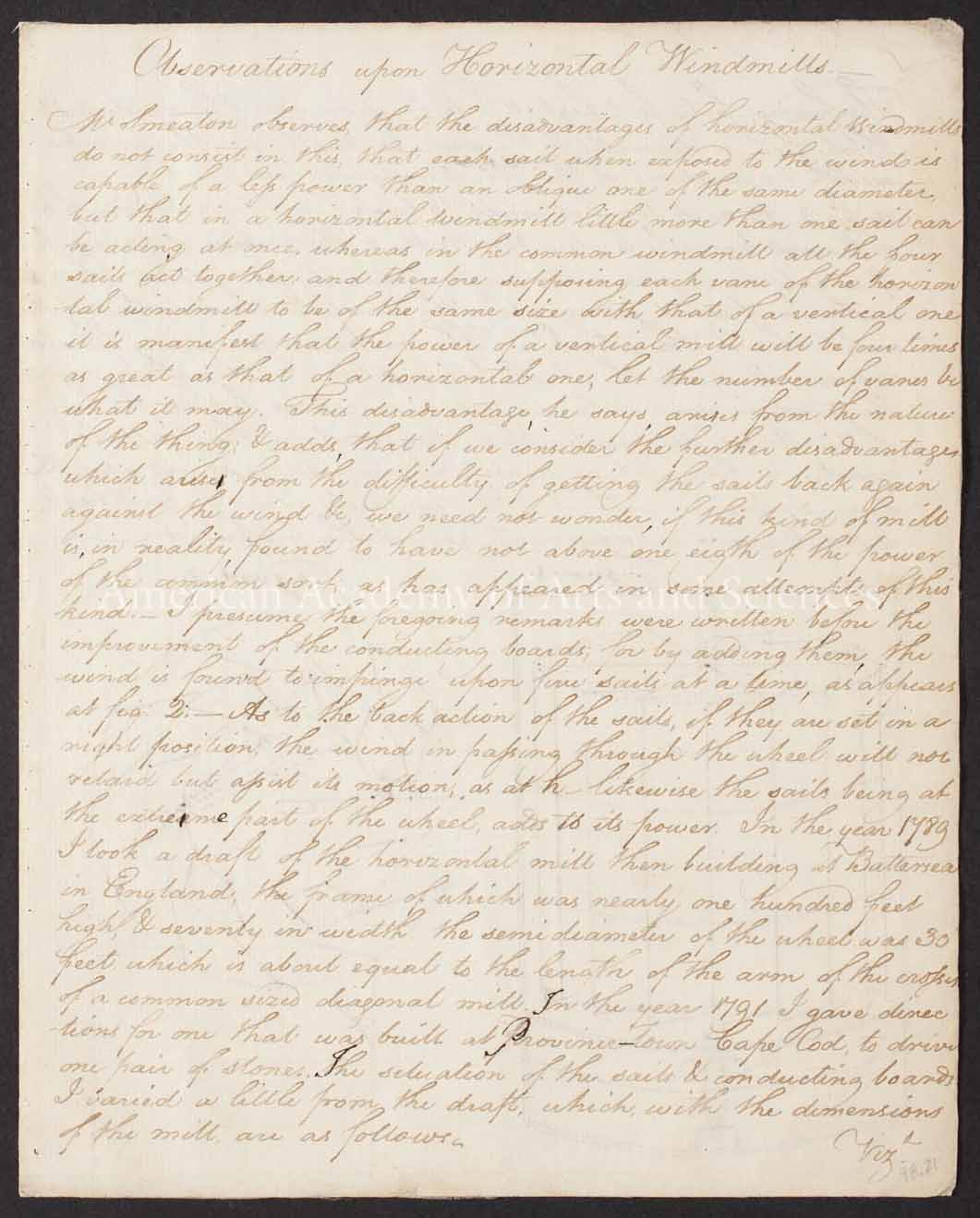
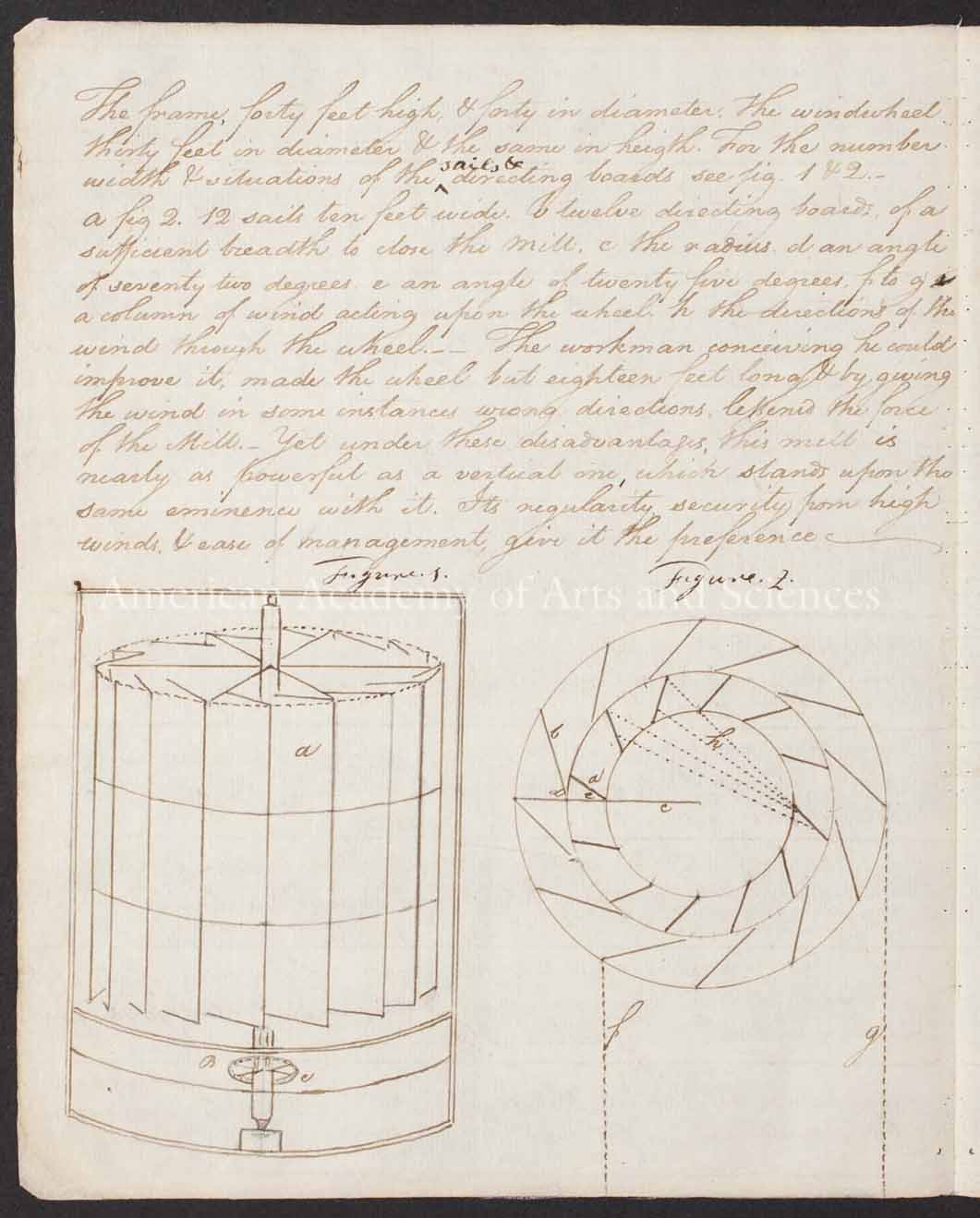
The "Series I-C-2: Communications. Unbound, 1767-1931. Archives, American Academy of Arts and Sciences, Cambridge, Massachusetts." contains an undated and unidentified author's "Observations on Horizontal windmills", which describes his work on a horizontal windmill at Provincetown, and which partly disagrees with Smeaton's experiments (which were published in 1759 - at least 30 years before the observations) p1 and p2 (including the figures):
Observations upon Horizontal Windmills
Mr Smeaton observes that the disadvantages of horizontal windmills do not consist in this, that each sail when exposed to the wind is capable of a less power than an oblique one of the same diameter but that in a horizontal windmill little more than one sail can be acting at once, whereas in the common windmill all the four sails act together and therefore supposing each vane of the horizontal windmill to be of the same size with that of a vertical one it is manifest that the power of a vertical one will be four times as great as that of a horizontal one, let the number of vanes be what it may. This disadvantage he says arises from the nature of the thing, & adds that if we consider the further disadvantages which arise from the difficulty of getting the sails back again against the wind & we need not wonder if this kind of mill is, in reality, found to have not above one eigth of the power of the common sort as has appeared in some attempts of this kind. I presume the foregoing remarks were written before the improvement of conducting boards for by adding them the wind is found to impinge upon five sails at a time as appears at fig. 2. As to the back action of the sails, if they are set in a right position the wind on passing through the wheel will not retard but assist its motion as at (h) likewise the sails being at the extreme part of the wheel adds to its power. In the year 1789 I took a draft of the horizontal mill then building at Battersea in England, the frame of which was nearly one hundred feet high, & seventy in width, the semi diameter of the wheel was 30 feet which is about equal to the length of the arm of the crosses of a common sized [diagonal] mill. In the year 1791 I gave directions for one that was built at Province-Town, Cape Cod to drive one pair of stones. The situation of the sails and conducting boards I varied a little from the draft, which with the dimensions of the mill are as follows
The frame forty feet high, & forty in diameter. The windwheel thirty feet in diameter & the same in height. For the number, width & situations of the sails & directing boards see fig. 1 & 2. a) fig 2. 12 sails ten feet wide b) twelve directing boards of a sufficient breadth to close the mill c) the radius d) an angle of seventy two degrees e) an angle of 25 degrees f to g) a column of wind acting upon the wheel h) the directions of the wind through the wheel The workman conceiving he could improve it made the wheel but eighteen feet long & by giving the wind in some instance wrong directions lessoned the force of the mill. Yet under these disadvantages this mill is nearly as powerful as a vertical one which stands upon the same [eminence?] with it. Its regularity, security from high winds, & ease of management give it the preference.
[Figure 1] [Figure 2]
| Last generated 05/06/2026 | Text and images © Mark Berry, 1997-2026 - |
 (
(