RSS feed.
 Bourne watermill receives £224K grant from Heritage at Risk Capital Fund
Bourne watermill, Colchester is one of the recipients of the 2026 Heritage at Risk Capital Fund awards.
According to the Historic England entry on the award,
Bourne Mill connectedThat entry raises a few questions:
Tendring District Council will use the funding to conserve and repair Bourne Mill, addressing water ingress, failing roof coverings, masonry defects, deteriorating historic joinery and the waterwheel structure through a conservation-led programme of works.
The funding will safeguard the heritage significance of Bourne Mill and prevent further deterioration, while enabling the site to reopen as a flexible heritage and community resource. This will support public access, learning, volunteering and community participation, as well as opportunities for heritage skills learning through partnerships with educational institutions.
Listed Grade I
Grant: £224,200
The mill previously had about £4000 of repairs done in 2010, so this grant is a considerable advance on that amount.
 The County Books Series: Sussex, by Esther Meynell
I would not dare to call myself an archaeologist: I am but a beginner, an amateur - which means a lover - of the subject.Whilst the immediate subject is archaeology, it's clear that Esther was a lover of Sussex, and this is generally a delightful book to read. Time has of course moved on; the Piltdown Man has long been understood as a hoax, yet here it is presented as fact, and our understanding of history has changed in so many other areas.
It's interesting however to read the words Esther has to say on Sussex windmills:
The visible relics of the old life on the land in Sussex are all beautiful. The old farmhouse and cottages, the tithe barns, the massive brick-built dovecots, the windmills - so many of which have vanished away and so few of which are any longer in use - the watermills, one or two of which still grind flour and as watermills are much older than windmills, so it is good that they have held out longer against disuse and decay.
Cobbett, when he rode about Sussex would see an abundance of windmills - so naturally at home on the breezy chalk hills and on the rising ground and little eminences that diversify the Weald. Most of these windmills have now tumbled down from disuse and neglect, or succumbed to their natural enemy, fire. But, happily the most famous, because the most prominent, pair of windmills in Sussex still survive to adorn the scene - they are known throughout the county as Jack and Jill, most appropriately as they've certainly gone up the hill, though the pails of water have to be fetched to those who dwell in them. These two mills are so admirably sited on the crest of the Down as to be almost as important in the landscape as the ring on Chanctonbury's head. It is long since they did any work, and for a time they were in peril of the fate of many other Sussex windmills, but they are now in good hands and have become the twin guardians of what must be the most breezy and elevated dwelling in the country, set in untouched Downland and commanding amazing views from the topmost storey of Jack, the black tower-mill. The variety of shape in the two mills which stand so friendlily together adds to their enchantment - there is a touch of fairy-tale about them, as though they had walked there from some mysterious region for the love of Sussex. Jack is a black tower-mill and Jill is a white post-mill. Adjoining the tower-mill Jack is the round house, all that remains of the little tower-mill, found too small to draw full benefit from the powerful winds, which Jack was built to replace. This round-house is all that remains of one of the oldest mills in Sussex, and is supposed to be something like 300 years old.Note: The roundhouse alongside Jack is from Duncton Gate post mill, not a tower mill. This may just be a simple editing error, rather than any deeper misunderstanding of the nature of this "round house".
An interesting bit of Jill's history is that she is that rare thing, a travelled windmill. She was built on the Dyke Hill above Brighton in 1821, and was later moved all the distance across the downs to the elevated site above the retired little village of Clayton, where she now spends an honoured old age. This removal was accomplished by an immense team of oxen, and must have been a notable sight.
In Sussex Notes and Queries for 1886, there is an account of the moving of another mill : "In 1797 a miller at Brighton, in the presence of many thousand spectators, removed his windmill whole, and literally as he worked her, with the help of 36 yoke of oxen and a number of men, across the plains to a brow near Withdean, a distance of more than a mile, where he fixed her without the smallest accident. The above mill stood to the westward of Brighton, very near the edge of the cliff, and had long being complained of as a nuisance which caused the removal. The neighbouring farmers accommodated him with their oxen for the purpose, gratis."
Not very far away from Jack and Jill above the village of Clayton, on that sudden eminence called Lodge Hill, which runs down to Ditchling, is another white post-mill, that has had its sails restored and has become a protected object. One cannot but feel that these poor pensioned mills of an age which has no use for the true stone-miller's art and mystery, would so much prefer to be doing their proper job. They were not made as objects to adorn the landscape, but to produce the whole-wheat flour to make man's bread. The beautiful natural sequence of the growing corn to the cottage loaf, in which the mill played an essential part, is broken.
One of the post-mills that is still working - though not to grind flour - is at Cross-in-Hand. And almost in the very centre of Sussex, on high and breezy Chailey North Common, is one of the prettiest and most shapely white smock mills in the whole county. Beside it stands a large pointed clipped yew tree, which looks as though it had come from a gigantic Noah's ark - indeed, both the white mill and the everlasting green tree have the look of enchanting outsize toys. The mill is, happily and suitably, in the hands of the Chailey Heritage Craft Schools, which are doing such marvellous work for crippled children.
From this well-cared-for mill it is a long stretch to the derelict old Saint Leonard's mill at Winchelsea. When I last saw this mill it had the most completely haunted air. It was evident that the saint, who used to keep watch over Winchelsea, had long forgotten his poor mill. But old though the mill is (it was built about 1760) that is a date long past the great days of Winchelsea. But it is very old for a wooden post-mill, and makes it definitely an historic relic, so it is good to know that this ancient Mill has now been restored to life.
A certain number of windmills in Sussex have been saved from complete extinction, even if sometimes considerably altered in appearance, by being made into dwelling houses. There is one hidden away up Pipes Passage in Lewes, and another at West Chiltington, which is a black smock-mill, still retaining its shutterless sweeps and fantail, both of which are painted white, so that it keeps much of the appearance of a working windmill. There is something very fascinating about a windmill house, and always great views from the top story.
But the vital working windmill is a sadly diminishing object in the Sussex countryside. The Reverend Peter Hemming in his valuable book on Windmills in Sussex has made a list (which he does not claim is complete, but is eloquent enough of windmill history to-day) of active, disused and completely vanish Mills in the county. Of post-mills there are two in use, sixteen disused, and forty-seven vanished away. Of smock-mills, in the same order, there are two, twelve and nineteen. Of tower-mills, There are two, nine and five.
It is a sad tale for the windmill, like the watermill which is historically so much older, is associated with one of the fundamental needs of mankind. And it is the one building raised by human hands and rooted in the ground which yet seems endowed with some vital life of its own. There was a recognition of this, as well as the old religious feeling which linked the fruitful earth with the God "from all from whom all blessings flow," in what was called "the miller's pride" - when at the end of the day's good work, the four sails were placed in the shape of the Cross.
 Heritage Open Days 2026
Although the National Trust themselves seem to be somewhat ambivalent about the mills in their care at the moment (at least 3 of them are currently closed, with no information available from the Trust as to if or when they will reopen), the Heritage Open Days website footer features a windmill silhouette (unfortunately the designer seems to have simply used clip art to form this - with what looks like a Massachusetts mill!) and a number of windmills and watermills are taking part.
Properties that take part are not always generally publicly accessible, and there is one windmill in this year's festival that is in this category - that of Dunstable windmill which is now used as a Sea Cadet headquarters. This property was open on 12th Sept, though I haven't seen a report by someone who visited. The listing noted
The Ship Without Sails
Discover the story of Dunstable Windmill and the Sea Cadets this HODs. Throughout the day, there will be continuous tours, talks, and information.
Barking Heritage Mural Lazy journalist does not visit Llancayo windmillThis one opens with "We've roamed the UK to turn up 22 of the most curious places to stay", but there is no evidence that the writer did anything other than let their fingers roam over their computer keyboard. Although the author's byline describes him as a photographer, the photos in the article are credited to either a stock agency, or to booking/airbnb, or in some cases they couldn't even be bothered to include a photo. Rather than link directly to the property being listed, the links given route through a site that by its very name admits they skim a commission off of the transaction.
The current version of this article is headlined with a Getty Images photo of Llancayo windmill, which appears at number 22 in the list. There it is given a single £ rating, indicating it's at the cheap end of the accommodation scale. That shows how little care has been taken in producing the text - staying at the windmill costs about £6000 (3 night minimum, at £2000 per night), which is hardly cheap. (One of the other properties which has been given a £££ rating has stays from £380, which is comparatively economic). The windmill property does sleep up to 12, but the text misleadingly says there are 6 round rooms, across 5 floors (you can instantly see the maths doesn't work out there!), but actually there are only 2 bedrooms in the windmill tower, with the other 4 in the decidedly rectangular building alongside (a former drying store). Although it has fake sails (made from galvanized steel), and a steel and fiberglass domed cap, there is no milling machinery left in the mill. The fantail is functional to rotate the sails to face into the wind. The top floor of the property is inaccessible to renters, being described as the generator room.
Although this is new August 2026 refresh of this article, it has been around for a few years. An earlier version from 2023 titled 25 of the best unusual places to stay in the UK has 24 places to stay (you see the lack of attention to detail when they can't even count correctly). Llancayo windmill was also on that list.
 Sawtry windmill sold at auction
It's not perfect - the archive page tries to load the bidding panel, and that just sits there spinning, the map preview does not appear, and the slideshow is inoperable. For the record, with a guide price of £320,000, there were 3 bidders, and the price went up in £5000 increments, with the final price on 2nd Sept 2026 being £350,000. (On top of that there were charges of approximately another £3000.)
I'd not spotted it before, but before going to auction, the property was for sale via estate agents. The Google Streetview imagery from June 2026 shows a William H Brown sales board at the property.
From an aesthetic point of view, the conversion is pretty unattractive. This was a smock mill, and the retained smock tower has had huge windows inserted into it, and also in to the base. These are only on the sides of the tower that face away from the attached house. The smock is topped of with an 8 sided sloping roof, rather than a windmill cap. The auction particular photos show a vacant property (presumably why it went to auction), and the empty rooms show that no machinery was retained in the conversion. (Yes, one of the reasons I have an interest in sales particulars even of converted mills is that the photos included can provide a rare opportunity to see the interiors of otherwise inaccessible mills).
Possible new charity forming to lease Burnham Overy Staithe windmill from the National TrustSave Burnham Overy Windmill - Peter Nicholson from the National Trust attended the meeting (during his holiday) and gave an update on progress. A small group of interested individuals, including an architect, were forming a charity to take over the Windmill and seek funding. The charity would lease the Windmill from the National Trust (NT) and take responsibility for the asset. Peter confirmed that the NT would be able to long-term lease the Windmill to such an entity, but would not be able to sell the Windmill, as it would become a Community Asset. The use of humidifiers over the past year has helped the Windmill dry out. Once formed, the charity would seek seed funding for a feasibility study, followed by capital funding for restoration and ongoing maintenance. The Council confirmed that they will be in regular contact with the NT through Peter. Potential future uses for the Windmill include open days and studio space for artists and designers with any commission from art sales contributing to ongoing maintenance were also ideas for the future. The Parish Council would be kept informed as plans develop. Anyone interested in joining the group setting up the charity can obtain details from the NT.There's an ambiguous sentence there, where Peter is confirming that the NT is not able to sell the windmill. I think the meaning is that "Since the mill will become a Community Asset, a long term lease can be arranged instead of a sale". (i.e this is not the alternative reading that the reason for not selling the windmill is that it would then become a Community Asset. NT is required to hold items placed in its care, in their words "for everyone, for ever"). This specifically appears to rule out providing a long term lease to someone who planned a private, not public future for the mill.
I have reached out to the NT to ask them for details about joining the group.
Movie Scene MapI only found a very few mills included:
National Trust pin badgesThere's a number of mill properties that have such badges, and they generally look pretty attractive. (The one badge that I would say is an exception to this is that from Bembridge windmill, where the badge is a very poor representation of the actual mill, with very thin sails and other inaccuracies).


There are additional mill badges that I have not tracked down examples of:
 Underwater turbine gives predictable energy generation
The article makes a couple of further points
Previous 2017 restoration of Halnaker windmill £0.5M + VAT budget approved for more restoration work at Halnaker millHowever, I can't find what the actual works planned are (though I have reached out to the Council for more information). No planning application has been submitted, and there are no supporting documents about the decision on the council website. Since the decision was individually decided by Andrew Edwards, Service Director of Property and Assets, there was no meeting to minute. I'm pleased that in these days of pressure on council spending, the decision notes that "Not supporting the project was rejected due to Heritage Conservation obligations."
The mill does not have sails on it at the moment, so restoring those may well be in the plan, but that shouldn't cost the full approved budget.
Update: [14/9/26] WSCC declined to answer most of my questions (erroneously claiming that they had already published the information in the Decision Record I linked above, or worryingly saying that they had no construction plan for the works), but they did say that the works comprise:
Specialist millwright reinstatement of the sweeps and stocks including work to the internal mechanisms. Introduction of safe working access. Work to the existing lightning protection system. Sympathetic replacement of missing and/or damaged external tiles.That just seems to be completing the works that were started in 2017, but (apparently) never completed. It is unbelievable that this should be costing £600,000 including VAT.
 Library of Congress:Daniel Halladay and His Windmill: Researching Lesser Told Histories
For the record, the pertinent facts on Daniel Halladay include:
Wind turbines on the cover of Physics World magazine
The cover image accompanies an interior feature titled "What physicists can do to support the green economy". This feature itself is a further recycling of existing material - it's a set of edited extracts from a panel debate held at the Institute of Physics in London.
Windmills in the Wikimedia Commons| Other Archive | number | percent | notes |
|---|---|---|---|
| Geograph | 12949 | 16% | UK geolocated images |
| flickr | 4881 | 6% | photo sharing site |
| Panoramio | 2386 | 3% | defunct geophoto site from Google |
| David Rumsey | 1848 | 2% | maps, but also general engravings |
| DPLA | 1753 | 2% | many digitized patents |
| Library of Congress | 975 | 1% | |
| New York Public Library | 125 | 0.1% | includes a collection of stereocards |
| Finnish Heritage Agency | 98 | 0.1% |
Since we can search via recency, we can see what has been added recently to the Commons, of which the following caught my eye:
Brixton mill muralsA survey on London's art neighbourhoods alerted me to the mural Big Splash painted by Christine Thomas on the wall of 20 Strathleven Road, Brixton in 1985. It shows an overshot waterwheel on the side of a building, where people are looking out from the windows and deck, and more people are bathing in the lower millpond, which is surrounded by foliage and birdlife. According to Brixton Murals it represents the now hidden river Effra.
Brixton windmill has been represented sequentially by 2 locals murals in Lyham Road. The earlier one by Mick Harrison and Caroline Thorp, was created in 1983, but had faded and become damaged, so was painted over by a new design by Positive Arts in May 2012, funded by the Heritage Lottery Fund. Parts of the original composition around the edge were recreated, but the central view of the mill differs. The sails shown on the mural are very inaccurate!
No Such Thing as a Fish discuss windmills and wind turbinesThey start by talking about the wind turbine installed in 1941 at Grandpa's Knob, Vermont, then mention mass produced wind engines widely used in America (though say they were used for grinding corn on farms, when they were mostly for pumping water). A question on "is there a society to do with wind turbines and windmills" gets the reply of not having found one (I said their research was shallow!), and the language of windmill sails (mourning, celebration etc) is covered, but not explained very clearly. A ramble around the direction of rotation of wind turbines is concluded with a mention of the Betz limit of how much power can be extracted from the wind. Finally there's coverage of James Blyth's pioneering work, though his 1887 wind turbine was certainly not the first to generate electricity.
Saxtead Green post mill trestle unsafeThe dramatic events started with the discovery of a loose chunk of oak on the floor, which lead to finding that one quarterbar had burst its mortice. Within a week a second quarterbar did the same, and soon there was a massive crack in the main post - described by Tim as making the trestle essentially "a snapped carrot". Planning is taking place to lift the buck off of the post.
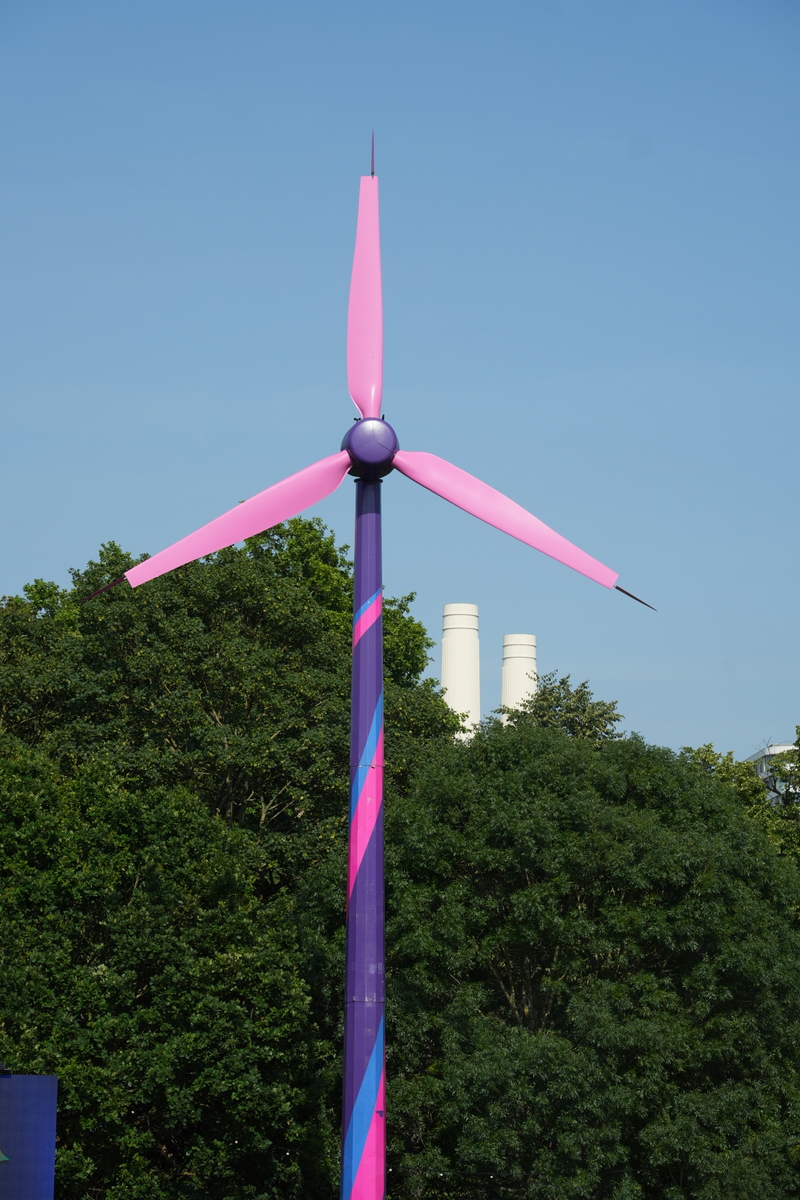
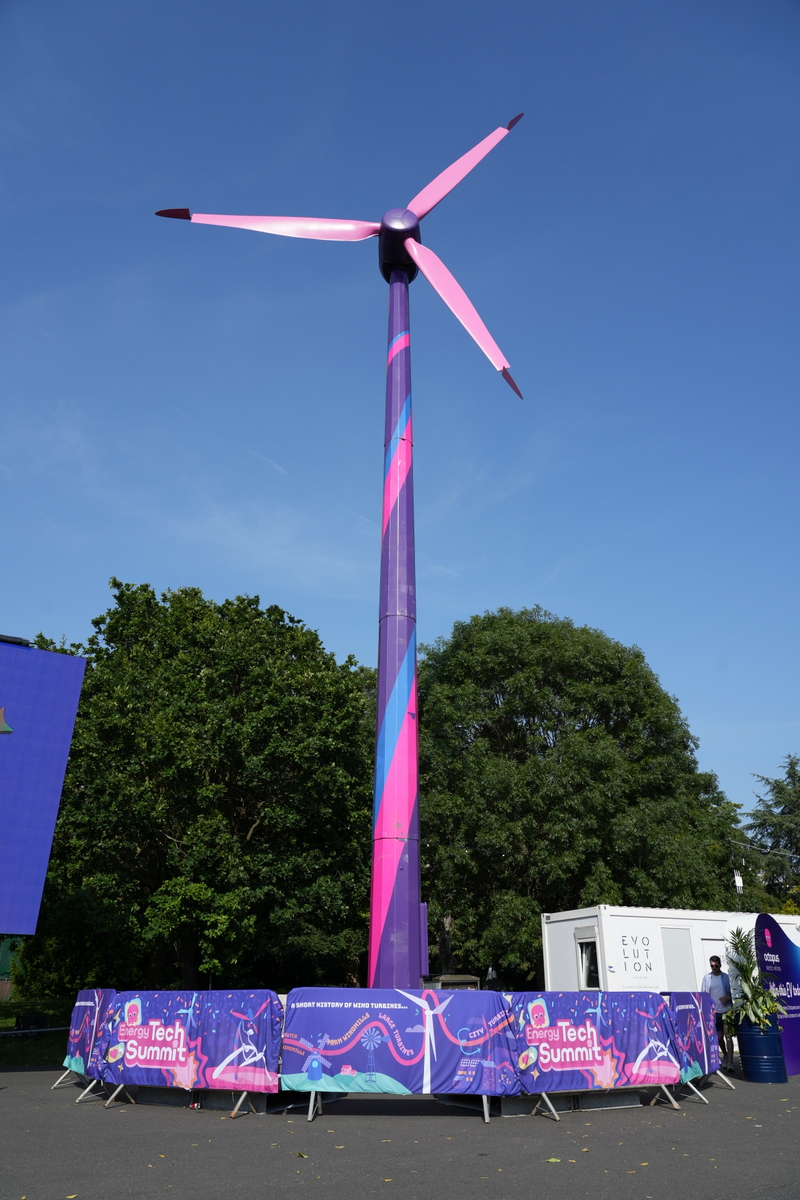
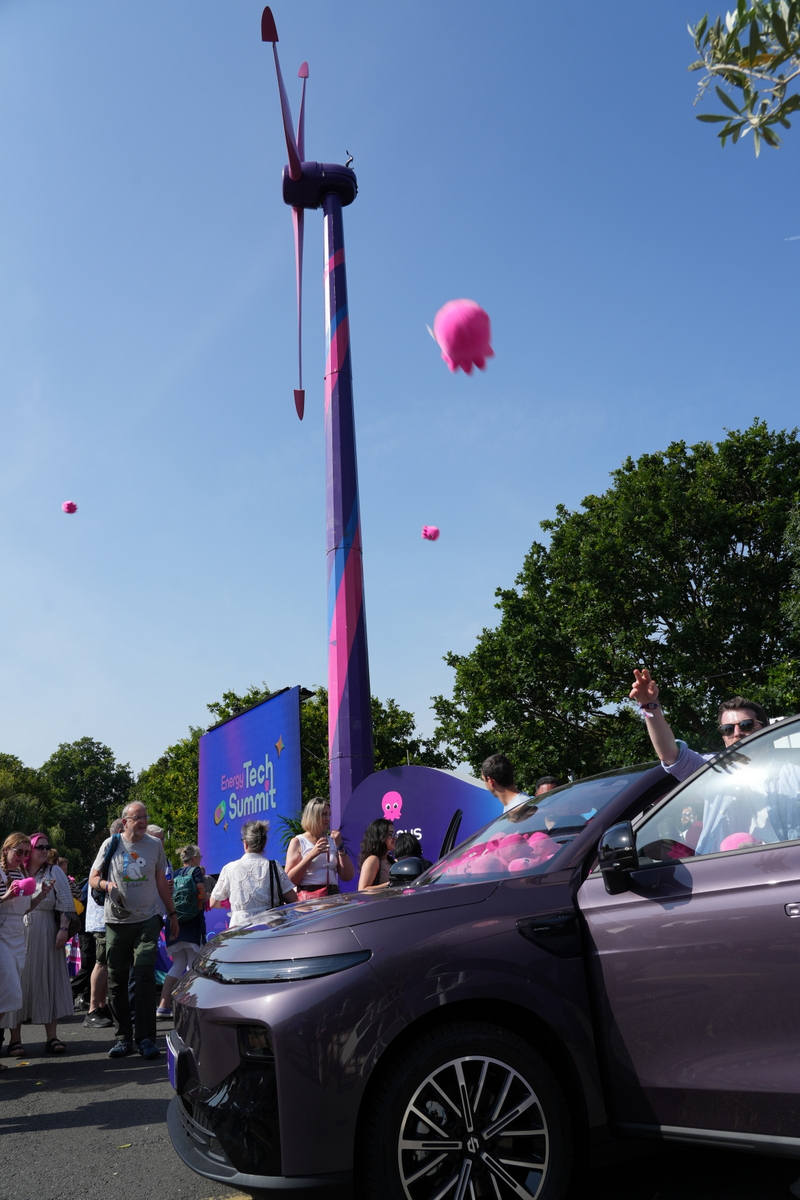
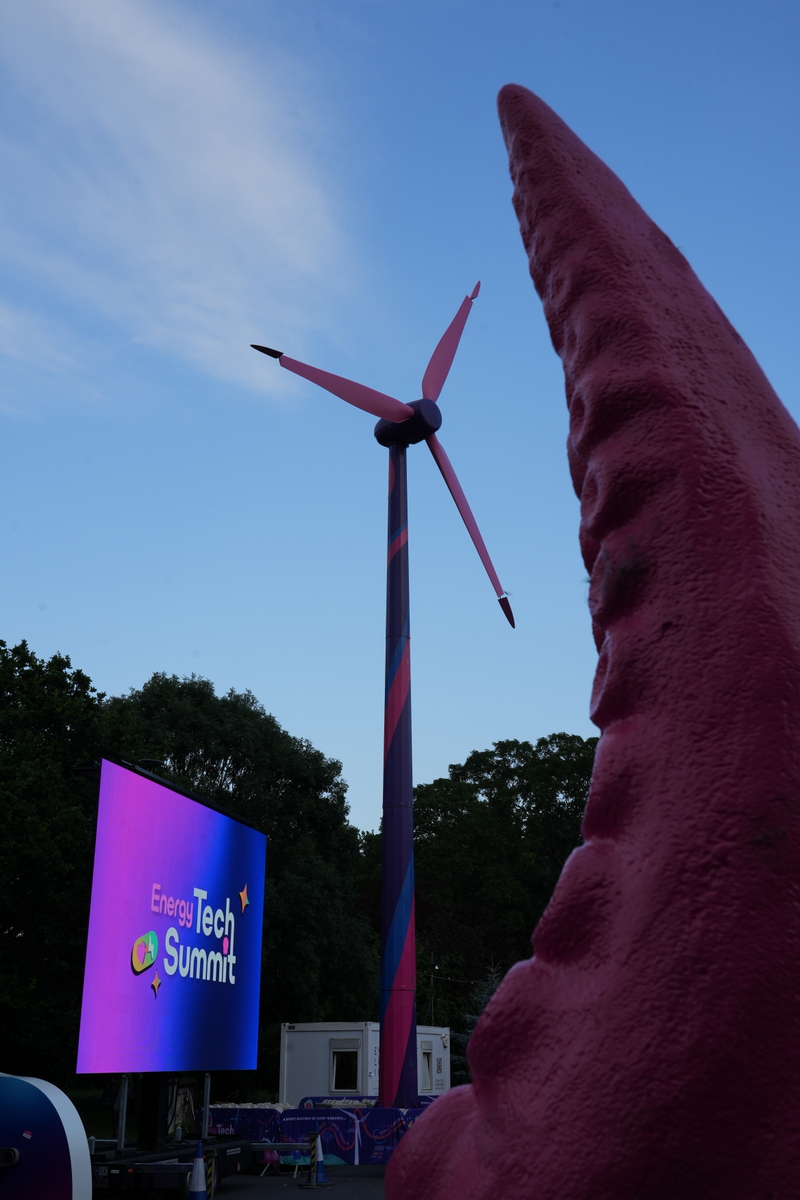
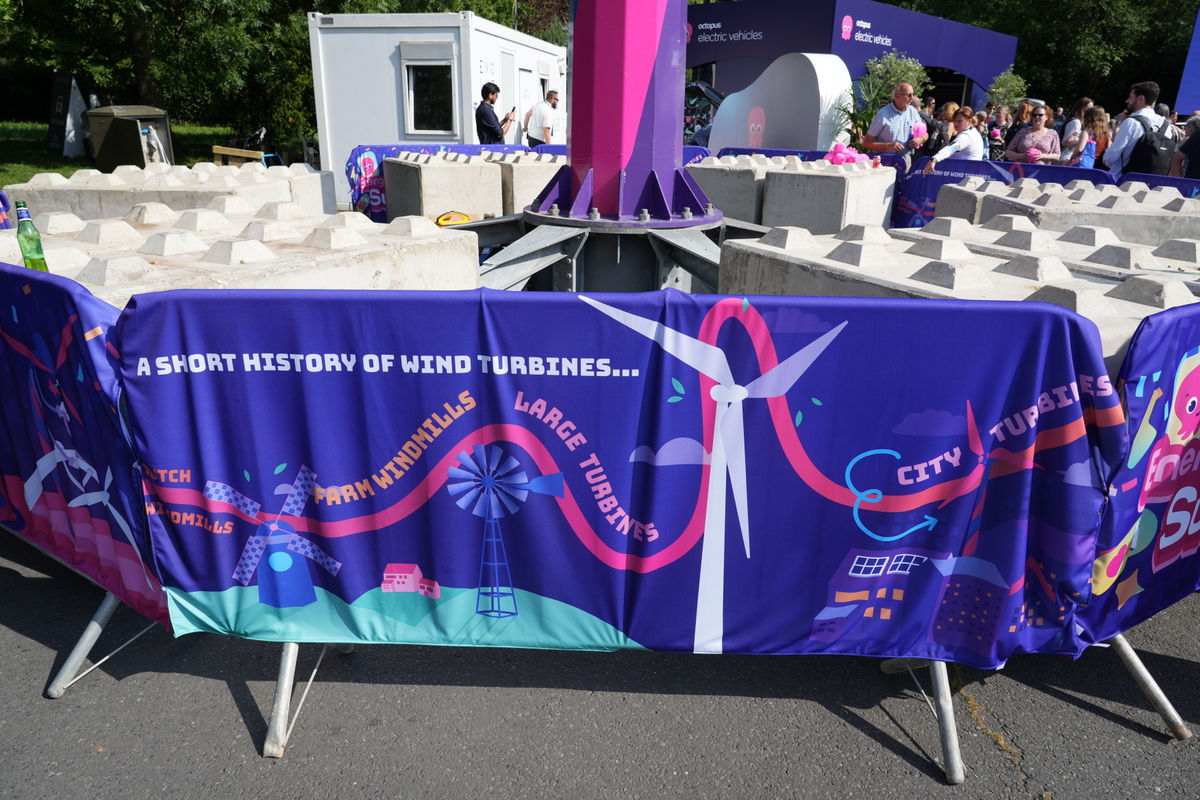
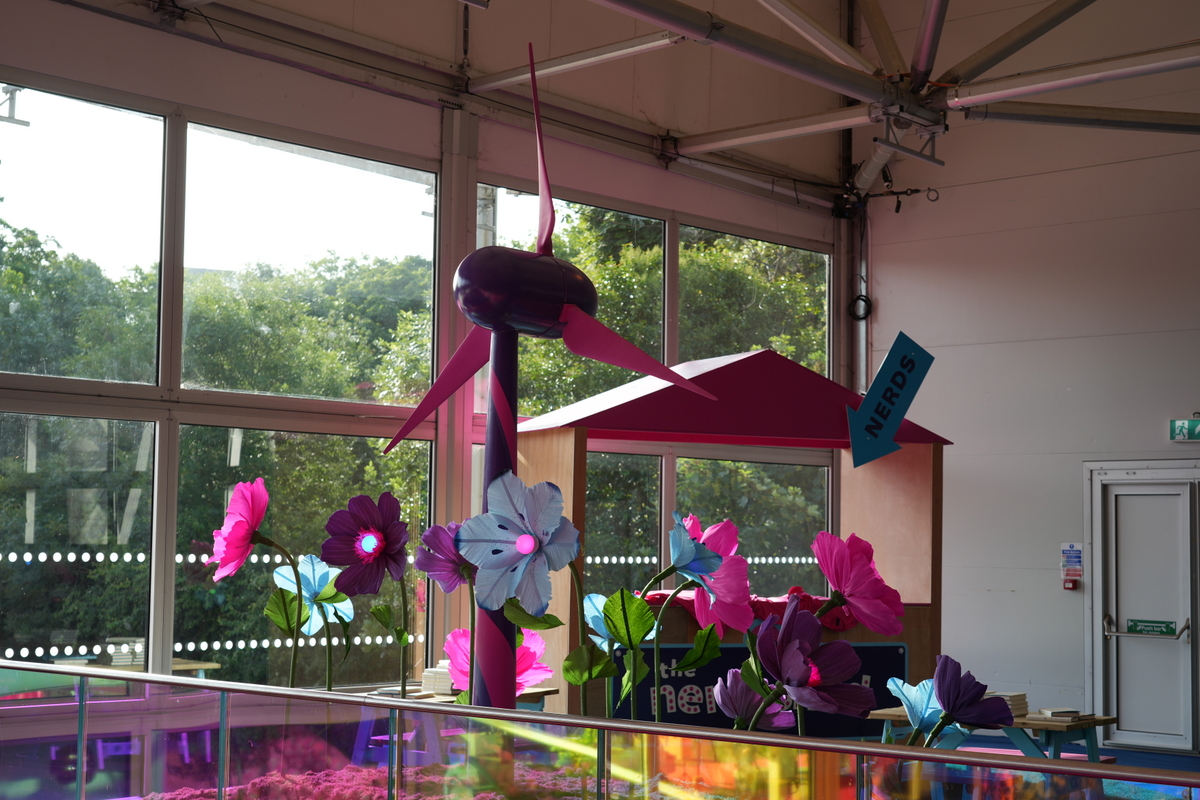
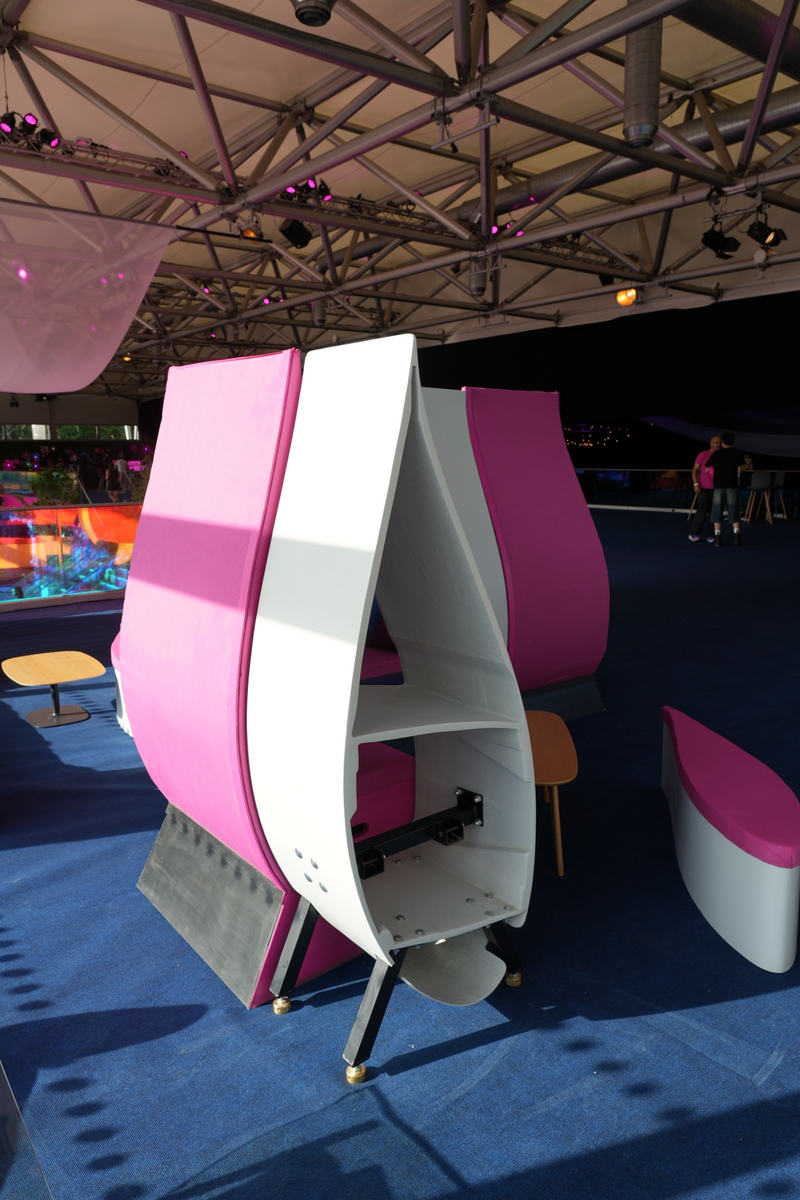
Octopus Energy Tech Summit 2026The Octopus Energy Tech Summit took place in Battersea Park on 22th June 2026. There about 4000 delegates heard from a variety of business and political leaders, talking about energy. Whilst Octopus is amongst other things a gas supplier, the geopolitical environment, and the record breaking temperatures we are currently experiencing had all sides agreeing that electrification of our energy usage is where we need to be.
The subject of wind turbines got coverage in various ways
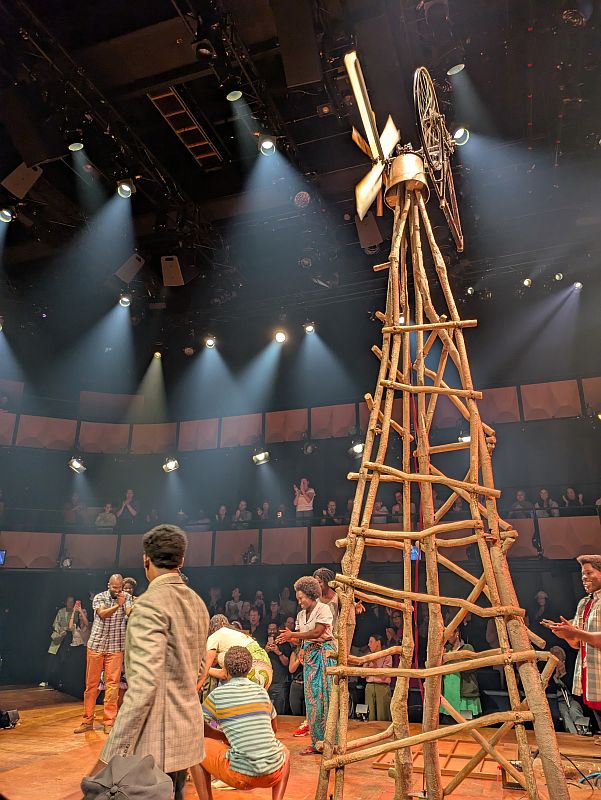
 The Boy Who Harnessed the Wind - stage musical
William Kamkwamba's story has become well known over time, in diverse forms including
The basic story is that William was a boy in Malawi who gets thrown out of school because his family cannot pay the fees. However his interest in learning continues, and he manages to get some library access, and sees pictures of wind turbines. When famine arrives at his village, he designs and builds a windmill from scrap material (but also including his father's bike which is needed for the dynamo), which saves the village since it generates some electricity which enables the crops to be planted and irrigated in the dry season.
The RSC spent years producing the adaptation, including a field trip for the writers, director, and set designer out to William's village in Wimbe, Malawi to see the windmill still in place in the village. As a result, the windmill that is built on the stage as part of the show is impressive, and superficially looks quite like the original, albeit adapted for quick assembly during the show. It's a real shame therefore, especially given the educational aspect of the story, that the designers have not understood how the turbine works technically, and have produced a facsimile whose sails are shaped to cause the wind to turn them one way, but the motor they use to turn them in the show rotates them the wrong way.
 Quentin Blake windmill illustrations New River Head windmill base at the Quentin Blake centre for illustration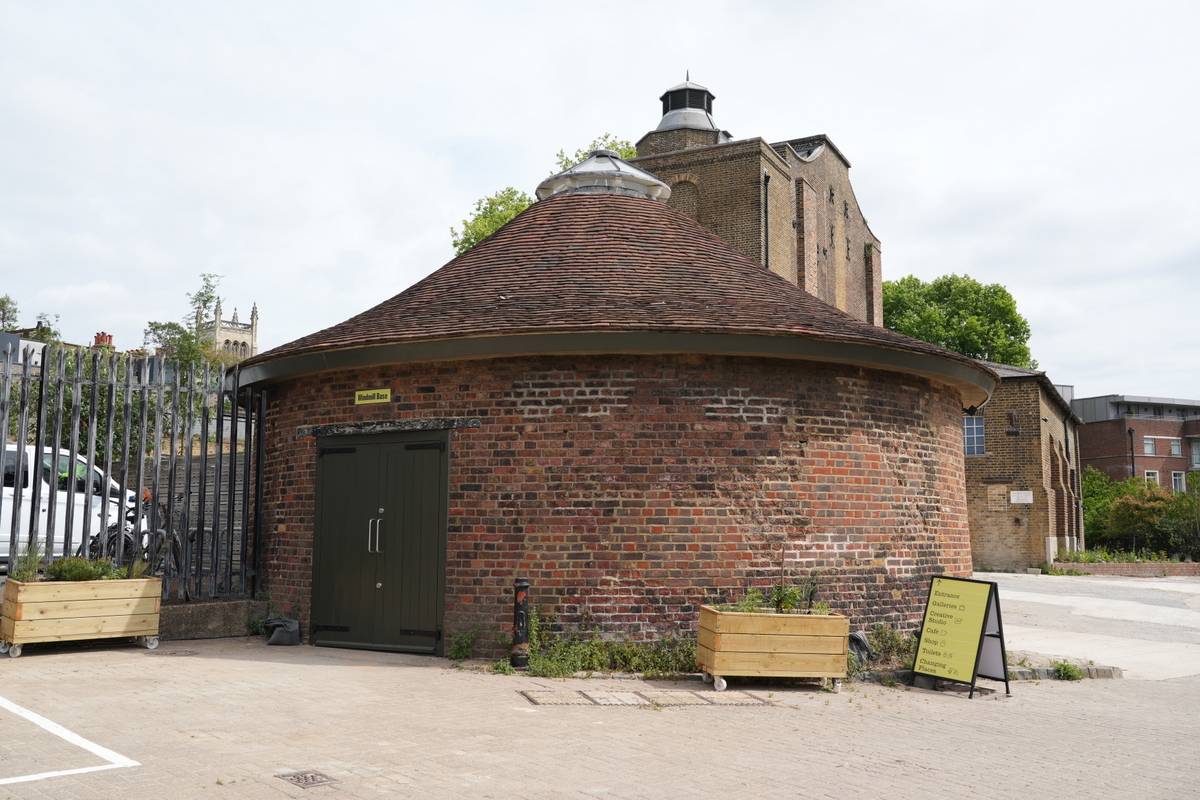
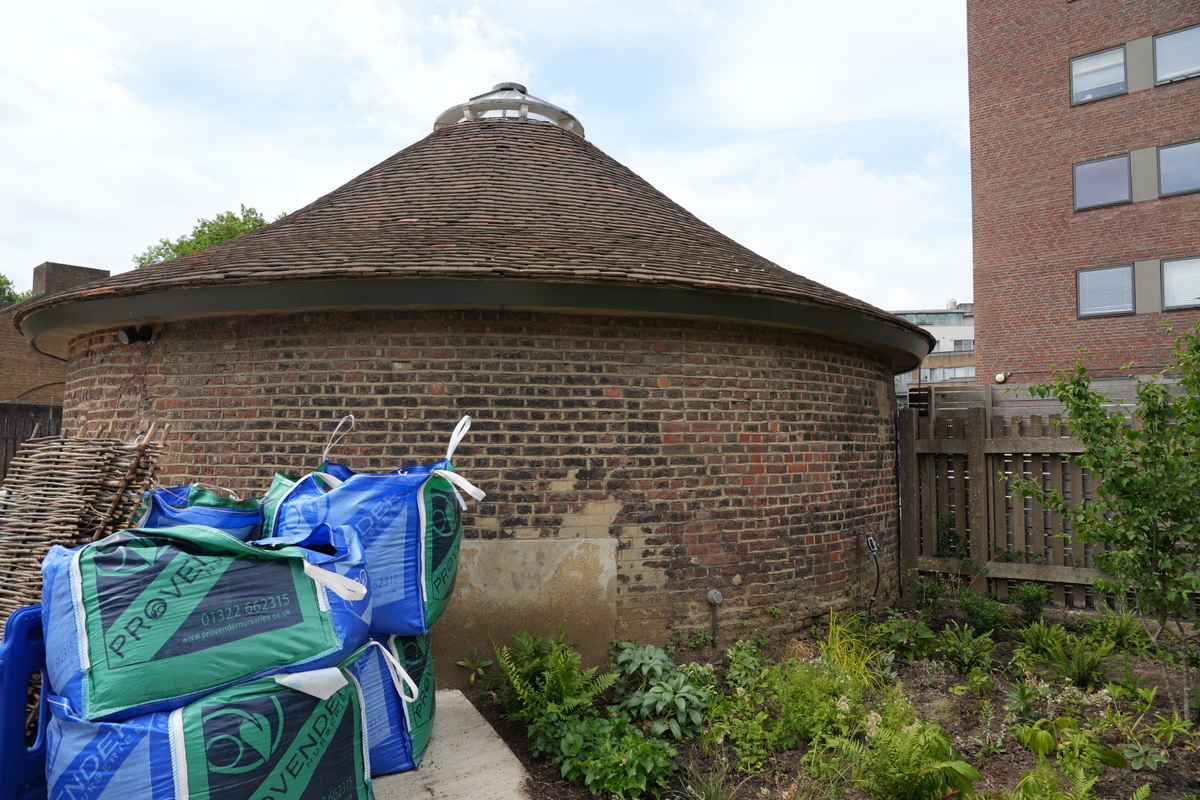
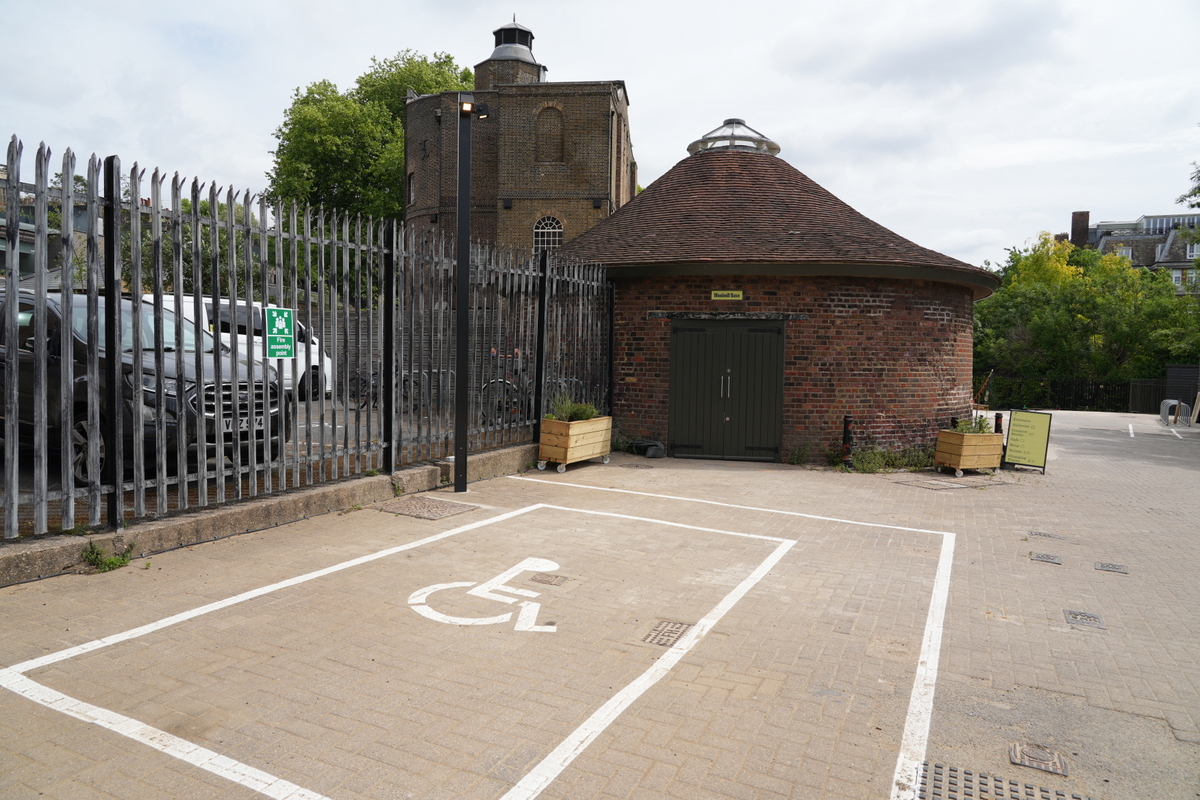
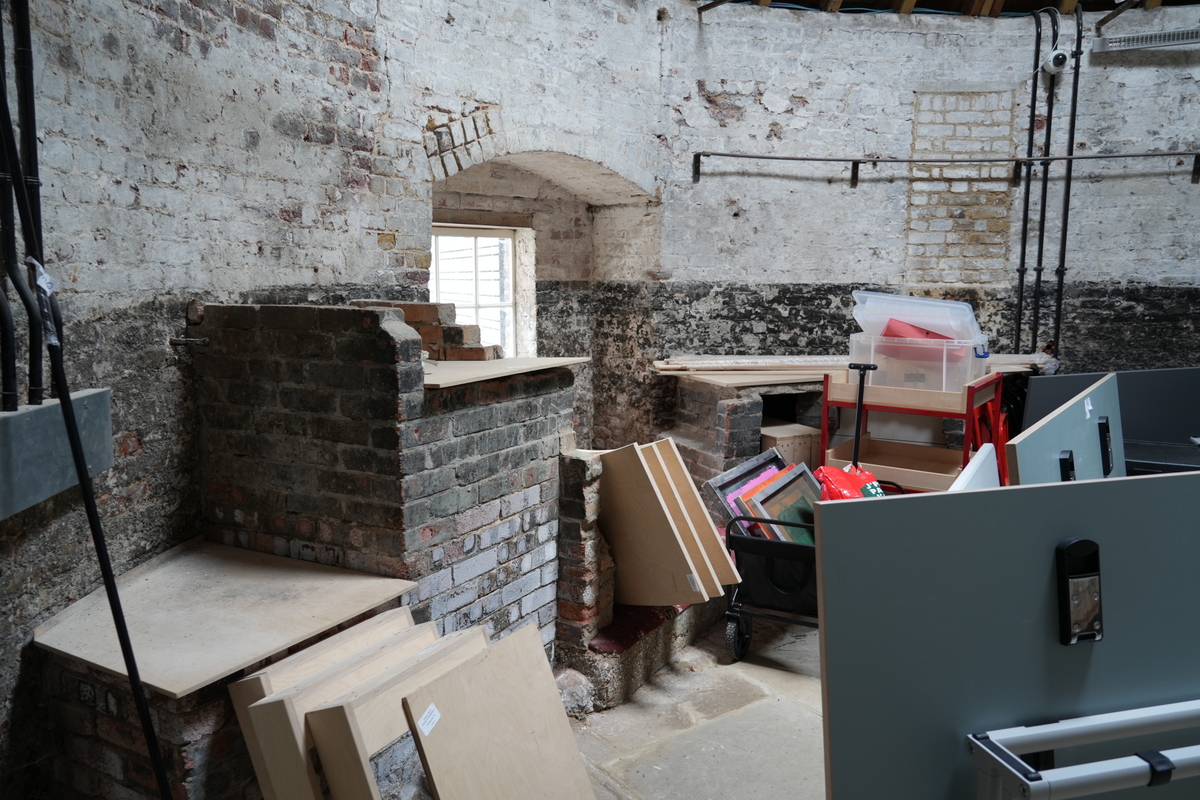
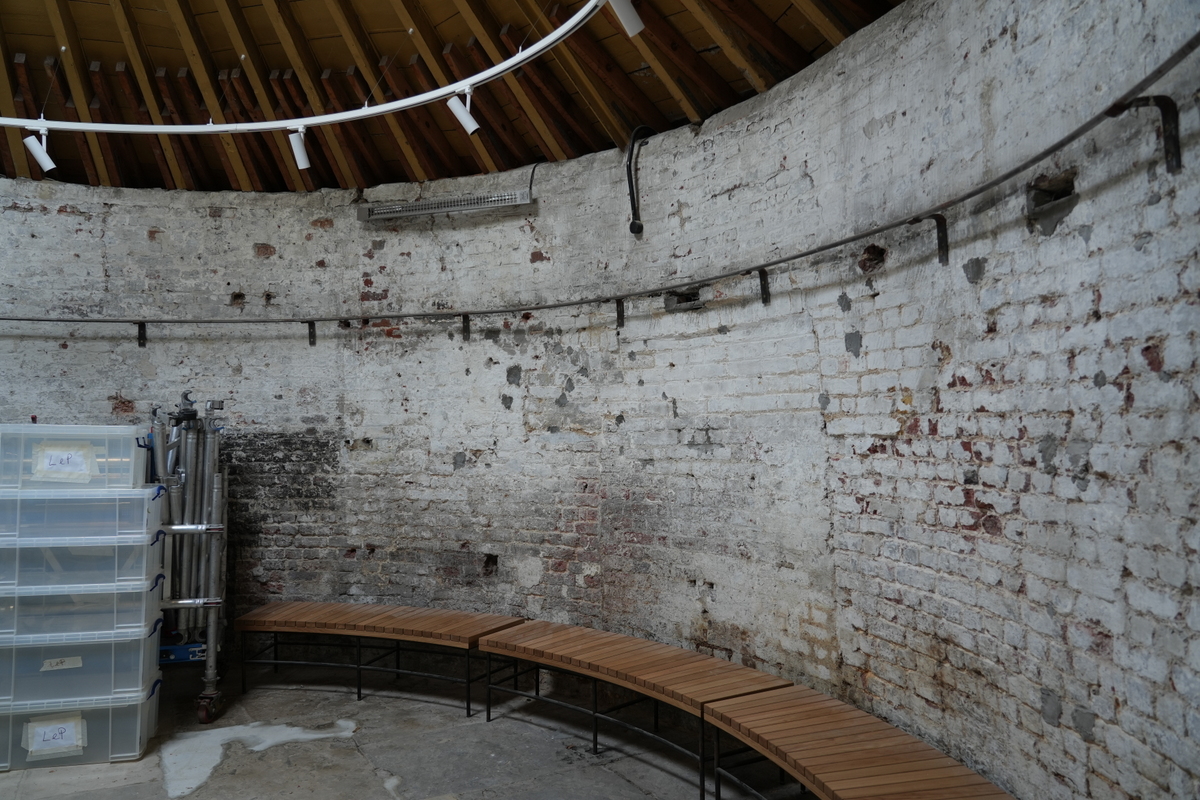
The windmill base has not been substantially changed from its general appearance in recent years, though some work has been done on it. Clearly it has had new electrical fittings, a picture rail installed to attach artwork, and new curved seating and curved worktops have been constructed. The internal walls however retain their original much patched and distressed appearance, and the existing brick built structures inside, whose purpose is uncertain have been retained, even down to the patch of carpet below the window. Early on in the conversion works, the pinnacle of the roof was removed since it was damaged, and this has been reused to form a 6-sailed windmill model or sculpture that will be shown inside. Externally the ugly protective concrete blocks that protected the mill when the yard was home to heavy machinery have now been removed, but the cast iron bollards which do a similar job retained. However, even the simple task of removing the weeds up the walls, and around the base of the area has not been performed. A garden has been planted up to the mill on the north side, and at the preview there was still left over garden landscaping construction materials partly obscuring the mill from the east side. The Thames Water plaque that used to be above the doorway, giving a one sentence history of the mill has been removed. Disabled parking places have been laid out alongside the mill, which when occupied will detract from the sightlines available from the west side.
When not in use for paid workshops, the windmill access will be free of charge. The centre as a whole is open Wednesday to Sunday, 10:00 - 17:00, and the path through the compound passing the windmill is traversable on opening days 09:30 - 17:30. Mill related books by Amberley Publishing Windmills of Essex by Ian Yearsley
 Windmills and Watermills of Suffolk by John Ling
 Windmills of Norfolk by John Ling
 Yorkshire Windmills Through Time by Alan Whitworth
 Good Honest Tales
by Adam Cartwright - book about Batemans Brewery, with a cover showing the windmill tower at the brewery
Good Honest Tales
by Adam Cartwright - book about Batemans Brewery, with a cover showing the windmill tower at the brewery Rayleigh Through Time
by Mike and Sharon Davies, with a cover showing the windmill in historical and modern views
Rayleigh Through Time
by Mike and Sharon Davies, with a cover showing the windmill in historical and modern views Sussex Industrial Heritage
by Colin Tyson - showing High Salvington windmill on the cover
Sussex Industrial Heritage
by Colin Tyson - showing High Salvington windmill on the cover Chilterns at Work
by Jill Eyers - showing a heavily obscured Lacey Green windmill on the cover
Chilterns at Work
by Jill Eyers - showing a heavily obscured Lacey Green windmill on the cover A-Z of the Isle of Anglesey
by Warren Kovach, with a photo of Melin Llynonn on the cover
A-Z of the Isle of Anglesey
by Warren Kovach, with a photo of Melin Llynonn on the cover Historic England: Bristol
by Simon McNeill-Ritchie, with a cover showing an aerial view of the Clifton suspension bridge, and the old snuff windmill (now an observatory)
Historic England: Bristol
by Simon McNeill-Ritchie, with a cover showing an aerial view of the Clifton suspension bridge, and the old snuff windmill (now an observatory) Illustrated Tales of Cornwall
by John Husband, with the windmill tower on the Lizard shown on the cover
Illustrated Tales of Cornwall
by John Husband, with the windmill tower on the Lizard shown on the cover Illustrated Tales of Norfolk
by John Ling, with a cover showing the windmill ruin at St Bennets Abbey
Illustrated Tales of Norfolk
by John Ling, with a cover showing the windmill ruin at St Bennets Abbey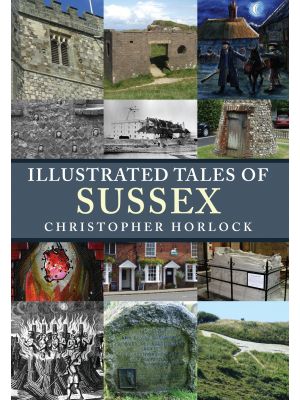 Illustrated Tales of Sussex
by Christopher Horlock, with a small image of the windmill at Tide Mills on the cover
Illustrated Tales of Sussex
by Christopher Horlock, with a small image of the windmill at Tide Mills on the cover Lancashire in Photographs
by Jon Sparks, with a photo of Lytham windmill on the cover
Lancashire in Photographs
by Jon Sparks, with a photo of Lytham windmill on the cover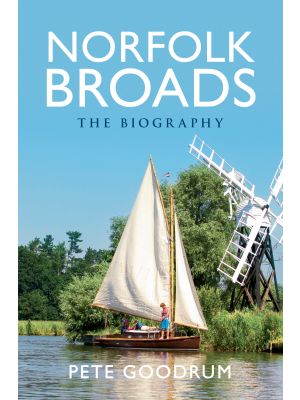 Norfolk Broads The Biography
by Pete Goodrum with a skeleton windpump on the cover
Norfolk Broads The Biography
by Pete Goodrum with a skeleton windpump on the cover Norfolk Places Behind the Faces
by John Ling, with a cover showing Cley-next-the-Sea windmill
Norfolk Places Behind the Faces
by John Ling, with a cover showing Cley-next-the-Sea windmill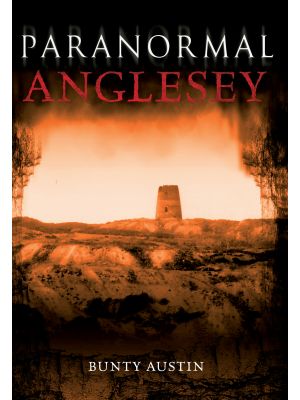 Paranormal Anglesey
by Bunty Austin, with a photo of a windmill tower on the cover
Paranormal Anglesey
by Bunty Austin, with a photo of a windmill tower on the cover The Broads Through Time
by David Holmes, with photos of broads windpumps on the cover
The Broads Through Time
by David Holmes, with photos of broads windpumps on the cover 50 Gems of the Cotswolds
by David Elder, showing Lower Slaughter mill on the cover
50 Gems of the Cotswolds
by David Elder, showing Lower Slaughter mill on the cover 50 Gems of County Durham
by Derek Dodds, showing the watermill below Durham cathedral on the cover
50 Gems of County Durham
by Derek Dodds, showing the watermill below Durham cathedral on the cover Lost Durham
by Michael Richardson with a old view of Durham cathedral and watermill
Lost Durham
by Michael Richardson with a old view of Durham cathedral and watermill Paranormal County Durham
by Darren W. Ritson, showing Durham watermill on the cover
Paranormal County Durham
by Darren W. Ritson, showing Durham watermill on the cover
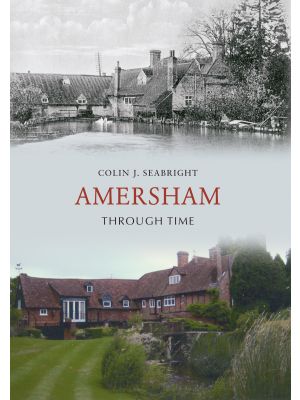 Amersham Through Time
by Colin J. Seabright, showing old and recent views of an Amersham watermill on the cover
Amersham Through Time
by Colin J. Seabright, showing old and recent views of an Amersham watermill on the cover Derbyshire in Photographs
by Richard Beresford, showing an abandoned Derbyshire millstone quarry
Derbyshire in Photographs
by Richard Beresford, showing an abandoned Derbyshire millstone quarry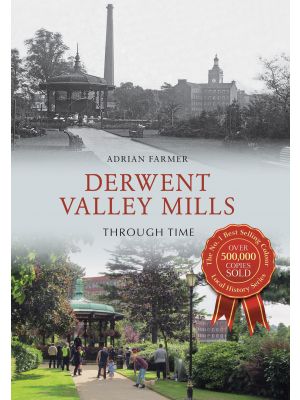 Derwent Valley Mills Through Time
by Adrian Farmer, showing textile mills in the Derwent valley
Derwent Valley Mills Through Time
by Adrian Farmer, showing textile mills in the Derwent valley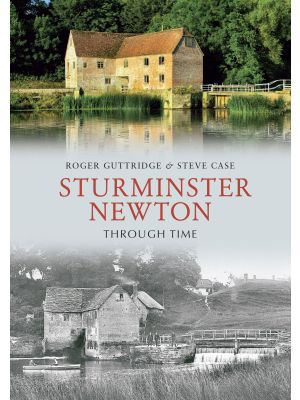 Sturminster Newton Through Time
by Roger Guttridge, Steve Case, with an old and new pair of photos of the White Mill on the cover
Sturminster Newton Through Time
by Roger Guttridge, Steve Case, with an old and new pair of photos of the White Mill on the cover The River Isbourne
by Mike Lovatt, with an iron waterwheel shown on the cover Matt Parker wears a wind turbine t-shirt
The River Isbourne
by Mike Lovatt, with an iron waterwheel shown on the cover Matt Parker wears a wind turbine t-shirt Book: Windmills of Essex, by Ian Yearsley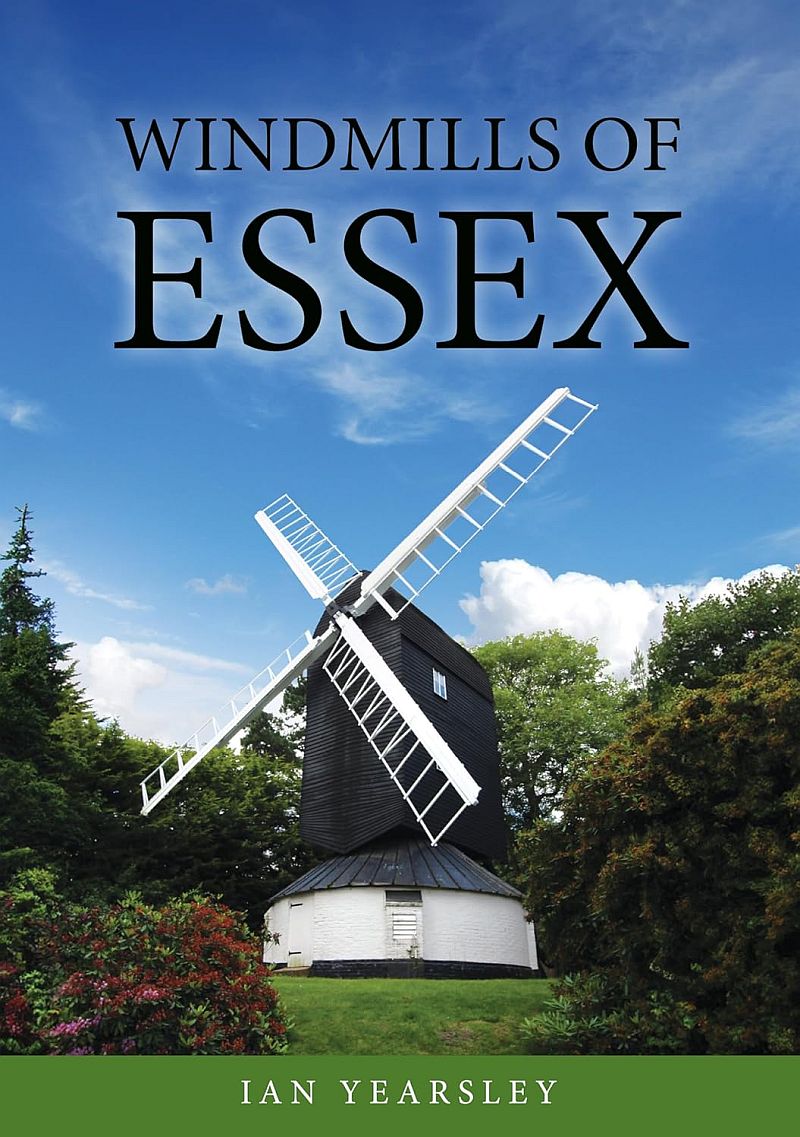
When you are writing a book about the mills of a particular area, especially when you make your local credentials clear in the preface, then you set an expectation that you have done your due diligence by making a recent visit to those mills. Thus Ian Yearsley's book, Windmills of Essex sets a strong first impression, by making the cover photo a glorious picture of Fryerning post mill, a mill that is rarely photographed, since it's hidden away in a private garden, not easily visible from outside the property. However, there's no mention inside the book of which mill it is that has pride of place on the cover, nor of the 2 mills pictured on the rear cover, that between them cover the three main mill types, post, smock and tower. In some respects it's no loss that the cover mills are not identified, since these images are not unique - they are repeated inside the book on the pages about the mills they illustrate, but I do feel that that is a missed opportunity - rather than repeat the one Fryerning image already shown on the cover, why not include a different image inside, since it's clear the author had close up access to the mill that few of the book's readers are likely to achieve. Whilst the approach adopted for the surviving windmills of including one recent, and one historic photo is a good one, overall, I feel that the photographs chosen to illustrate the mills throughout the book are a little bit of a let down, The recent photo of Baker Street Mills, Orsett is really a photo of a fence post, with a small windmill visible in the background, and several other photos would have benefited from an alternative angle that avoided obscuring the mill with so much foliage.
As well as "surviving windmills" (which roughly equates to extant full height mills, with or without sails, including conversions), there's a shorter section covering "some lost windmills", which actually mostly covers mills that survive in a truncated (and often converted) form, rather than ones that are truly lost to history. It is notable that in neither section are there any interior photos of the windmills - the closest we get to seeing anything relating to the actual machinery of windmills is the appearance of millstones that have been relocated outside the mills as garden ornaments.
The text that describes each mill is a mixture of a potted history of the mill (this is a lightweight popular history book, so none of the facts are backup up with citations), together with some recent information about recent and (at time of publication) current owners and sometimes their plans for the mill. This I feel is a strong feature of the book, showing that the author has been in contact with many of the mill owners in the course of researching the book, and providing information that the heavyweight historical coverage of the county in Farries is of course unable to provide.
Finally, I should point out that the final very short chapter on modern windmills alerted me to an Essex windmill I'd not come across before - the reduced scale windmill being built on Ashley Cooper's farm in Gestingthorpe. Although there are only 3 sentences about the mill, it does get a March 2025 photo, showing the progress that has been made in the build at that point.
| Last generated 16/10/2026 | Text and images © Mark Berry, 1997-2026 - |