This page presents draft information, that is still being actively researched and fact checked. It may be incomplete, and contain more than the normal level of mistakes and factual errors. If you have any corrections or additions please get in touch.
Local terminolgy makes little distinction between bespoke flour windmills (well, even then a good few NZ examples were imported as kits), and the mass produced wind engines, often for pumping water, that later came to be the dominant form of wind power across the country. All are simply referred to as windmills, making it hard to understand from written records what type of device was being referred to. In addition, to add to the confusion, it seems that the wind wheel of the wind engine may often have been referred to as its sails.
But ingenious machines are specially beneficial in connexion with agriculture, where the produce is for the most part perishable, and time and rapidity of appropriation are elements in the estimate of value. In this sense there is scarcely an improvement, local or general, which will not affect the value of agricultural produce beneficially. Obviously the improvement in the character of agricultural implements must have the most immediate and efficient influence. The show in this respect, on Tuesday, was very interesting. One of the most attractive features of the collection exhibited by Messrs. T. and S. Morrin was a wind-mill complete with sails set, and suitable for a great variety of farm work, such as pumping, driving chaffcutting machines. Driven by a very moderate breeze, it was estimated to have the force of two-horse power; but it needs no great penetration to infer that this power might be indefinitely increased.
NOTES AND QUERIES.
A. B., Invercargill, writes :— Could you tell me if a windmill could be procured in New Zealand fit to drive a good-sized chaffcutter - moderate in price, and easily erected and worked? I saw a notice of such a mill lately in the Otago Witness, manufactured in Australia. Are they sold in New Zealand? - American windmills similar to those in use by the Government on the New Zealand railways can be procured, we believe, in Oamaru. The price is : - 10ft, £29; 12ft, £33. We believe this would do more than the work indicated. They are not difficult to erect, but the cost of doing so would have to be added to the above price.
In the outdoor railway section of the museum, and labeled as being in tribute to the many wind engines that served New Zealand Railways, yet this is nothing like those standardized design wooden wind engines - this is a fairly generic metal wind engine. The wind engine used to be closer to the water tower, but realizing that it was not representative of the devices used on the railways, it was moved away from the water tower so that these were not considered to be a group exhibit.
Relocated here to give a feature to the shopping development
Another T R Clow "Daisy" wind engine, an 8 foot design, relocated from Kaitaia.
[homepage]
The engineering firm of E Hayes, in 1909-10 built a large wind engine to power its works. The 6.5 metre diameter wind engine was placed atop a substantial 18 metre high wooden tower. This engine was the prototype for a series of wind engines that the firm later produced.
The wooden base of the original wind engine tower still exists - it was adapted to form a building to house the pelton wheel that replaced the wind engine for driving the works.
The first commercial wind engine that Hayes sold has been re-erected on the lawn space within the works, and a collection of other Hayes wind engines have been assembled along the driveway out to the roadway. Other wind engines parts can also be found around the site.
Otago Witness, Issue 3039, 12 June 1912, Page 49 (Supplement)
[info] [info] [info] [info] [info] [info] [mention] [photo] [info] [photo] [photo] [info] [photo]MOTIVE POWER FROM THE WINDMILL.
This particular windmill supplies the power for Messrs Hayes and Son's foundry at Oturehua, Central Otago. The windmill is said to be the largest in New Zealand.
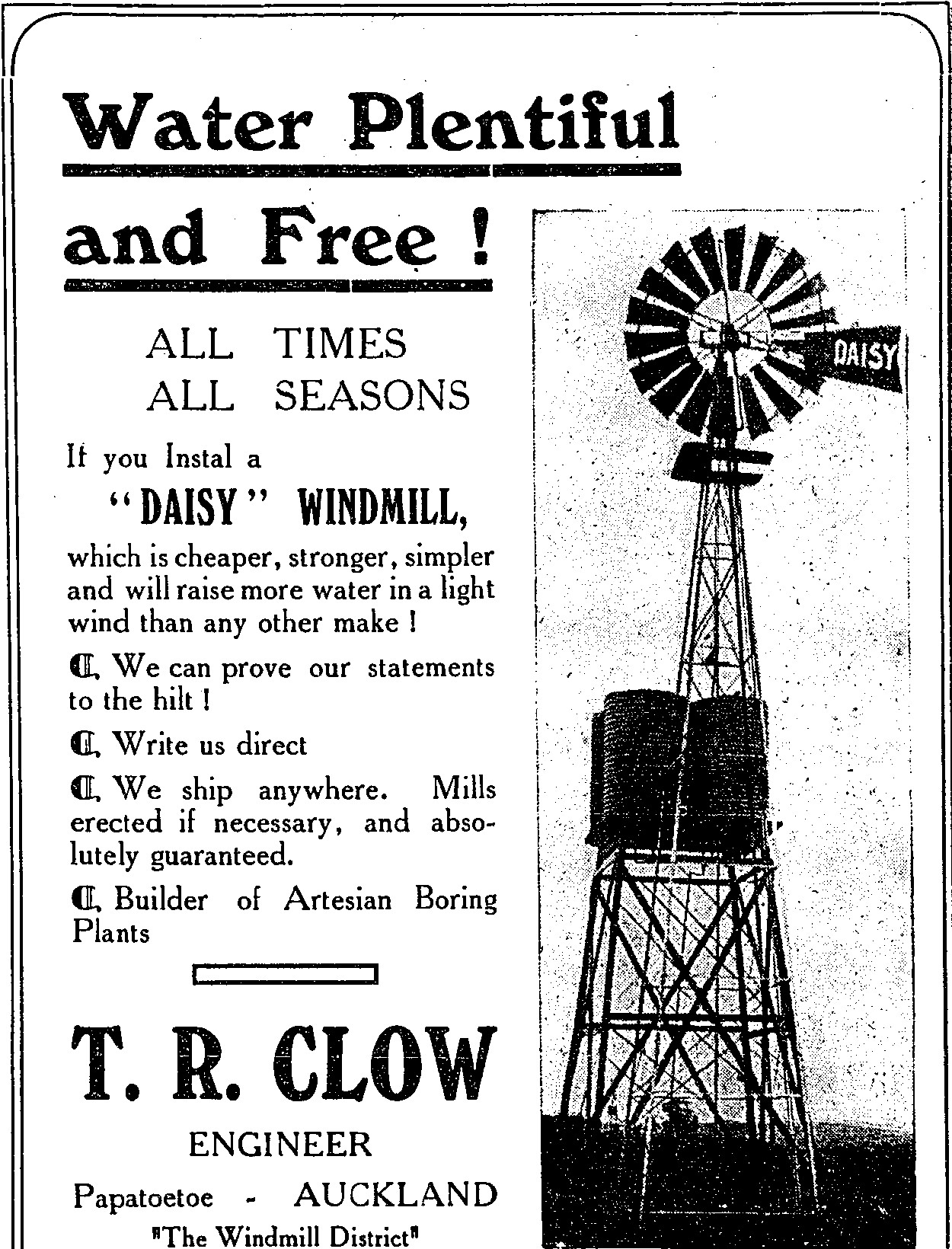
The Papatoetoe engineer Thomas Roger Clow produced artesian boring machines, hay making implements, and windmills using the model name "Daisy" (named after his daughter) from around 1908-1912, and one example of these has been reerected in the town alongside the old railway station. His engineering workshop was at Number 7 Kingswood Road.
From: Progress, Volume VII, Issue 4, 1 December 1912
The "Daisy" Windmill
Elsewhere in this issue we print a business announcement on behalf of Mr. T. R. Clow, Papatoetoe, the patentee and manufacturer of the "Daisy" windmill. In common with the most successful mechanical devices which save labour on the farm, Mr. Clow's invention was originally subjected to very severe tests before being placed on the market, the patentee realising that the farmer must have a mill whose working parts were few and as frictionless as ingenuity could devise; in short, a machine which would run year in and year out with an occasional refilling of the oil cups as the only necessity. Since the first "Daisy" appeared in 1908, farmers have not failed to acknowledge its merits, and we hear of as many as eighteen being recently delivered in less than two months. Of the sixty installed last year, seventeen were repeat orders. In a future issue we shall illustrate the mechanical simplicity of the "Daisy" windmill.
NZ Patent applications 25218 (Nov 1908) and 26533 (Nov 1909)
[info] [info]Globe, Volume IX, Issue 1253, 13 March 1878
The Althouse Windmill. - Messrs Friedlander Bros., Ashburton, have erected one of these most useful mills on the reserve opposite their store, for the purpose of affording an opportunity of inspecting it. The simplicity and completeness with which its motions are regulated are its chief merits. No increase of wind will increase the speed of the mill. In a strong wind the fans fold up, and only present a small surface to the wind. The quickness with which the fans adapt themselves to any change in either the strength or direction of the wind, is remarkable. These mills will raise water from a depth of 200 ft., and must prove of inestimable benefit to the farmers on our plains.Press, Volume XXIX, Issue 3960, 3 April 1878
The weather at Ashburton. Our correspondent writes:- The weather has for some days been unusually warm. On Sunday the heat was almost insupportable and on Monday a strong nor'-wester commenced, lasting all night, and on Tuesday attaining the force of a hurricane. The town was covered with dense clouds of dust, which rendered all outside work extremely unpleasant. Messrs Friedlander Bros. Althouse windmill seems to be the only thing entirely unaffected by the wind. It remains motionless, with its fans securely folded up, waiting for a more moderate breeze to resume its labors.
From Auckland Star, Volume IV, Issue 1072, 28 June 1873
It will give general satisfaction to those frequenting the North Shore to learn that the feud so earnestly fought out both on the waters and in the law court between the Takapuna on the one hand, and the Devonport and Enterprise on the other, has been ended, that the hatchet has been buried for ever, and that like every good story it has ended in a marriage. After considerable negotiations, in which Mr J. B. Russell has acted as the heavy father, proceedings have eventuated in the Messrs Holmes joining the Ferry Company, and henceforth the boats will be run as one property. The form which negotiations have taken is that the company purchase the Enterprise No 1 and the Devonport, with water rights, windmill, tanks, hose, &c, for the sum of £2000 cash, and five hundred one pound shares in the company; and although there is no stipulation to that effect it is understood that one of the Messrs Holmes takes a seat in the directory.and Auckland Star, Volume IV, Issue 1074, 1 July 1873
[T]he Company will have, entirely free of every liability, as nice a little plant of three steamers, all in excellent working order, and with all appurtenances of well, tanks, windmill, coal-shed, and all fixings requisite for the efficient carrying out of a ferry service, as could be desired.
The blance sheet for the year ending 30th June 1893 records the line item:
shoeing horses, repairing drays, harness, windmill, hurdles, flags, etc., £47 8s 9dThe following year, ended 30th June 1894, the accounts bunched together even more oddments
horse feed, seed plants, etc., shoeing horses, repairing windmill, hurdles, etc., printing, advertising, stud books, petty charges, stamps exchange, gas, cleaning office, £200 12s 2d
From: Progress, Volume VII, Issue 4, 1 December 1912 (obvious errors corrected)
[The "Daisy" windmill by T R Clow, engi]neer, of Papatoetoe, was another interesting exhibit that attracted the farmers by its easy running in a light breeze, and the quantity of water pumped. Farmers will never cease to be interested in the windmill. It is so simple and easy to keep in order. Mr. Jas. Mclntyre, of Onehunga, also showed his windmills in operation.
Numerous were the makes of agricultural implements exhibited by the N.Z. Loan and Mercantile Co., Ltd. Several kinds of ploughs, two large agricultural tractors, Cambridge rollers, hay tedder, made up a comprehensive and interesting show that attracted large numbers.
Messrs John Burns, too, had considerable space to show off their many farmer's requisites, from garden tools to ranger, and windmills, and oil and petrol engines in operation.
Goldmining at Charleston: West Coast Times, Issue 2025, 27 March 1872, Page 2
THE NORTH BEACHES. (From the Herald, March 23.)
It is a matter of importance to those interested in the continued prosperity of this district, that while the terraces are showing signs of decay, the beach workings are about to become extensive, and the works in connection are of so substantial a character, that when completed, will require little if any additions or alterations for a number of years. The great drawback to those who follow this line of mining has resulted from insufficiency of water, which, however, will soon be obviated, as no less than six permanent supplies are in course of completion, as also a wind-mill, and horse machine for raising water. As the particulars of their supplies, and their localities, may not he uninteresting to your readers, I therefore give a short account of the works in connection therewith.
On arriving on the Nine-mile Beach, the races which have hitherto supplied the miners, are those of Messrs Hall, Parsons, and Harie. Recently Mr Hall has constructed a new race, and made additions to his dam, at considerable expense, by which means he is able to benefit a greater number than formerly. The new race of Harle's from the Totara, is one of the works which is looked upon as likely to confer a permanent benefit to those whose claims are situated north of present supplies. The levels have been taken by Mr A. Greenwood, and its length is, from its source to the lagoon at the rear of the beach, about a mile and three-quarters; its construction consists of fluming, cutting, and a portion tunnelling through hard limestone rock. It is cut to carry, and is registered for eight Government heads, or in other words to supply thirty two claims. The lagoons running parallel with the beach, now held by the proprietor, will be used as a dam, and the water will be flumed at intervals of seven chains on to the beach. The whole of this race is now approaching completion, and in a few weeks we may see miners, now shepherding their ground, employed.
A short distance to the north of Harle's is the race now being brought in by Hayes and party, of eight men. The original intention was the erection of a dam, in the Totara, thereby shortening the distance to the beach, but, as has already been recorded in your paper, the dam has been swept away during a flood, and consequently they determined to proceed three-quarters of a mile further up. They have exhibited great pluck and perseverance, and have got through a great deal of work for the time. The major portion consists of fluming, some of which is already cut. As they have lately been joined by a number of persons desirous of using their water, they expect to have their race completed as soon as Harle's. They are registered for twelve Government heads, which they will be enable to carry north as far aa the outlet of the Totara river.
On crossing the Totara, the first work that meets the eyes is the wind-mill now nearly completed, and from the substantial appearance of the structure, and also from the fact that its architect is a gentleman who has erected many similar works in various parts of France, and in the adjoining colonies, its success ia almost assured. The iron work has been manufactured in Charleston, and is the heaviest that has been forged in the district. The work in connection with it will cost over £400; and it has only been delayed in consequence of their store dam being carried away by the heavy winds that occurred a few weeks back. They expect to be at work in two or three weeks, and as their claims are considered as being the best on the beach, it is to be hoped that they may be able to realise quickly to reimburse them for their time and outlay.
A few yards from the wind-mill is situated the horse machine; this was originally erected by a party of Germans, who finally succumbed to a few petty difficulties that beset them at the outset, without anything like a fair trial. Messrs Taylor and Brown have it, and with the addition of a larger cog-wheel they have every expectation of being able to lift four box heads of water. I have learnt that it has been tried and found to answer, but the horse was not sufficiently powerful for the pumps. This, however, can easily be remedied.
Christchurch, 13th May, 1873. I have the honor to report that I inspected Sunnyside Lunatic Asylum this day in manner prescribed by "The Lunatics Act, 1868." ... I am glad to report that the tanks required as a safeguard in case of fire have been erected at the level of the top of the Asylum, and are kept full by a force pump worked by a windmill. The Keeper informs me that the windmill is too much sheltered by trees in summer, and by the building in N.E. winds, which prevail for nine months out of the twelve. I beg to recommend that the Fire Brigade should be asked to take the engines up to the Asylum at an early date, and test the sufficiency of the water supply. I am myself of opinion that the reservoir at the ground level will probably be found on trial to be too small. It is at all events very desirable, I think, to test this point in good time.H-02 LUNATIC ASYLUMS IN NEW ZEALAND, (REPORTS ON THE)., Appendix to the Journals of the House of Representatives, 1 January 1874
Christchurch, 20th January, 1874. I have the honor to report that I visited Sunnyside Lunatic Asylum this day. ... The Keeper informed me that the tanks set up for safety against fire in the old buildings have been empty at some time since I last saw him. As I had already reported, the windmill has been placed too much to leeward of the building for the N.E. wind, which prevails for nine months out of the twelve. During the comparatively calm days of winter there has not been power to drive the sails. Hand gear might be provided for occasional use during calm weather. The risk of being without this supply ready for sudden emergencies again induces me to ask your Honor to urge on the General Government the immediate completion of the telegraphic communication between all the three main buildings at Sunnyside and the Police Barracks and Fire Brigade Office at Christchurch.H-02 LUNATIC ASYLUMS IN NEW ZEALAND, (REPORTS ON THE)., Appendix to the Journals of the House of Representatives, 1 January 1875
Christchurch, 20th February, 1875. I have the honor to report that I inspected Sunnyside Lunatic Asylum this day, in accordance with the provisions of "The Lunatics Act, 1868." ... The new and old buildings are now both in constant communication with the Police Dept and Fire Brigade Office at Christchurch, by means of the electric telegraph. A windmill, with force-pump attached, keeps tanks filled, from which the upper floors can be flooded in case of fire.
Press, Volume XCIV, Issue 28153, 17 December 1956, Page 7
Father Christmas Was Dressed At Nudist Club
Father Christmas is conservative. He visited the Canterbury Sun and Health club where everyone was nude yesterday afternoon; but he wore his full dress of fur-trimmed hat, long red coat and trousers, and high boots. "It's a bit chilly," he confided, "or I would lave worn just my whiskers." This was a big day for the Sun club. When most other societies are holding parties to close their year, this one was heralding the height of its season. By Christmas about a dozen members will be using the bunk rooms in the new pavilion, opened a few weeks ago. Many more families have reserved caravan and camping sites on the clubs nine-acre grounds, others will be spending their holidays at other sun clubs, and a delegation will be attending the national sun club convention in Wanganui.
Father Christmas's visit yesterday in every way conformed to the precepts of naturism. Naked children were singing "The farmer's in the dell" as they played this and other games while awaiting his arrival. Then a forest-green car came through the trees with which it had merged and Father Christmas stepped to the foot of the Christams tree - probably the only one growing in a permanent site in Canterbury. It was planted in a corner of the grounds, when the club was formed, for just this purpose and with two smaller flanking trees, it was gay with baubles and tinsel. Here Father Christmas distributed books toy aeroplanes and ships, bouncing balls, fire engines, skipping ropes and - best of all - water pistols to about 50 excited youngsters.
The children had just taken occupation of their new splash pool, 12ft square, and with yesterday's high gale whirling the club's new windmill pump, it was rapidly filled. The swimming pool for adults is now almost half excavated. By the end of the season it will be concreted over an area of 20ft x 40ft and the abundant wind-pumped water will overflow from the storage tanks into the splash and swimming pools, giving a constantly changing fresh supply. The swings, and see saws, solidly mounted on converted car chassis, have all been freshly painted and with irrigation giving a good growth of new grass and ornamental trees, the Sun Club's grounds are looking really well.
"Golly you are big children. This life must agree with you." said Father Christmas as he emptied the last of his presents from his bag sack. Then "Ah-ah," he said. "Keep the grounds bare too." This is a motto on refuse containers all over the grounds and some of the children had scattered the wrapping from their gifts.
The Dunedin racecourse was built on swampy land, which used a wind engine to drain it. Auckland Star, Volume XXIV, Issue 4305, 8 March 1884
THE DUNEDIN AUTUMN MEETING.Otago Witness, Issue 1703, 12 July 1884
... I was driven out to the Forbury for the purpose of inspecting the racecourse. Anything more pretty than the surroundings could not be wished for, and the Dunedinites can congratulate themselves on having the best appointments of any leading New Zealand Club. Their members' stand, which has a raised lawn in front, is a most comfortable structure, and an uninterrupted view of the racing can be seen by all without the slightest difficulty. Inside the enclosure too, everything is very conveniently arranged, among other things a narrow strip being fenced off so that the jockeys and their horses can in no way be interfered with while weighing in and weighing out; the time of the races is officially taken and put up with the placed horses after each race is run, and there is also a carriage paddock where members can take their wives and families to comfortable nook for luncheon. The ladies are also well provided for, there being a building specially set apart for their convenience. The course at one time was a complete swamp, but now it is nearly all that could be desired, and the running track, which is lefthanded, measures exactly one mile round. Inside it is an unrailed ditch for the purpose of holding the water until it is taken away by a windmill pump, and it was in this ditch that Sou-wester (who at the time had the inside running) unfortunately got one of his feet, or I think Lady Emma would never have been returned the winner of the Dunedin Cup of 1884.
The annual meeting of members of the Dunedin Jockey Club will be held on Monday, when the following report will be submitted :— "The Committee have to congratulate the members on the conclusion of a most successful year, both as regards racing and finance. Five meetings, including the Hunt Club and Hussar gatherings, have been held during the year, the entries for which have been numerous, good fields of horses have competed, including all the best in the Colony, and the racing has been especially good. Several most necessary additions and improvements have been completed, amongst which may be mentioned — windmill pump for drainage purposes, connection with the telephone exchange telegraph, stewards' room, ladies' room, and totalisator houses, and a large amount of fencing.Lyttelton Times, Volume LXII, Issue 7340, 8 September 1884
The Forbury course is to be further improved. The D.J.C. has definitely decided to form a new approach to the course. It will be placed close to the tramway terminus—between that spot and the windmill. So as to be able to do the thing properly, and put up substantial ticket-boxes, form a docent roadway, &c., the Club has bought the freehold of an adjoining section, having a frontage of 50ft with a depth of about 70ft, so that, when finished, the undertaking will beautify the place, as well as render it more handy for all concerned.Lyttelton Times, Volume LXVI, Issue 7933, 9 August 1886
This Gaspard met with a curious accident on Sunday. Young M'llroy was exercising him on the tan track, when the horse took it into his head to bolt across the wooden bridge that crosses the ditch round by the windmill, and fell into one of the wells that were dug to collect the water prior to being pumped out. The horse was extricated with difficulty, having sustained only a few bruises and flesh wounds; but poor M'llroy got his elbow dislocated and his arm badly bruised through being thrown as the horse slipped up in rushing across the bridge. The joint was pulled in by the lady belonging to the hotel, and Dr Coughtrey was brought out to attend the youngster.The wind engine clearly was a recognisable landmark round the course: Lyttelton Times, Volume LXIV, Issue 7725, 7 December 1885
Going round by the windmill, Tasmania was with the leaders, and a little further on the whole field closed up for a moment. Then Quibble began to drop astern, and the further they went the further he fell to the rear.Otago Witness, Issue 1922, 21 September 1888
The horse was going well until nearing the hurdle round by the the windmill on the last time round, when suddenly he stopped — a bone in the fetlock had broken. Kingan tells me that he heard the crack, the sound being like that made by one stone being hit against another. The horse was hardly able to crawl off the course, he was limping so badly; but it is hoped that he may be preserved for the duties of a covering stallion.Auckland Star, Volume XXIV, Issue 45, 23 February 1893
DUNEDIN RACESThe wind engine itself was put up for sale in 1888 (perhaps to be replaced with another one): Otago Witness, Issue 1911, 6 July 1888
... At the Windmill Justice assumed the lead and for a time the trio were well abreast. At the second to last hurdle Justice dropped back beaten.
FOR SALE BY TENDER. TENDERS will be received by the Dunedin Jockey Club for the WINDMILL PUMP and GEAR as it now stands (Aldrich, maker) on the Racecourse, Dunedin. Tenders close on MONDAY, July 23. at 12 o'clock. SYDNEY JAMES, Secretary.The use of the wind engine was held up as an example that the city might follow: Evening Star, Issue 7820, 28 January 1889
THE CITY DRAINAGE.The racecourse was abandonned after a while, but then resurrected: Otago Daily Times, Issue 12442, 27 August 1902
As to Dunedin, the Admiral expressed the opinion that the most satisfactory scheme would be to gather the sewage in a reservoir or reservoirs and there subject it to purification. Then the liquid portion should be pumped into the harbor with an American windmill, such as that in use at Forbury racecourse, and the solid matter, which would be much smaller than might be supposed after deodorization, might be easily disposed of.
DUNEDIN DRAINAGE BOARD.Lyttelton Times, Volume CVIII, Issue 12927, 22 September 1902
The Forbury Park Company wrote notifying that they intended to erect at Forbury Park a pumping windmill capable of raising about 2500 gallons of water per hour.— Received.
DUNEDIN, Sept. 20. A windmill is being erected at the Forhury, and it is intended to make a separate trotting track there. Several owners propose to work their horses on it.Otago Daily Times, Issue 12483, 14 October 1902
FORBURY PARK RACING CLUB. The first general meeting of the Forbury Park Racing Club was held at the Dunedin Stock Exchange last evening. There were were about 70 gentlemen present, and the Hon. H. Gourley occupied the chair. The Chairman said there had been a general expression of opinion throughout Dunedin for some considerable time that steps should be taken to reopen the old Forbury Park Racecourse, and a number of suggestions had been thrown out by those anxious to see it reopened. ... The Forbury Park Company had granted them what was in his opinion very liberal terms. They had agreed to put the course in thorough order, and, he was pleased to say, that when he was out at the Forbury course the other day he noticed that both the training ground and the racecourse were never in better condition than they were now. The company had now called for tenders for cleaning out the ditches, and they had erected a new windmill that would keep the place dry.
A vintage photo was published in Press, Volume CXIV, Issue 33615, 17 August 1974, Page 11 showing a horizontal wind engine on a wooden tower, clearly used for pumping water into the adjacent water trough. There are two gentlemen in the photo, both with distinct hats, and what looks to be the rear of a early motor car is visible to the edge of the photo. The text of the accompanying article, Press, Volume CXIV, Issue 33615, 17 August 1974, Page 11 noted that the image had been provided by Mr C. J. Crosbie, of the Ministry of Agriculture and Fisheries, and invited readers to help identify it.
A couple of weeks later, the paper printed an identification, that this was the wind engine at Fencourt, one of several erected by Ralph Levesque around 1918: Press, Volume CXIV, Issue 33627, 31 August 1974, Page 12
Identity of windmillThe mystery of the windmill photograph printed on this page on August 17 has been solved by the Rev. L. Shapcott, of Rangiora, who writes that this particular windmill was erected at Fencourt, near Cambridge. It was one of several built in Waikato about 1918 by Ralph S. Levesque, the man in the bowler hat. Mr Shapcott has obtained from the inventor's nephew, Colin Wiseman, of Fencourt, details and a testimonial written in 1920. The writer, owner of the Goodwood Jersey Farm, stated that the mill operated in the slightest breeze, did not race in a gale, was practically noiseless and gave entire satisfaction. Although credit for this patented invention must go to the North Island, a local reader remembers that about 1920 there was a horizontal windmill in the Railways Department nursery on the Main South Road, south of, and adjoining, the Sockburn crossing. Another reader has a photo of the Railways Department mill and tanks at Motukarara which were opposite the school. The water was needed to refill the engines which took large picnic trains to nearby Waihora Park.

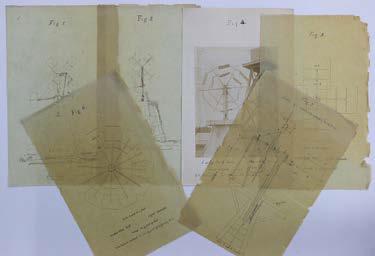
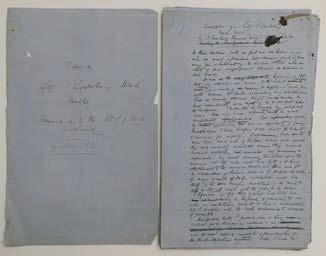
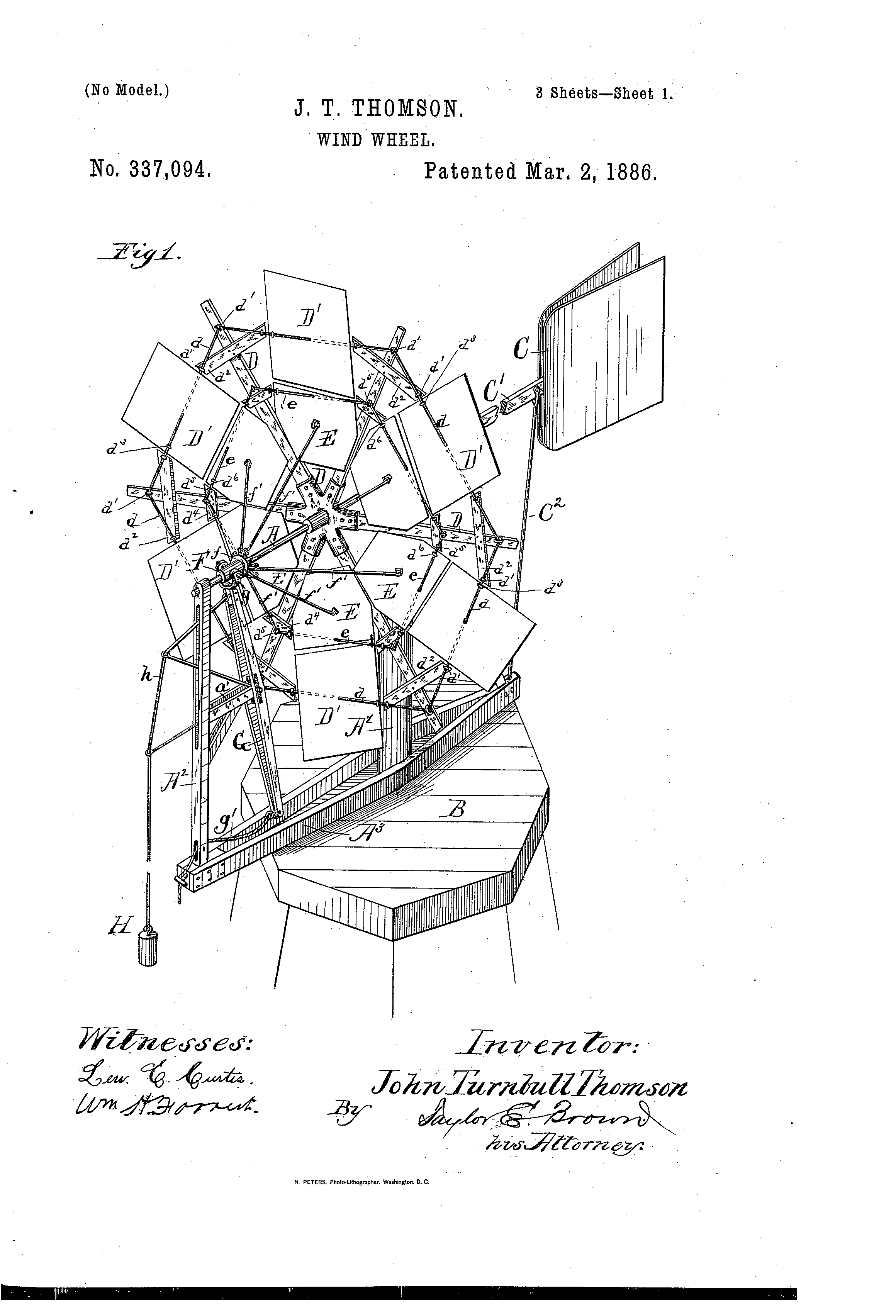

A wind engine with 6 whips, 6 feet in diameter, constructed at Lennel House, Invercargill by John Turnbull Thomson, to a design that he invented, presented about, and patented.
The Transactions and proceedings of the New Zealand Institute records an address given to the Southland Institute, Third Meeting, 11th July 1882. "On Self-registering Windmills" by J. T. Thomson.
ABSTRACTJohn Turnbull Thomson [1821-1884] had been Chief Surveyor of Otago, and the first Surveyor General of New Zealand. The original work that was presented as that address was included in an auction in August 2017, where the auction catalogue entry read:
The author gives an account of the various contrivances that have been adopted for obtaining a self-regulating Windmill, and describes in minute detail the experimental steps by which he was led to the invention of the particular form of windmill which he recommends; the leading features of which can be most easily understood from the accompaning illustration.
191 THOMSON, JOHN TURNBULL Wind-Mill [original paper with plans and Sketches.] The original hand written paper headed 'Description of Self Regulating Windmill' by J. Turnbull Thomson. 16 foolscap pages each closely hand written together with 5 ink sketch plans and an original photograph [200 x 150mm] of the completed windmill, inscribed - 6 whip windmill, 6 feet in diameter. In operation at Lennel House Invercargill N.Z. [Lennel House was the home of John Turnbull Thomson] Also a photocopy of the illustration of the windmill from T.N.Z.I. Vol. XV [1882] $1000 - $2000The auction lot failed to sell.
US patent 337094 was issued for the device, described there as a wind-wheel. The US patent was filed on Sep 29 1884, just a couple of weeks before J T Thomson's death on 16th October 1884. He had previous patented the device within New Zealand.
The text of the patent reads:
UNITED STATES PATENT OFFICEI've so far been unable to track down a copy of the New Zealand patent (stated as being no. 672) - the online record of New Zealand patents is unfortunately missing most patents in the number range 400 - 4900. (They state "The collection does not include patents published in the period 1880 to 1890, as patents from that era were not in a format that could be digitised economically.")
JOHN T. THOMSON, OF INVERCARGILL, NEW ZEALAND, ASSIGNOR TO JOHN CLAY, JR, AND WILLIAM H. FORREST, BOTH OF CHICAGO, ILLINOIS.
WIND-WHEEL.
SPECIFICATION forming part of Letters Patent No. 337,094, dated March 2, 1886.
Application filed September 29, 1884. Serial No.144,282. (No model.) Patented in New Zealand July 14, 1882, No. 672.
To all whom, it may concern: Be it known that I, JOHN T. THOMSON, a citizen of Great Britain, residing in Lennel House, Invercargill, New Zealand, have invented a new and useful Improvement in Windmills, (for which I have obtained a patent in New Zealand, No. 672, bearing date 14th day of July, 1882,) of which the following is a specification.
This invention relates to that class of wind wheels or mills having vanes or sails adapted to be faced to the wind when required to work, and to be swung or edged from the wind when not in use; and to this end my invention consists in providing a wheel with two sets of vanes or sails, in one set the vane or sail being suspended or hung at or near its edge off balance, and the vanes or sails in the other set are suspended or hung at or near their center in counter-poise, and so connecting the vanes or sails of each set with each other by means of longitudinal rods, and also by means of radiating or converging rods meeting in a reciprocating swivel collar or boss, in order that all the vanes may be faced to or edged from the wind simultaneously.
It further consists in providing a weight attached to said reciprocating collar or boss, whereby the vanes or sails are faced to or edged from the wind automatically; and it also consists in providing means for controlling the vanes or sails through said collar or boss by means of a lever connected therewith.
I have shown a wind wheel or mill embodying the features of my invention in the accompanying drawings, which form a part of this specification, and in which similar letters of reference indicate like parts, wherein -
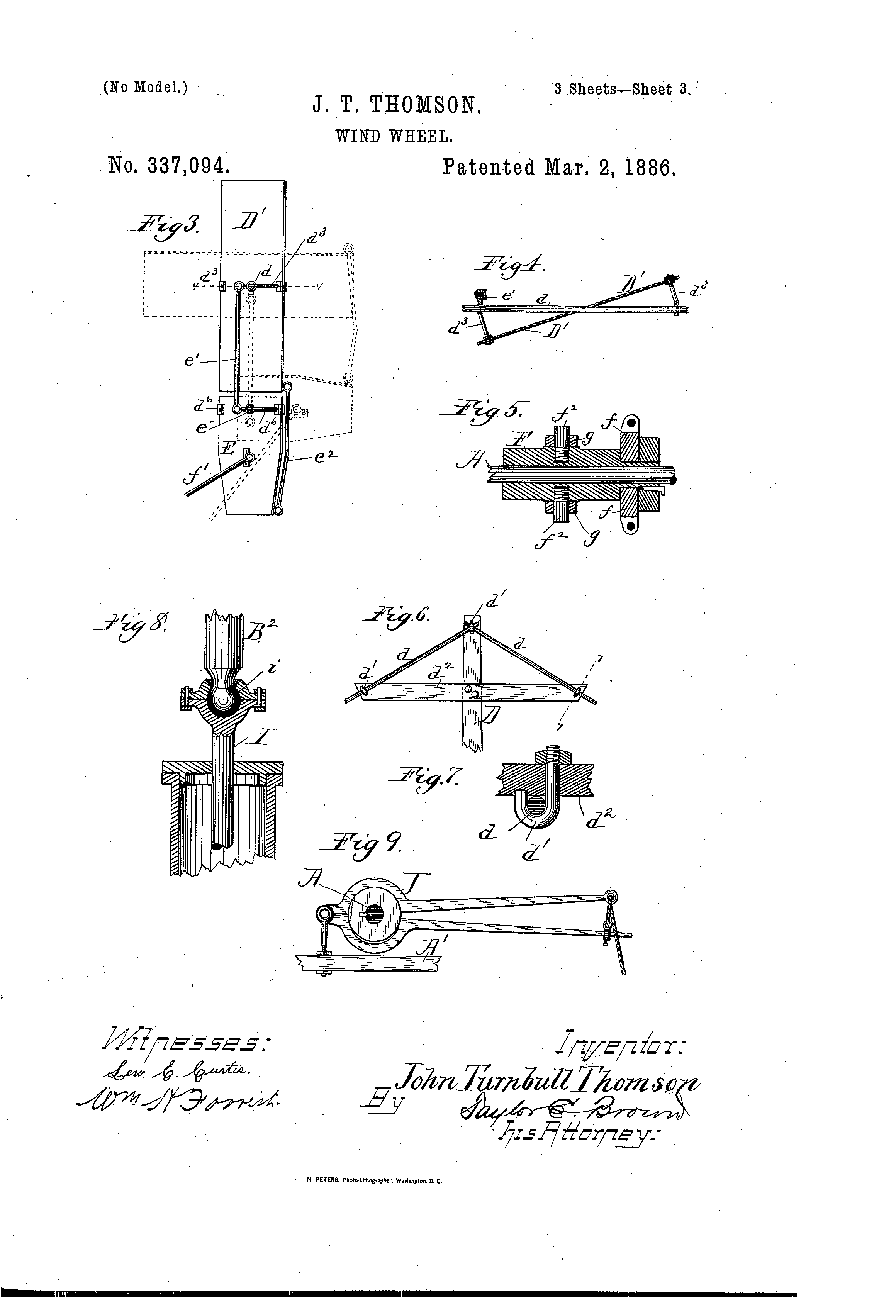
Figure 1 is a perspective View of the wind wheel or mill, the vanes or sails faced to the wind; Fig. 2, a central vertical section there of. Figs. 3, 4, 5, 6, 7, 8, and 9 are enlarged detail views of parts more fully hereinafter explained.
In said drawings, A represents the main shaft or axle, which is secured at one end by suitable boxes or bearings, a, to the top of the revolving sleeve or hearing A’, and at the other end it is supported in the vertical standard A2. The standard A2 and the sleeve A’ are secured firmly together by means of the framing A3 and brace rod or bar A4. Within the sleeve A’ and secured to the main frame B of the mill is the usual stationary hollow sleeve, B’, through which power is applied or exerted by means of the pitman B2 and crank B3 on shaft or axle A.
C is the usual tail-vane, supported on the beam C’, secured to the sleeve A’ and braced by the rod or bar C2. I prefer to make the tail-vane of two parts, as clearly shown in Fig. 1.
The wheel D is mounted or secured rigidly to the axle A to revolve therewith,and carries the vanes or sails D’ D’ and E E. The outer or main sails, D’ D’, are set or hung, preferably at or near the center, in counter-poise on the small wrought-iron rods d, which are firmly secured to the wheel D by bolts d’ and strengthened by cross bars or braces d2, which project from each arm of the wheel. The sails D’ D’ revolve readily on the rods d, passing through them, and are held at a suitable angle to the face of wheel D by means of stay-rods d3.
The inner or governing sails, E E, are set or hung near their outer edge, off balance, on small rods e, also secured to the arms of wheel D and cross-bars d4 by bolts d5. These sails E are also held or secured at an angle to the face of the wheel D by stay-rods d6.
Each outer sail, D’, is connected with one of the inner sails by fore and rear guide-rods, e’ e2, as shown in Figs. 2 and 3, so that both will move simultaneously.
F is the non-rotating collar or boss, placed loosely on the axle A, so as to be easily moved forward or back thereon, having mounted in a suitable groove or recess therein the rotat ing or swiveling collar f, to which is secured one end of the rods f’. These rods f’ radiate from this collar, and are attached at their other ends each to one of the vanes or sails E E. When the mill is not in use or the sails require to be edged from the wind, the collar or boss F is moved toward the wheel, thus spreading the rods f’ and edging the sails, as shown by Fig. 2 in dotted lines, by means of the lever G, pivoted to the arm a’ on the standard A2, and provided at its upper end with a a yoke, g, fitting over the pins f2, secured to the boss F. The lever G is secured in this position by a cord, g’. From the upper arm of the lever G, I suspend a weight, H, by means of a suitable cord, h, passing over a small pulley or through eyes of derrick-arms, as shown. When the lever G is unfastened,the weight H causes the boss F to slide or move out on the axle A, thus facing the sails to the wind and starting the mill. I maintain the velocity of the wind wheel or mill at the same speed by this weight H, the tension of which constantly balances the force of the wind impinging on the governing-sails E E, whose angle to the direction of the wind of course decreases as the force of the wind increases.
In Fig. 8 I show a convenient method of attaching the lower end of the pitman B2 to the piston I of a cylinder or pump by a ball and socket, i, allowing the wheel and frame to revolve or rotate in any direction.
J is a common form of a friction-brake surrounding a disk or collar on the axle A, secured at one end to the sleeve A’, and operated by means of a cord or chain secured to the lower lever or arm of the brake and passing through an eyelet or opening in the upper arm, thence to the ground. This is illustrated in Fig. 9.
When the mill is to be arrested, I unhook the weight H, throw the lever G, by means of the cord g, to the position shown in dotted lines in Fig. 2, and then brake the axle A by applying the brake J.
The vanes or sails I make of any suitable material, such as framing covered with canvas, galvanized iron stiffened with angle-iron, or light boards clamped with transverse pieces. The weight, in pounds, depends, of course, on the work required of it - that is, on the number of square feet in the regulating or inner sails. In a medium breeze, traveling at, say, eighteen feet per second, I would use a weight of three-fourths of a pound to the square foot.
I have shown the vanes or sails applied or attached between the arms of the wheel D; but I do not wish to limit myself to such construction, as it is obvious that other means of securing the sails may be employed, as they may be placed behind or before on the arms themselves with equal advantage. Nor do I wish to limit myself to the number of sails, as I may use one or more inner or governing sails to each ordinary outer sail; or I, may use more than one outer sail to each arm and employ one governing-sail to operate them, and I may swing these sails, as shown, or roll them up, slide them together, or fold them close.
Instead of guide-rods e e', but one rear guide-rod may be used, if affixed to a hinge or bracket projecting behind plane of sails.
What I claim, and desire to secure by Letters Patent, is -
1. A wind wheel or mill wherein the sails are secured to rods connecting the radial arms of the wheel, having some of said sails pivoted to said rods at or near their edge off balance, and other sails pivoted at or near their center in counterpoise, and mechanism, substantially as described, for facing or edging all the sails to or from the wind simultaneously.
2. In a wind-wheel wherein the sails are connected by radial rods to a reciprocating boss on the axle, the reciprocating non-rotating boss F, provided with a revolving collar, f, having proper lugs for securing said radial rods thereto, said non-revolving boss being also provided with pins f2, so as to engage the end of the lever G. substantially as specified.
3. In a windmill, the sleeve-bearing A’, surrounding the stationary sleeve B’, said sleeve A’ having a wind-wheel and a tail-vane mounted on its upper end, and the framing A3, secured at its lower end, in combination with the standard or brace A2, for supporting the wind-wheel axle A, and the brace-rod C2, for supporting the vane C, substantially as specified.
4. A windmill-wheel consisting of the radial arms D, connected with bolts by the rods d e, each of said rods d e having a sail mounted so as to revolve thereon, said sails being secured at a suitable angle longitudinally to said rods by stay-rods d3 d6, substantially as and for the purpose specified.
5. In a windmill, the manner of securing the sails D’ and E to the rods d and e at an angle by means of the stay-rods d3 and d6, substantially as shown and described.
In witness whereof I have hereunto set my hand this 4th day of August, A. D. 1884.
J. T. THOMSON.
Witnesses:
Wm. McCulloch, Resident Magistrate, Invercargill, New Zealand.
Thos. M. Macdonald, Crown Solicitor, Invercargill.
I assume this was a wind engine - the reports certainly talk of a "wheel" that catches the wind. Whatever it was, it was destroyed just few weeks after it was put in place. Southland Times, Issue 903, 21 February 1868
A few weeks since Messrs Gerbes erected a windmill at their furniture factory, in Dee-street. It was the observed of all observers, and since it has been in operation visited by many of the townspeople, to see how it worked the turning machines of its enterprising owners. We visited the establishment yesterday morning. Seeing it revolving with great rapidity, and considering it a good time to make observations as to its power, we entered the workroom, at the time Mr Gerbes was engaged in turning some massive table legs. One had just been completed, and another was being fitted for drilling. Another gentleman was there on a like mission - to inspect the machinery - when the sound from above indicated that the high wind was driving the mill at electric speed. In a few seconds, slap, slap, - bang, bang, came fragmentary pieces of timber rattling on the shingles of the roof of the workihop. The inmates fled at a rate that could scarcely fall short of the speed of the wheel, which now was flinging pieces of its fanners in all directions. The proprietor of the establishment, quickly followed by others, darted towards the back door, and fled for refuge to a small building at the back, while the writer, with kangaroo strides and a John Gilpin appearance, darted through the front door, hatless, and with coat-tails flying, across the street, much to the amusement of the numerous lookers-on, who had been watching the struggle between jointed timber and strong wind. All succeeded in reaching places of safety, and had the opportunity of watching the final event. The wheel flew round with a rapidity indescribable; the massive timbers of the tower to which it was fixed swinging and swaying to an extent which led to the expectation that it would come down with a crash. In a few seconds, however, that danger was over; the arms of the wheel went crack, and the fragment of the fanners were hurled into the air, falling upon the roofs of neighboring houses, causing the inmates to rush into the street with frantic haste. Fortunately, no damage was done except the destruction of the wheel of the mill. In a place like Invercargill subject to frequent heavy gales of winds, we can not but think the erection of windmills in the heart of the town should be discouraged. We give Messrs Gerbes every credit for their enterprise in attempting to economise labor by enlisting the aid of the wind; but it is evident that had the tower fallen, much damage, if not loss of life would have resulted - that not only their own, but adjacent property would hare been seriously affected.
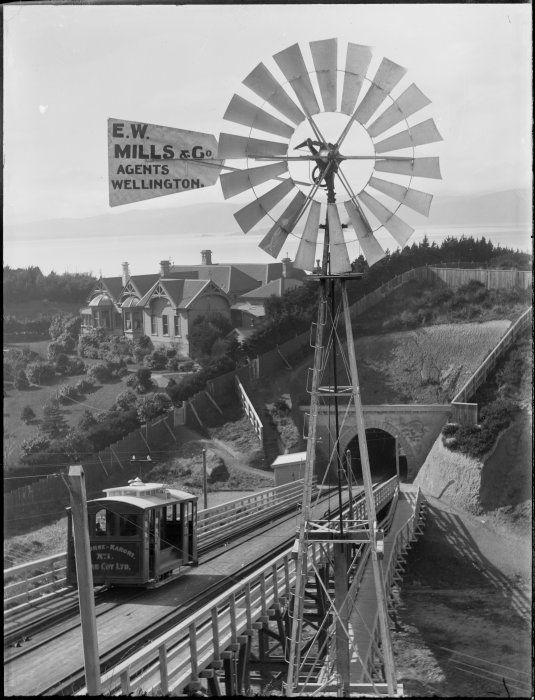
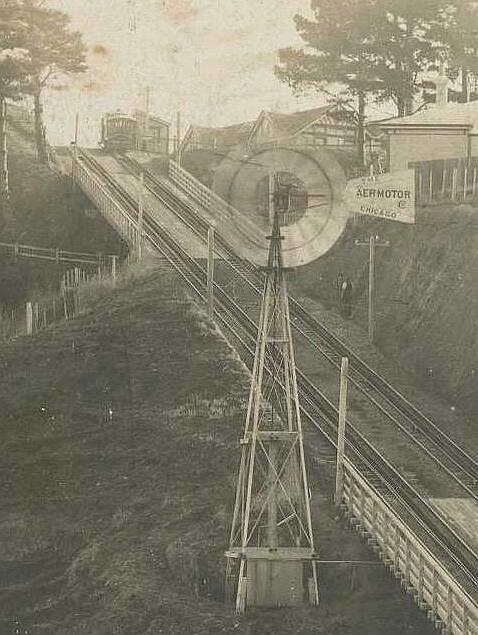
A Chicago built Aermotor wind engine, imported by the appropriately named E W Mills & Co, arrived in Wellington on the ship Freeman on 11th Nov 1898, and was sold on 29th Sept 1901 to the Kelburne Tram Co (operators of Wellington's Cable Car), who used it to pump water for use by the cable car steam engine.
The Freeman's voyage had not been a smooth one: Evening Post, Volume LVI, Issue 115, 11 November 1898
Levin & Co were responsible for handling the cargo locally: Evening Post, Volume LVI, Issue 115, 11 November 1898FREEMAN, FROM NEW YORK.
At 4 o'clock this morning the barque Freeman, from New York, arrived off the Heads, and a few hours later was towed to an anchorage in the stream by the Duco. Captain Van Namee reports that the passage of 120 days was an exceptionally stormy one throughout, gale upon gale succeeding each other with methodical and monotonous regularity. Often the vessel would be under full sail, which in a few hours it would be necessary to reduce to the lower topsails. She shipped immense bodies of water, but excepting some damage to the port bulwarks the vessel, which has the reputation of an excellent sea boat, came very well out of the ordeal. Captain Van Namee considers the trip just ended as one of the most disagreeable he has encountered for many years. The direction of the gales was from north to south, very little Westerly wind being met with. She was off Cape Farewell yesterday in thick weather, and made the Heads as above stated. The vessel and her captain are strangers to Wellington. Captain Van Namee, some 16 years ago, was instructor to the Boys' Naval Training Institute at Auckland. Particulars of her cargo - all for Wellington, and which include 7500 cases kerosene - have already appeared. Newcastle is likely to be her next destination, to load for an American port. Dr Pollen, in the absence of Dr James, who is away in the South Island, inspected the vessel. His examination was satisfactory, and the vessel will be berthed at the Queen's Wharf this afternoon. Messrs Levin and Co are the local agents.
BARQUE FREEMAN, FROM NEW YORK.[photo] [photo]
THE above-named vessel arrived this morning, and will commence to discharge To-morrow (Saturday), 12th instant. Consignees are requested to take delivery of cargo in terms of Bills of Lading, otherwise it will be landed and stored at their risk and expense. Any damaged must be examined prior to removal from wharf, otherwise no claim will be acknowledged. LEVIN & Co., Ltd., Agents.
Captain Van Namee will not be responsible for any debts contracted by the crew without his written authority.

When talking out the water supply for Lower Hutt, the 1941 publication "Lower Hutt, Past and Present" mentions that "Numerous windmills, and where possible hydraulic rams, were also used", and accompanies the section with a photo of Orr's wind engine, noting that this was built 1885 and was still in operation (in 1941 that is).
Orr House (which still exists) was built by Stephen Strand to a design by Charles Petrie's for Robert Orr in 1885-1887. Orr devoted much of his 17-acre property for market gardening, with up to 40 employees, and presumably the wind engine provided water to the house and gardens. The wind engine was taken down around 1950 and the estate subdivided in the 1960s.
[photo]Wairarapa Daily Times, Volume 2, Issue 545, 18 August 1880, Page 2
Muir and Dixon Bros, have just completed, to-the order of Dr Hosking, a self-acting wind-mill, and which Dr Hosking intends to use as a means of keeping the tanks used to irrigate his garden full of water. We are given to understand that the machine works well, a lever regulating the force of the wind on its sails, and as soon as the tanks are full the machine stops working. The special advantages of the one made by this firm are that the ironwork is wrought, and the whole article turned out at a much less cost than it could be imported. We believe we are right in saying that this is the second windmill in the district used for the purposes above mentioned, the other being owned by Mr. Chalmers, of the Upper Plain.
Nelson Examiner and New Zealand Chronicle, Volume XXI, Issue 26, 5 April 1862
FOR SALE, a Six-horse power patent self-regulating WIND ENGINE, with flour-mill, Pump, &c.At the same time as offering the wind engine, Jellicoe also had other items for sale, including mill related products: Nelson Examiner and New Zealand Chronicle, Volume XXI, Issue 30, 9 April 1862
The Engine is suitable for house or farm purposes, or for pumping. It will work day and night without expense. It requires no attention, the sails being so constructed, that they present a varying surface to the wind, according to its strength.
Similar engines are much used in America.
Mr. Jellicoe, Top of Trafalgar-street.
FOR SALE -
...
1 Winnower, 1 Flour Mill
Horse Mill, by Ransome
Pump, Grindstones
400 Flour Bags
...
Mr. Jellicoe, Top of Trafalgar-street.
Otago Witness, Issue 2441, 26 December 1900
VIEW OF PALMERSTON FROM THE RESERVOIRS. PALMERSTON SOUTH WATER SUPPLY: THE TWO WINDMILLS TO BE USED FOR PUMPING WATER UP TO RESERVOIRS. - A. E. J. Gill, photo, Palmerston.
Auckland Star, Volume XXIV, Issue 48, 27 February 1893
DAMAGE AT RANGITOTO SALTWORKS.
During Thursday night's south-easterly gale some damage was caused at the newly opened salt refining works on Rangitoto Island, near the Reef. The windmill used by those employed at the works to pump up salt water was blown clean away, and could nowhere be found. A sixteen feet open boat lying at the small wharf at the salt works was also smashed up.
The Page 3 Advertisements Column 2, Auckland Star, Volume XXVI, Issue 272, 23 November 1885 carried a wanted ad to tender for installing this wind engine:
WANTED, Tenders for Erecting a Windmill to Pump Water, and two Tanks, — Apply Auckland Dairy Company. Remuera
From Southbridge - Weekly Press 14 Jun 1911:
Mr David Tongs homemade windmill.[photo]
Mr Tong an ingenious Southbridge farmer built the simple but cleverly constructed windmill which he used for pumping water.
Bay of Plenty Times, Volume XI, Issue 1215, 15 February 1882
The windmill at the top of a certain joiner and builder's shop, has been very busy of late. Although there was not much wind yesterday this little machine, it is said, drew up large quantities of shaving from the shop belong and showered them down on passers-by. Of course we don't blame anyone in the shop - the windmill, and it alone is hold responsible for this!
Offered for sale by auctioneer R C Greenwood on July 16 1884, Page 3 Advertisements Column 9, Auckland Star, Volume XXVI, Issue 410, 3 July 1884
WAIKOMITI. - 11 acres 3 roods Land at Waikomiti, being Allotment 160, Parish of Waikomiti. County of Eden, known as Johnson's Brick Yards; together with three new Sheds (one blown down by the wind), the material for which alone cost £100); Windmill with Pump, the latter costing £30; a good 2-roomed House, and good well of water. Capital view, and close to the Waikomiti Station. Very suitable for a brickyard or other works, as the railway runs through the property, and a siding can easily be made.
There's a great photo of McPherson's woodworking shop, showing a Sampson wind engine mounted on a tower in the background. There is certainly a water tank up in the tower, but unclear if the wind engine also drove any machinery in the workshop.
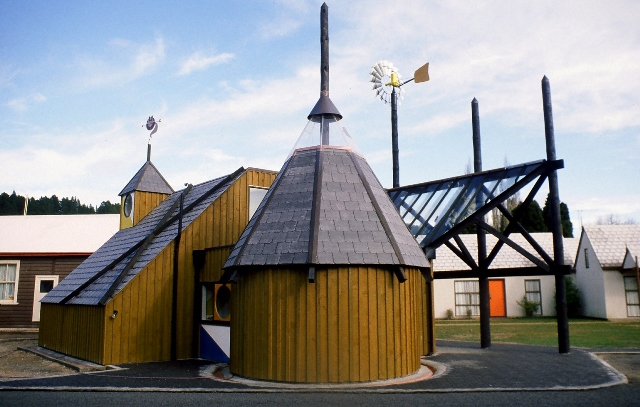
[photo]When Roger Walker designed the Facilities Buildings to be built in the ground of the THC Wairakei Hotel, he included a pair of wind engines mounted on poles above the buildings, just as he did on his Willis Street Village in Wellington. These are no longer in place.
[photo]From Auckland Star, Volume VI, Issue 1810, 3 December 1875
A windmill has to-day been erected at the Hot Springs. There will be games to-morrow. Great preparations. Nearly all visitors in training — both sexes. Great glee and expectation of coming event. Sends us two donkeys.and Auckland Star, Volume VI, Issue 1811, 4 December 1875
[PER PIGEON EXPRESS.]
This day.
The windmill is just erected, and all are enjoying the sport. Games are to start this afternoon.
Press, Volume XIX, Issue 2762, 8 March 1872, Page 3
AMONGST THE VINEYARDS.
Probably many of our readers may imagine that the heading of this article refers more particularly to other climes than ours, but there is growing up in our midst an industry, which, some years ago, was looked upon as an impossibility to establish with any degree of success - an industry which is rapidly extending its operations, and promises to become a very important item in the sum of our prosperity. To the majority of the inhabitants of the province the existence amongst us of vineyards to the extent of that owned by Mr Lord is comparatively unknown, and therefore a brief description of the establishment owned by that gentlemen may not be uninteresting.
Situate at Waltham, within easy distance of town, and, comparatively speaking for our flat plains, picturesquely placed, Mr Lord's vineyards attract attention from the passer-by. The extent of ground comprised in the vineyards is two acres, the vineries proper covering 7000 superficial feet.
Having, to use a Yankee phrase, "interviewed" Mr Lord, and received from that gentleman a cordial invitation to inspect his grounds, we start upon our mission. We first come to the very unambitious structure - a greenhouse some 20 x 10 in which Mr Lord first essayed the growing of grapes, which has since assumed such a large shape - which contrasts with the wide expanse of glass covering the present vineries. Taking a cursory glance into this the nucleus of the present large establishment, and noting the large clusters of grapes hanging in endless profusion on the vines, we pass on to a novel invention of Mr Lord's used for the purpose of irrigating the soil of the vinery. This machine is nothing more nor less than a windmill of improved construction, after a patent taken out by Mr Lord, and which we will briefly describe. We may premise the description by stating that at one end of the vineries is placed a tank holding 4000 gallons, into which the whole of the rain water collected on the roof of the vinery is conducted, and where also is a pipe leading to an artesian well in the centre of the building, the windmill pumping the water from this well into the tank, and distributing it by means of iron pipes running through the centre passage of the vinery, having T points for conducting the water down the latteral passages, branching off from the main one. The windmill consists of five arms or sails, constructed of two wide boards ten feet in length working like on a hinge, and opening to an expanse of three feet when going before the wind, but which shut closely up, and therefore present little or no obstruction to the wind when going against it. Running from the extreme end of these sails or arms to the centre post, which is some ten feet high, is a wire guy passing over a small drum, and connected with a small toothed arm at the centre post. When the small lever which keeps the toothed arm down upon the cog wheel is set free, the wire guy is drawn in, and the sails closely reefed so to speak, which is only done when the wind is exceedingly high. The sails setting the machine in motion by means of cranks and pinion wheels, lifts the pump, and thus causes the water to flow into the tank, whence, as before stated, it is distributed throughout the vinery. The wind-mill is so constructed that the pump is lifted three times to one revolution. The whole machine is a very ingenious one, and was designed and erected wholly by Mr Lord himself. Passing around to the front we enter the vinery itself, which is 110 ft. long and 65ft. wide, consisting of four ridges or houses, and a cupola in the centre. On entering we found ourselves in a perfect forest of vegetation, the vines being trained over the various passages to form natural arbours, every plant from root to top being thickly clustered with bunches of grapes in fine perfection.
Auckland Star, Volume X, Issue 2718, 8 January 1879, Page 3
SALT WATER BATHS. Salt water covered swimmings baths aro to be erected at the head of Evan's Bay, in connection with a new hotel erected there. The water will be pumped from the sea by a patent wind-mill imported for the purpose.Auckland Star, Volume X, Issue 2718, 8 January 1879
The city authorities of Wellington are taking active measures to secure that cleanliness among the population which is said to be next in merit to Godliness, by providing salt water baths at the head of Evans Bay. The water for the purpose will be pumped up from the sea by means of a patent windmill which has been imported for the purpose. The site of the proposed baths is certainly not readily accessible from the central portions of the the city, but their establishment will be a great boon to the residents at the Te Aro end. We trust Auckland will not allow itself to be excelled by so great public importance.
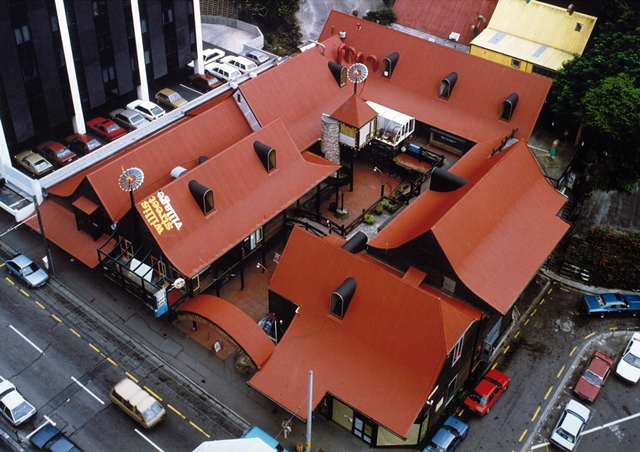
Wellington is known for its winds, so it's appropriate that even within the CBD, dominated by surrounding buildings (and the natural form of the land which rises up abruptly) an architect decided that wind engines would make an interesting architectural flourish. Thus they featured on the the somewhat quirky Willis Street Village development by architect Roger Walker. The engines were part of the original 1979 construction, but nearly 40 years later after a number of adaptations to the site, (and perhaps new planning laws), they are no longer present.
The wind engines were just ornamental, produced by an Australian firm. They became somewhat of a trademark for the architect, who featured them on several other developments around New Zealand. [photo] [photo] [photo]
From August 1885 onwards, a grand Industrial Exhibition was staged on the Wellington waterfront, in a expensively constructed building. There are conflicting reports as to how successful it was, but it seems to have attracted over 130,000 visitors, which seems a reasonable number given the population of the whole country was less than 500,000 at the time.
Pictures of the building show I believe 2 wind engines on the roof. The Exhibition catalogue has the entry
202—Booth, Macdonald, & Co., Christchurch and Invercargill. Carlyle Iron Windmill for Pumping Water. Erected complete.That for Scott Bros is less specific:
234—Scott Brothers, Christchurch. Steam Engines, Steam Pump Turbine, Ely Press, Register Grates, Fountains, Garden Seats, Architectural and other Ornamental Castings.The exhibition awards were published in New Zealand Herald, Volume XXII, Issue 7456, 12 October 1885, Supplement
Windmills: Booth, MacDonald, and Company, Christchurch 1st prize; Scott Bros, Christchurch, 2nd prize.The Carlyle Iron Windmill (by Booth, MacDonald and Co.) was advertised the following year with the tag line "First Award N.Z. Exhibition, Wellington 1885", though they removed the tag line in subsequent years. [info] [info] [info] [photo] [info] [info] [info] [info] [info]
New Zealand Times, Volume XLI, Issue 6987, 13 October 1883
MOUNT COOK PRISON.
VISIT OF THE GOVERNOR. His Excellency the Governor paid a visit of inspection to the Mount Cook penal establishment yesterday afternoon, and performed the ceremony of lighting the first fire in the new and decidedly mammoth brick kiln which was completed on Wednesday. ... Large bricked and cemented water tanks have been constructed near to the brick-making sheds, one of which is capable of holding 50,000 gallons, and the other will contain 15,000 gallons. The smaller one is filled by means of a windmill whilst the other will receive the rainfall from the corrugated iron roofs of the brick drying sheds, which in the aggregate will cover several acres of ground. The brickmaking machinery is driven by a portable steam-engine of 12 horse power. The machines bear the impress of J. Whitehead and Co, Preston, England, and all of them are of the most modern description.
The patent windmill, invented by J. G. Oates was extensively shown at a number of A. & P. shows in the Wellington region.
No 7995.Clearly there were no farms on Lambton Quay - that was merely the address of Oates' patent agent. The illustrations have unfortunately not been included in the digital archive.
Dated 22nd October, 1895.
COMPLETE SPECIFICATION
"An improved windmill"
I, John George Oates, of 42 Lambton Quay, Wellington, in the colony of New Zealand, Farmer, do hereby declare the nature of my invention for "An improved windmill" and in what manner the same is to be performed to be particularly described and ascertained in and by the following statement, -
My invention relates to an improved windmill and has more especial reference to small windmills which are extensively used for pumping and other purposes, The usual construction of such mill is well known to consist of a horizontal shaft working in bearings and having at its outer end arms carrying blades or sails which revolve by the action of the wind, the said shaft being fitted with a crank or pulley to drive a pump or other light machine. The bearings in which the shaft revolves are formed upon a frame which frame is fitted with projecting vane or other suitable apparatus which has the effect of always keeping the working vanes opposite and at right angles to the direction of the wind.
It is evident that by these arrangements the windmill will be driven at different speeds according to the strength of the wind and the work to be done, and it is found in practice that when the current of wind is strong the machinery is often driven at such speed and with such force as to carry away the sails or otherwise disarrange the machinery.
Now, it is to obviate this difficulty that the improvements hereinafter mentioned have been invented and which give a means of perfectly governing the speed of windmills. In carrying my invention into effect I prefer to fix the mill sails firmly on to a hollow axle which hollow axle works in ordinary bearings fixed on a revolving frame or table in the usual manner in order to face the wind in whatever direction it may blow. The inside of this hollow spindle I prefer to make in the form of a pipe or tube and into this tube I fit a sliding shaft which shaft is longer than the said tube and projects beyond each end. The end projecting in front of the vanes I prefer to be square or in any suitable form so that it will be able to slide freely within the tube but will be certain to revolve with it. On this front end of the sliding shaft I fix a boss which carries rods which project backwards diagonally and are of such a number that there is one rod to each vane of the mill. The vanes are hinged to the arms which support them and the diagonal rods are hinged to the boss and the vanes so as to allow of the vanes having either their whole surface exposed to the action of the wind or to be turned backward to present a smaller surface when exposed to a stronger current.
It will be evident that if this governing action of the vanes can be made automatic so as to be actuated by the current of the wind the machinery will be freed from the usual shocks which take place from sudden gusts.
To accomplish this object I fix to the inner end of the beforementioned sliding shaft a connecting rod fitted at one end with a bearing in which the end of the sliding rod revolves and at its other end a coupling by which it is attached to an upright arm carrying a suitable vane. This vane is so arranged that it always faces the wind and the arm upon which it is fixed is so regulated by means of a lever or counterbalance weight or both that it remains stationary with the normal state of the wind, but should the current of the wind increase more than is required the said upright vane is blown backwards carrying with it the coupling and the sliding shaft thus acting upon the working vanes of the windmill through the beforementioned diagonal rods, and pressing them back so as to reduce the surface exposed to the wind, and oppose a more acute angle to the action of the same.
Behind the said upright arm of the regulating vane I prefer to have a spring buffer to prevent too great a shock arising from sudden gusts, and I so arrange the details of my apparatus that the whole may be readily altered and set so as to give less or more power as required.
In order that my invention may be most easily understood by one skilled in the art to which ir appertains I will now proceed to describe the same in detail and in doing so shall refer to the accompanying drawing, whereon similar letter of reference indicate corresponding parts.
Figure 1 is a side elevation of my windmill.
Figure 2 is a front view of the same.
Figure 3 is a view of alternative balancing mechanism.
Referring to the views, the sails /a/ are fixed firmly to the hollow axle /b/ which works in ordinary bearings /b'/ fixed on a revolving frame or table /c/ having vane /c'/ in the usual manner. Into hollow axle /b/ I fit a sliding shaft /d/ which is longer than the said axle and projects beyond each end. The end projecting in front of the sails /a/ I prefer to be square in section, and on this front end of the sliding shaft I fix a boss /d'/ which carries rods /d2/ which project backwards and are equal in number to the sails. The said sails /a/ are hinged at /a'/ to the arm /a2/ which support them and rods /d2/ are hinged to boss /d'/ and sails /a/ so as to allow the sails to yield and turn backward and offer less resistance when exposed to a stronger current.
This movement of the sails is made automatic by fixing to the inner end of the sliding shaft /d/ a coupling /e/ fitted at one end to crosshead /e'/ in which the end of sliding shaft /d/ revolves and at its other end is coupled to upright arm /f/ by means of pin /e2/, said arm /f/ being pivotted at /f2/ to frame /c/ and carrying vane /f'/. This vane is kept up to its work by weight /g/ and cord /g'/ passing over pulley /g2/, which is placed out of the centre to make room for eccentric /j/ or other mechanisms to work, and in the normal sate of the wind the said vane will remain stationary, but with increased force of wind it will be blown backwards taking with it coupling /e/ and sliding shaft /d/ thus acting upon the sails /a/ through rods /d2/ and pressing them back so as to reduce the angle at which the wind strikes them. When the weight /g/ has been raised a certain distance, the adjusting stop /g'/ will pick up a second weight /g3/, and by arranging the height and varying the number and size of these weights I can correspondingly increase or decrease the resistence of vane /f'/ so as to obtain more or less power from the windmill as desired. If necessary, weights /g/ & /g3/ may be made to operate outside turntable /c/ as shewn by dotted lines.
Referring to Figure 3, an alternative balancing mechanism is shewn when the vane /f'/ upon arm /f/ is kept up to its work by weight /g/ suspended upon a continuation of said arm /f/. Counterbalance weights /g4/ may be any desired size so as to counteract weight /g/ or entirely overcome it when it is desired to stop the windmill from working.
I prefer to use a spring buffer /h/ to prevent shock arising from the action of sudden gusts upon vane /f'/, and to keep the said vane up to its work against the wind.
Having now particularly described and ascertained the nature of my said invention and in what manner the same is to be performed, I declare that what I claim is,-
1. In a windmill, in combination, sails hinged to their supporting arms and connected to a shaft capable of sliding within a hollow axle and operated by a vane and connections, substantially as and for the purposes set forth herein.
2. In a windmill, in combination, sails hinged to their supporting arms and connected to a shaft capable of sliding within a hollow axle and operated by a vane and regulating weights, substantially as and for the purposes set forth herein.
3. In a windmill, in combination, sails hinged to their supporting arms and connected to a shaft capable of sliding within a hollow axle and operated by a vane and regulating spring, substantially as and for the purposes set forth herein.
4. A windmill, constructed, arranged and operating, substantially as and for the purposes hereinbefore described and illustrated on the accompanying drawing.
Dated this 17th day of July, 1896.
Henry Hughes
Agent for the Applicant.
| Where | Newspaper | Report |
|---|---|---|
| Carterton Agricultural Show | Evening Post, Volume L, Issue 107, 1 November 1895 |
Implements are a feature of the Show, and it is agreed that a larger collection has never been seen in the district. The principal exhibitors are - ... Mr. J. G. Oates (Carterton), a patent automatic self governing windmill |
| WELLINGTON A. & P. ASSOCIATION | New Zealand Times, Volume LVII, Issue 2666, 14 November 1895 |
It can be fairly claimed for the Wellington Agricultural aud Pastoral Association’s seventh annual show, which began at their grounds at Petone yesterday, that it is by far the best the Association has yet held, and that the number and excellence of the exhibits place it amongst the best shows held in the North Island. |
| Manawatu and West Coast A. and P. Show | Feilding Star, Volume XVIII, Issue 104, 30 October 1896 |
The eleventh annual show in connection with the Manawatu and West Coast A. and P. Association was held on the Show grounds, Palmerston North, on Wednesday and Thursday. |
| THE CARTERTON SHOW | New Zealand Times, Volume LVIX, Issue 2970, 6 November 1896 |
The annual show of the Wairarapa Pastoral and Agricultural Society was opened to-day at their show grounds in this town. |
| The Wellington A. and P. Association | New Zealand Times, Volume LVIX, Issue 2981, 19 November 1896 |
The eighth annual show of the Wellington Agricultural and Pastoral Association, which was opened at Petone yesterday, may be considered as one of the best ever held since the foundation of the Society. |
| MASTERTON A. &. P. SHOW | Evening Post, Volume LV, Issue 46, 24 February 1898 |
It is admitted on all sides that the annual show of the Masterton Agricultural and Pastoral Association yesterday was an unqualified success. The weather was beautiful, and the attendance was larger than at any previous show in the North Wairarapa. |
| WAIRARAPA AGRICULTURAL AND PASTORAL SOCIETY | New Zealand Times, Volume LXVIII, Issue 3581, 5 November 1898 |
Mr J. G. Oates had a Premier windmill on exhibition. |
| The Manawatu and West Coast A. and P. Association | Feilding Star, Volume XX, Issue 117, 16 November 1898 |
The thirteenth annual show under the auspices of the Manawatu and West Coast A. and P. Association commenced on the show grounds, Palmerston North, to-day and once again claim is laid to its being the premier show of the North Island, a reputation which the energetic and competent committee are evidently determined shall be maintained so far as lays in their power. |
| MASTERTON AGRICULTURAL AND PASTORAL ASSOCIATION | Wairarapa Daily Times, Volume XVI, Issue 6167, 23 February 1899 | MR. J. G. Oates of Carterton, had on view a windmill of his own manufacture, and which is now being largely used in the South Wairarapa. A feature of this mill is that it works automatically, and in stormy weather adjusts itself to speed. There is nothing in the mill to work loose, and Mr Oates guarantees his patent to last a lifetime. |
| MANAWATU AND WEST COAST AGRICULTURAL AND PASTORAL ASSOCIATION | Wairarapa Daily Times, Volume XVI, Issue 6395, 16 November 1899 |
The fourteenth annual Show of The Manawatu and West Coast Agricultural and Pastoral Association commenced at Palmerston North on Wednesday. |
| WAIRARAPA A. AND P. SOCIETY'S SHOW | Wairarapa Daily Times, Volume XXVI, Issue 6697, 1 November 1900 | Mr J. G. Oates, of Carterton, had his Premier windmill, which is in all respects all that a windmill should be, being perfectly under control, and most easily adjusted. It is almost as completely under control as a steam-engine, and is one of the best wind-engines we remember to have seen, as regards strength of construction and perfect automatic regulation. |
From: Page 16 Advertisements Column 1, New Zealand Tablet, Volume XXV, Issue 19, 10 September 1897
STEAM ARTESIAN WELL SINKER
House and Sanitary Plumber. Hot and Cold Water Services. Founder and General Engineer. Maker of the Celebrated Tital Steel Windmill. Creamery and Butter Factory Machinery. Contractor to the Central Dairy Company. Pumps, Pipes, Rams, Gasfittings, etc., etc., fixed at Lowest Rates. Estimates and Plans on Application.
THOMAS DANKS,
Providence Works, Lichfield street, Christchurch, N.Z.
From: New Zealand Tablet, New Zealand Tablet, 10 December 1908
Farmers and others desirous of seeming a cheap and effective water supply for farm and domestic purposes should write to, or call on, Mr. Thomas Danks, Lichfield Street, Christchurch, for particulars of his Tiian Windmill, which will be found to do all that is claimed for it....
From: Page 20 Advertisements Column 1, New Zealand Tablet, Volume XX, Issue 28, 29 April 1892
COSSENS & BLACK,
ENGINEERS, IRONFOUNDERS. &c.
CRAWFORD STREET, DUNEDIN.
Manufacturers of BRICK and DRAIN PIPE-MAKING and WOOD-WORKING MACHINERY, CHAFFCUTTERS, TURNIP PULPERS, HORSE GRABS, WATER WHEELS, &c. ; also.
WINDMILL PUMPS Of the Latest Designs, for Draining, Irrigating, or supplying water for the use of Stock or Domestic Purposes, or the Windmill can be geared for chafcutting, &c, &c.
Special attention given to the requirements of the Goldmining Districts. Every Description of Hydraulic Mining Plant Manufactured.
ESTIMATES GIVEN for all kinds of MACHINERY, CASTINGS, and OTHER IRONWORK.
From: Page 9 Advertisements Column 1, New Zealand Tablet, Volume XXIV, Issue 49, 2 April 1897
COSSENS AND BLACK
ENGINEERS, BLACKSMITHS, MILLWRIGHTS, IRON AND BRASS FOUNDERS, Crawford Street, Dunedin.
Manufacturers of Pumping and Winding Machinery, Hydraulic Mining Plant — including Hydraulic Giants, Sluice Valves, Elevator Castings, Iron and Steel Fluming, etc., etc., Dredge Tumblers. Buckets, Links, Windmills, Waterwheels, Turbines, Brick and Drain Pipe Making and Wood-working Machinery, Horse Powers, Chaff Cutters, Turnip Pulpers, and all kinds of Machinery and Gearing.
A VERY LARGE STOCK OF PATTERNS TO SELECT FROM.
ESTIMATES GIVEN.
CORRESPONDENCE INVITED.
Repairs and Every Description of Engineering and Blacksmith Work Promptly Executed.
From Marlborough Express, Volume XXII, Issue 227, 25 November 1886

From The Marlborough Express, July 14, 1887:

The Carlyle Iron Windmill
The Best and Cheapest in the market. Made entirely of iron. Cannot shrink, swell, warp, rattle, or be torn to pieces by the wind. Self regulating and will weather the fiercest gale without injury. Weighs no more than the old wooden wheelmill. Costs nothing for repairs and works right along without any touble.
Mill, free to most ports in the colony, £19.
Illustrated catalogues free. Mention this paper.
Booth, Macdonald & Co., Manufacturers of all kinds of Agricultural Implements, Carlyle Implement Works, Christchurch.
From: Page 13 Advertisements Column 1, New Zealand Tablet, Volume XXI, Issue 38, 18 January 1895

WIND AND WATER COST NOTHING!
You can make the wind raise the water, and so turn Nature's gifts to your advantage.
There is money in it. A good Windmill Pumping Plant is the most profitable investment you can make, whether for household, garden, or farm purposes, for watering stock or irrigation. It will pay you 25 per cent, on its cost — that is if you get the right kind of mill. There are some that cost little money but cause a lot of trouble.
Don't Come to us for that kind.
We don't make them. We build the best, or we would not sell more every year than all other colonial makers put together, as we do.
Sizes from 6 to 14 feet diameter. Capacities 50 to 5,000 gallons per hour. Prices as low as compatible with first-class quality and honest workmanship. Please write us for information, mentioning this paper.
CIRCULARS, ESTIMATES, ADVICE FREE. PLANS AND INSTRUCTIONS PROVIDED.
Packed closely for shipment.
BOOTH, MACDONALD & CO., CARLYLE IMPLEMENT AND IRON WORKS, CHRISTCHURCH.
From: Page 5 Advertisements Column 1, New Zealand Tablet, Volume XXIV, Issue 44, 26 February 1897

WIND AND WATER COST NOTHING
You can make the wind raise the water and so turn Nature's gifts to your advantage.
WHY NOT DO IT? You want water for your stock, your household, your bathroom, your garden. It only requires pumping, The wind will do that for you. MONEY IN IT? A good Windmill Pumping Plant will pay you a bigger profit than any other investment you can make — to say nothing of the increased comfort and happiness it will afford you.
We build a splendid line of Windmills and will gladly send you our Catalogue and advise you as to cost of most suitable style and size for your purpose. The first cost is not great and subsequent expense is practically nothing. Please write us andmention this paper.
BOOTH, MACDONALD & CO., CHRISTCHURCH.
From: Page IV Advertisement 1, Progress, Volume X, Issue 7, 1 March 1915
BOOTH, MACDONALD & Co. Ltd
We have a well-equipped Manufacturing Plant, including Iron and Brass Foundry with modern appliances. Machine Shop, with latest Grinding, Milling, and Shaping Machines, Lathes, Screw Machines, Drills, etc., and a Competent Staff of Skilled Mechanics, and are prepared to take up the Manufacture of ENGINEERING or HARDWARE Specialities in quantities for INVENTORS, AGENTS, or IMPORTERS!
Give us a chance to capture some of the trade in GERMAN GOODS of this class, and we will do our best!
We manufacture a full line of CAST IRON PULLEYS (SPLIT and SOLID), fully machined, well finished, no dearer than the imported, also PLUMMER BLOCKS, COUPLINGS, COLLARS, FRICTION CLUTCHES, VACUUM PUMPS, MILKING MACHINE COMPONENTS, POWER PUMPS, WINDMILL PUMPS, HAND PUMPS, Etc., Etc. !
Send for Quotations, etc. Please mention this Paper. Booth, MacDonald & Co., Ltd., CARLYLE IMPLEMENT & IRON WORKS, CHRISTCHURCH.
Branches: Auckland, Hamilton, Gisborne, Hastings, Hawera, Palmerston N. & Timaru.
From: Page 34 Advertisement 1, New Zealand Tablet, 18 November 1920

The Booth Self-Oiler Windmill has altered the whole position of pumping by wind-power! It lias eliminated quite 95 per cent, of former troubles and messy jobs! It lias also reduced the risk of personal accident to a minimum, in the fact that, instead of a weekly climb up a greasy ladder, with an oiler in one hand, you oil once a year and, as the oil is held in an oil-tight casing, the tower doesn't or shouldn’t become besmeared, thus the annual job is easy, clean and as devoid of danger as any ladder job can possibly be! Many thousands of BOOTH SELF-OILERS are now pumping water for all sorts of jobs, but chiefly for country homesteads, some of which windmills were sold over ten years ago, and none have yet shown signs of excessive wear. We could fill pages with unsolicited testimonials, but, better still, can refer you to users in your locality from whom you can get first-hand and disinterested information. Send us your name and address, and we will send Illustrated Catalogue, etc., and advise you on best ways and means for your job, but PLEASE MENTION N.Z. TABLET.
Booth, Macdonald & Co., Ltd., Ch-ch.
Branches:— AUCKLAND, HAMILTON, GISBORNE, HASTINGS, NEW PLYMOUTH, MASTERTON. PALMERSTON NORTH, ASHBURTON. TIMARU, DUNEDIN.
From Page 10 Advertisement 4, New Zealand Tablet, 25 September 1919

Wind and Water Gratis!
The Best Wind Power Pumping Plant in existence is the BOOTH SELF-OILER WINDMILL. OF WHICH SEVERAL THOUSANDS ARE IN USE, AND FOR WHICH WE ARE SOLE NORTH OTAGO AGENTS
Let us quote you for an up-to-date outfit and make you happy on the water question. We are specialists in the line!
FAMILTON & SLATER
Plumbers and Pumping Experts, Thames Street, Oamaru.
From: Page 28 Advertisements Column 2, New Zealand Tablet, Volume XXIII, Issue 25, 18 October 1895
WINDMILLS, SEED AND GRAIN CLEANING MACHINERY.
JOHN MARSHALL, late of Springston, bus removed to 204 St Asaph street, Christchurch, and is Manufacturing Windmills of the Most Simple, Strong, and Durable Make. None but the very best iron and steel is used in their manufacture.
Derricks Supplied of either Wood or Iron.
Windmills from L 5 upwards; Derricks from Ll 10s upwards.
I have had a large experience amongst Harvesting Machinery, and all work entrusted to me will have my most careful attention.
JOHN MARSHALL, Agricultural Engineer, 204 St Asaph Street, Christchurch, N.Z.
An advertisement from the Kaipara Advertiser and Waitemata Chronicle, December 4 1912:
John Simcock, Builder and contractor, Helensville.
Plans and specifications on application.
All kinds of repairs undertaken.
Artesian well sinker.
Maker of the Famous Automatic Wooden Windmill
New Zealand coverage in The Windmill Journal - History of Australian and New Zealand Windmills
| Last generated 15/09/2026 | Text and images © Mark Berry, 1997-2026 - |
 (
(