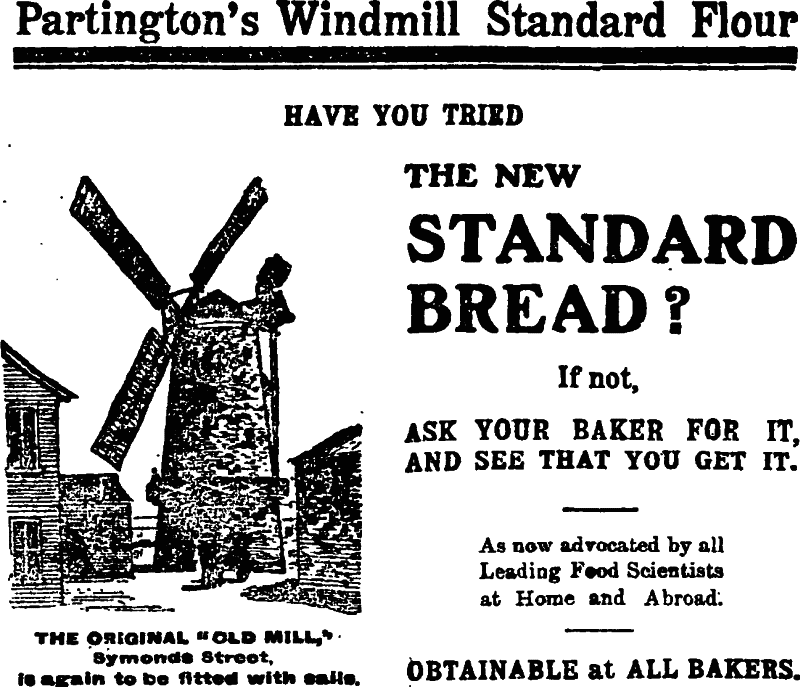
Originally built by Charles Partington in 1851 (supposedly from hand made bricks formed on site), the business soon expanded to include a Steam Biscuit factory (which also included additional milling facilities).
After Charles Partington died the mill jointly passed to a number of his sons, but eventually Joseph Partington ran it alone. His hold on the mill was not continuous, due to a number of financial and legal setbacks (including a celebrated libel case which bankrupted him for the second time) but eventually he regained ownership of the mill.
It went out of use for a time, and was converted to an observation tower.
However later in 1915 it was increased in height, and reinstated as a working mill using the machinery from Orston, Nottinghamshire leading to an unusual appearance of a conical tower, with a cylindrical extension. The mill in its second form continued to work commercially (with the help of electricity), surviving both broken sails, and fire damage, till 1941.
Along the way, the site was earmarked for a new city fire station, but Joseph Partington was violently opposed to that, and organized a public petition to save the mill. He also revealed that his will left the mill to the citizens of Auckland, to safeguard the mill as the basis of a public park. However when he died, the will, (and a subsequent similar one) whose contents were not disputed, was unable to be found, and a long drawn out court case supposed that he had deliberately destroyed the wills to invalidate them. Thus rather than passing to the people, the mill was passed to his next of kin. They sold on the valuable property, and the new owners wanted the mill off of their land. Despite drawn out attempts to find a way to relocate the mill to another location, in the end the enormous costs of so doing, especially at the end of WW2 mean that all proposals were abandoned, and it was demolished in 1950. This was however greatly regretted, and helped jump start the heritage preservation movement in New Zealand.
The tower was brick, and the machinery included 2 pairs of French Burr stones 4ft and 4ft 2ins diameter; Dressing Machine, Smut Machine, Sack Tackle, Elevators, Spur Gearing, Pinions, Bevel Wheels, Belts.
The site is now occupied by an hotel, and although a commemorative plaque was originally included, subsequent renovations of the hotel have gradually expunged all reference to the former mill.
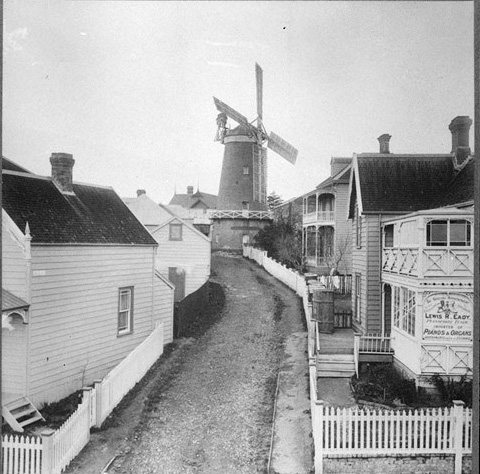
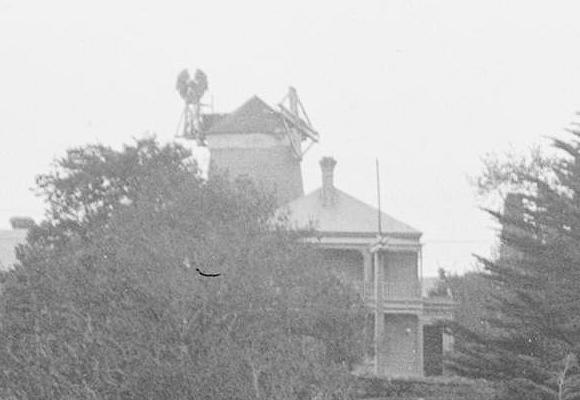
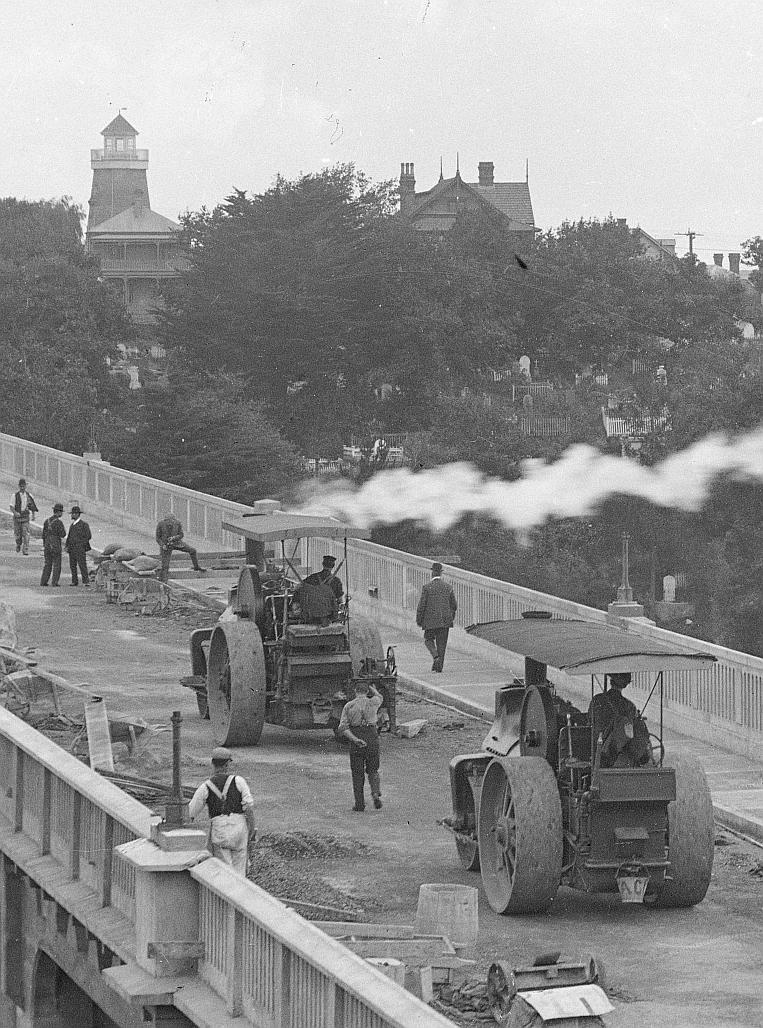
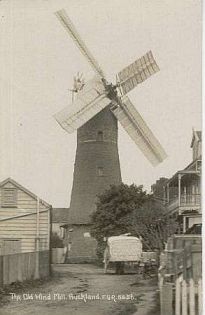
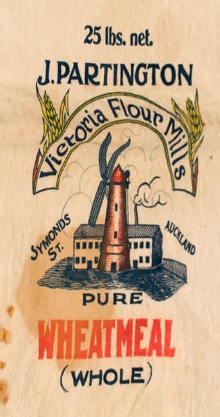
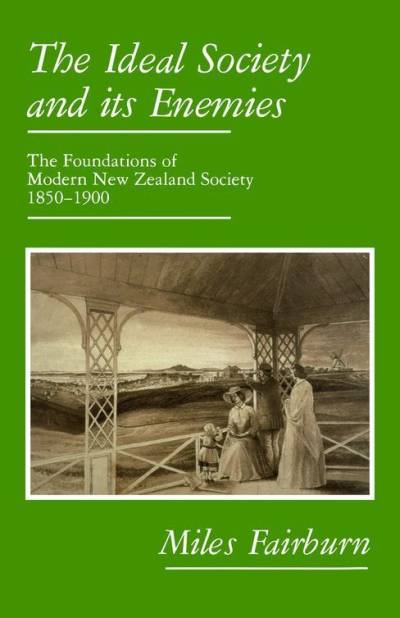
Although this page is principally about Partington's windmill, the windmill was part of a wider milling establishment including the Victoria Flour Mills, Steam Biscuit Factory, and so information on all the bits can be found here (and indeed it is often difficult to work out from some reports what part of the establishment is being described.) The windmill was also run for many years by two colourful men - first Charles Partington, and then his son Joseph Partington, and thus the information presented includes information on the men themselves, even if it is not directly about the windmill.
Sale of Crown Lands. - On Friday, the Colonial Treasurer, Mr. Shepherd, in fulfilment of a long standing advertisement, attempted to effect a clearance of sundry waste lots, the property of the Crown. ... his lots hung heavy ... Nos. 8 and 9, however, paid their upset shot of £100 per lot. The area was half an acre each. They were taken by Mr. C. Partington; and, if we are correctly informed, with the intention of erecting a Wind-mill thereon. If so, we wish it more success than that which has attended that sleepy affair, "the Dangar Steam Mill."
NEW WIND MILL.An early set of detailed prices can be seen in this ad from Daily Southern Cross, Issue 461, 28 Nov 1851:
ON SALE, FIRST QUALITY FLOUR, Seconds Ditto, Sharps, Pollard, Bran, Wholesale and Retail. Chas. F. Partington.
NEW BRICK WINDMILL.Right from the start, there was a sense of civic pride that the town had such a fine windmill New Zealander, Volume 7, Issue 596, 31 December 1851
On Sale by the Undersigned.
FINE FLOUR, at 18s. per 100 lbs.
Seconds ditto, 15s. " "
Sharps, ... 9s. " "
Wheaten Meal, 16s. " "
Maize Meal, ... 8s. " "
Crushed Maize, ... 3s. per bushel.
Bran, ... 10d. " "
Charles F. Partington.
Nov. 26th, 1851.
The facilities for grinding corn have greatly increased, there being in addition to two watermills, a second and large windmill, and a complete steam flour mill; besides several mills which the Maories in the interior have, by a course of self-denial, industry, and economy which speaks volumes for their improved and improvable character, purchased for themselves. From these and other causes, there is an unprecedented extent of land under wheat this season, and there is every probability that the produce will be abundantly sufficient for home demands, if indeed there should not be a surplus for exportation to those colonies on which we have been hitherto dependent for a portion of our supply.The windmill was an instant landmark: New Zealander, Volume 8, Issue 634, 12 May 1852
AUCKLAND AND ITS NEIGHBOURHOOD
Seen from the Harbour, the Town makes a considerable appearance, and suggests the idea of expansiveness. St. Paul's Church, with its neat spire, occupying a prominent position on the centre headland is an ornamental feature. The Barracks, the Scotch Church, the Colonial Hospital, the Wesleyan Institution, the Roman Catholic Church, and the Windmill on the hill, with Mount Eden in the back ground are the most prominent objects.
SUPREME COURT.— Civil Side. Monday, June 7, 1852. Coolahan v. Low and Motion.
...
Charles Oakford, sworn — Is a miller, and works for Mr. Partington, at the windmill; about two-and-a-half years ago he was employed at Low and Motion's mill, where he wrought about five months.
John Bycroft, examined by Mr. Hartley, is a miller at Epsom. ... He knew Oakford. ... His present mill is a wind-mill; does not know whether there would be a difference in produce from a watermill and wind-mill power.
WANTED, a practical MILLER that understands working a Windmill. Liberal wages will be given.
Apply at the New Windmill.
Auckland, Nov. 16th, 1852.
FLOUR! FLOUR!! FLOUR!!!Daily Southern Cross, Volume X, Issue 653, 4 October 1853
New Wind Mill.
On Sale by the Undersigned,
FINE FLOUR, equal to any imported 28s. per 100 lb.
Sharps 12s. " do.
Bran 9d. per bushel.
Chas. F. Partington. Dec. 14th, 1852.
AUCKLAND MARKETS.
Wheat and Flour. — Messrs. Low and Motion's. Prices :— Fine flour, £22; seconds, £18, per 2000 lbs.; wheat, 7s. to 7. 6d., per bushel; bran, 1s. 3d. per bush. Mr. Fletcher's Steam Mill. Fine flour, £22; seconds, £20, per ton; bran, 1s. 6d. per bushel. Mr. Partington's Mill. Fine flour, £22; seconds £20, per ton; pollard, 1s. 8. per bushel; bran, 1s. 3d. per bushel.
The flour market is firm, prices remain steady, about 2000 bushels of wheat have been delivered at the mills, during the week, the price for which has been from 7s. to 8s, per bushel, according to quality.
TENDERS will be received, until noon of Friday, 25th instant, for the erection of TWO LARGE FURNACE OVENS.
For further particulars, apply to C. F. Partington. Wind Mill, Symonds-street. November 15, 1853.
Daily Southern Cross, Volume XII, Issue 794, 6 February 1855
Flour, Flour!
THE undersigned has now on sale Fine Flour at 28s, per 100lbs., seconds at 26s. per 100lbs., sharps, 14s. per 100lbs., bran, 2s. per bushel.
Charles F. Partington. Wind-mill, Symonds-street, Feb. 6, 1855.
WINDMILLHowever his tenure as miller was short lived, and when he suffered from ill health, the lease was cancelled: New Zealander, Volume XIV, Issue 1304, 16 October 1858
F. W. FLETCHER begs to inform the Public that he has leased the Windmill in Symond-street, belonging to Mr. C. F. Partington, and that it is his intention to grind Wheat on hire, on the most reasonable terms. He assures all those who may employ him that strict attention will be paid to the producing a superior article.
Auckland, June 7, 1858.
NOTICE
VICTORIA FLOUR MILLS
In consequence of the ill health of Mr. F. W. Fletcher, Chas. F. PARTINGTON begs to inform the Public that the Lease of the Windmill has this day been cancelled (Oct. 16th, 1858).
In resuming possession of the Mill, C. F. P. takes this opportunity of returning thanks for past favours, and hopes by strict attention to business, and the manufacture of a good article, to retain the support of his friends and the public generally.
C. F. P. is a purchaser of Wheat in any quantities.
Wheat ground at the usual rates
VICTORIA FLOUR MILLS & STEAM BISCUIT MANUFACTORY, SYMONDS-STREET, AUCKLAND.
C. F. Partington's Prices Current.
October 16, 1858.
WHOLESALE. RETAIL. Fine Flour, per ton, £19 Fine Flour, l00lbs, £1 Seconds, ditto, £14 Seconds ditto, 16s. Sharps, ditto, £9 Sharps ditto. 10s Bran, per bushel, 1s. 3d. Bran, per bushel, 1s. 6d. Cabin Biscuit, ton, £23 Cabin Biscuit 100lb 25s Pilot ditto ditto, £21 Pilot ditto ditto, 23s Ship ditto ditto, £19 Ship ditto ditto, 21s.
CHEAP BREAD, CHEAP BREAD.Partington later advertised for a baker: New Zealander, Volume XV, Issue 1371, 8 June 1859
CHARLES F. PARTINGTON, in returning thanks for past favours, begs to inform his Friends and the Public that he has now commenced the
BREAD BAKING BUSINESS,
wherein, by strict attention and by furnishing a good article at the very lowest price, he hopes to receive a share of public support.
The Prices will be as follows :— FOR CASH,
Best Bread per 2-lb. loaf - 4 1/2d. " Flour per 100 lb. - - 20s.
Seconds Flour " - - - 14s.
Sharps " - - - 7s.
Bran per bushel - - - - 1s. 3d.
Cabin Biscuit per lb. - - - 3d.
Wine Biscuit " ... 8d.
Flour per 100 lb., delivered to any part of the Town 20s.
Victoria Flour Mill Store, at the foot of Wakefield-street, oppposite Mr. Marriott, Butcher.
N.B. Parties taking one dozen — 13 loaves.
April 29, 1859.
WANTED,7 months later a similar ad reappeared, but with "journeyman" adjusted to "competent": New Zealander, Volume XVI, Issue 1436, 21 January 1860
A JOURNEYMAN BAKER. None need apply but a thorough good workman. Apply at the Windmill.
Chas. F. Partington.
June 7, 1859
WANTED — A Baker competent to take charge of a Bakery; none need apply but a first rate hand.
CHAS. F. PARTINGTON, Wind Mill January 20, 1860.
Ads for the mill and bakery product were direct and to the point: New Zealander, Volume XV, Issue 1412, 29 October 1859
FLOUR! FLOUR! FLOUR!
BREAD! BREAD! BREAD!
THE Undersigned is now selling Fine Flour, 23s. per 100lbs., seconds ditto, 20s.; Bread, 5d. the 1lb. loaf.
C. F. PARTINGTON, Wakefield-street. October 28th, 1859.
TENDERS will be received by the undersigned until noon on FRIDAY, 11th inst., for the erection of a Cottage in Symonds-street.
Plans and Specifications can be seen at the Wind Mill.
CHAS. F. PARTINGTON, Symonds-street.
Not bound to accept the lowest or any Tender.
Notice.
I, The undersigned, will not be answerable for any debts my wife may contract from this date.
CHAS. F. PARTINGTON. Windmill, August 28, 1860.
Auction of Furniture, Piano Forte, Carts, Horse, Wheat, Flour, &c.Another short notice again suggested he may be trying to tidy up his cash position: Daily Southern Cross, Volume XVII, Issue 1339, 9 October 1860
CONNELL & RIDINGS
Are instructed by Mr. Charles Partington, to sell by auction, at his Residence next the Windmill, on TUESDAY next, 2nd October, at 11 o'clock,A ROSEWOOD PIANOFORTE, by Stoddart
A Walnut Book-case, Pictures
Sofa, Tables, Chairs
A Family Spring Cart and Harness Spring Cart
A Capital Draught Horse
Scales and Weights
A Winnowing Machine
2 Pair Springs
A Lathe
A Lot of Firewood and Timber
Iron Patterns and Sundries
Also,—
300 Bushels Wheat, more or less
A Quantity of Flour
&c, &c, &c.
Terms Cash.
NOTICE. ALL Debts due to me, must be paid to me. C. F. PARTINGTON.A further month later, he announced he was ready to retire: New Zealander, Volume XVI, Issue 1522, 17 November 1860
NOTICE TO MILLERS, BAKERS, AND CAPITALISTS.
C. F. PARTINGTON begs to intimate that, being about to retire from business, he offers to Let on Lease, for a term to be agreed upon, together or separately, the WINDMILL, also the STEAM MILL and BISCUIT BAKERY, all in complete working order.
Also for Sale or Lease, The DWELLING-HOUSE adjoining the Windmill, and at present occupied by C. F. P., containing 7 rooms, with outhouses and every convenience; Garden and Orchard in full bearing, &c.
Also The HOUSE and ALLOTMENT (66 feet by 32 feet frontage) in Symonds-street, adjoining the Wesleyan College Grounds, at present occupied by Capt. Campbell, and containing 7 rooms; a good well, &c.
Also 4 BUILDING ALLOTMENTS adjoining: the situation is most advantageous and commands a complete and extensive bird's-eye view of the Harbour and City of Auckland, &c.
Panoramic Photograph of Auckland. - In our notice of the various articles exhibited at the Odd Fellows' Hall, we made incidental mention of Mr. Crombie's panoramic view of Auckland. This picture which is upwards of five feet in length, is taken from the tower of the Windmill, near the residences of Lt.-General Cameron, C.B., and Mr. Williamson, the Superintendent of the Province. From such a site, the panorama is as extensive as it is beautiful, embracing the leading features of our own embryo City - the waters of the Waitemata, the wharf with its clustered shipping, the anchorage with the guardian men-of-war, the Military Barracks, Government House, the House of Assembly, and the numerous marts, storehouses, and private dwellings, constituting a throng of lively and life-like accessories to a landscape of the finest order. Contrasting Mr. Crombie's work with a view taken about 1841, and with those of Mr. Hogan which followed some ten years subsequently, we can with difficulty discover the elementary parts of the present picture. Great are the changes that have since taken place; the tee-tree and fern, then everywhere obstructive, have disappeared, and handsome villas with beautiful gardens, well ordered lawns, rows of streets, and, in the distance, well grassed paddocks, attract the eye. There are few young cities which present a finer subject for the pencil of an artist than Auckland; but it is not at one or half a dozen points that the picture can be made complete. It is to be hoped that Mr. Crombie will go on with the work so well begun; in the meantime, we beg to render him our meed of praise for his present agreeable contribution, which is truly patriotic, being gratuitous and executed at considerable labour and expense, whilst, as we are told, fifteen guineas were offered to artists producing like photographs of Nelson.
Serious Accident. - On Friday evening last, an accident occurred near the Artillery stables, Auckland, which might have been attended with fatal consequences. It appears that the horses in the Drury omnibus took fright at the Windmill, and when opposite the Artillery stables, Lieut. White, of the 65th, was either pitched off the box-seat or leaped off to save himself, and fell heavily on the ground, knocking his teeth through his tongue, and sustaining concussion of the brain. He is recovering. The horses were finally pulled up at the Grafton-road. Other persons were more or less hurt. The driver stated, as the cause of the occurrence that a rein broke; but we can speak from personal knowledge, of his reckless and unskilful driving coming into Otahuhu on the same evening, when it was positively unsafe for any other party to be either riding or driving on the highway. We hope the proprietors of public conveyances will, for the future, only employ skilled and careful drivers, for they must recollect that heavy damages are recoverable.The windmill was seen as a possible place of refuge to head for if fire were to break out in the town: New Zealander, Volume XIX, Issue 1915, 9 July 1863, Page 3
Mustering Points for the Rifle Volunteers and places of Refuge. - ... There is one point, as yet, unsettled, - namely the places of rendezvous for women and children in the event of a night alarm, and this is a point which demands immediate attention. The Britomart and Albert Barracks, the Scotch Church, the Wesleyan Church and the Roman Catholic Schoolroom at the junction of Pitt and Hobson-streets, the Roman Catholic Church, Messrs. Thornton, Smith, and Firth's mill, the windmill in Symonds-street, are or might all be places of rendezvous for the armed forces and are all substantial places of safety for women and children. There is too another important point, the securing the alarm bells from being tampered with—and for this purpose, we would recommend that a guard be placed on each alarm bell. The firing of there or more signal guns from the barracks would have a double effect if accompanied with the continuous ringing of the fire bells: We throw out these remarks because we feel that after the confusion which all witnessed who were in the streets on the occasion of the last large fire in Queen-street. A night alarm will not take place without the accompaniment of fires. Let no one therefore be deceived; let there be rallying points for the women and children as well as for the armed men, and if we can ensure freedom from confusion in any emergency which might, we say might arise, much of the worst would be averted.Ironically, the mill inadvertently came under (gun) fire: New Zealander, Volume XIX, Issue 1946, 14 August 1863, Page 3
To the Editor of the New-Zealander.
Sir, — Whilst walking down Symonds street last evening, about half-past six o'clock, the report of a rifle was heard in the direction, as near as I could judge, of Mechanics' Bay, and about two or three seconds afterwards the palings in front of the Windmill enclosure about four yards in front of me, were sharply struck by some missile, which, I have no doubt, was the expended ball from the shot. Last Saturday afternoon my ears were also regaled by the firing of a ball, passing over my head, from a shot in the gully on the far side of the right hand cemetery. As it is probable our surgeons may get as much practice as they may wish for by-and-by, I do not think it advisable that they should be held quite so liable to have to probe bullet holes, as they undoubtedly are, by the reckless way rifles are now continually being discharged from all parts of the town. It is, doubtless, necessary that these weapons should be ventilated occasionally, but I would suggest to our gallant young militiamen the desirability of firing them into an embankment as much safer than pointing them in the air, as the ball must certainly fall somewhere, and an ounce of lead from a height of three to four hundred yards would not be very pleasant on a lady's bonnet, saying nothing of the chance of its retaining a little of the impetus given to it by the powder. Yours, &c, J. C.
Symonds-street, 13th August, 1863.
By this time Partington had the biscuit bakery going, but a long article about that started by talking about the windmill: New Zealand Herald, Volume I, Issue 115, 26 March 1864, Page 4
OUR MANUFACTORIES.There was a followup article about the factory New Zealand Herald, Volume I, Issue 213, 19 July 1864, Page 3
Mr. Partington's Biscuit Manufactory.
For years past the windmill at the head of Queen-street has been a familiar object to the citizens of Auckland - a well-known land-mark eagerly looked for from the deck of many a coasting craft nearing the North Head, at a time when Shortland Crescent and West Queen-street were Auckland, and the place where the mill now stands was a distant suburb, a waste of ti-tree scrub. Then, however, Auckland grew wheat to grind, - steam machinery was unknown in the province - and the mill was a scene of bustle and activity.
Since the commencement of the war, from which time the supply of Auckland-grown wheat has ceased, we have not seen the old sails in motion, and we had almost thought that it had become a very "Castle of indolence" — that it must have been converted into an emigration barracks or a blockhouse - and it was only the other day, on passing the entrance to the premises, that we saw unmistakable signs of activity which showed there was a large business of some kind being carried on there. On enquiry we found that Mr. C. F. Partington is carrying on the largest biscuit-baking establishment in Auckland, upon the premises, and the machinery then at work, and appliances provided, showed at once the extent of the business.
MR. C. F. PARTINGTON'S STEAM BISCUIT FACTORY.In a late number we published some account of the steam biscuit factory of Mr. C. F. Partington — where the newest and best machinery has been introduced, and where, by the saving of labour, so caused, as good, and at the same time, a cheaper article can be furnished to the public.
With the machinery erected in his premises at the old wind mill, at the top of Wakefield-street, Mr. Partington can, with the labour of three men, turn out something like thirty tons of biscuit per day. In consequence of the scarcity of wheat to grind and flour to use, the works at the factory were for a time stopped, but now that there are large stocks of flour in Auckland, and that the price has been considerably reduced, we perceive that Mr. Partington has again fully entered into business, and is prepared to execute orders to any amount. We also notice that prices are considerably reduced, the best navy biscuit being advertised as low as 22s. per 1001b. The decrease of price of breadstuffs has been a great boon to the people of Auckland generally, and this fall in the price of biscuit will enable the Commissariat to effect a saving of more than three hundred pounds per week, on the terms of the present contract —no small item even to the Imperial Treasury. The consumption of biscuit by the army has been, very large, amounting at times, we believe, to no less than from thirty to forty tons per week.
Mr. Partington, we see, is prepared to supply all kinds of fancy biscuits, which are packed at once, upon the premises, into sound new boxes, fit for transmission to any part of the world. They are cut in a variety of shapes and forms, a complete set of dies having been procured at a very great cost by the proprietor. The process of biscuit making by machinery, from the first mixing of the flour to the removal of the biscuit at the back of the oven, is an interesting one, and Mr. Partington, we see by his advertisements, invites the curious to pay a visit to the factory in Symonds-street.
NOTICE.
I WILL NOT BE RESPONSIBLE for any DEBTS my Wife may contract - she having left her home without any provocation.
CHARLES F. PARTINGTON. April 19, 1865.
A narrow escape from fire was made on Friday night, at Mr. Partington's mill, Karangahape Road. About midnight, as constable Hoare was passing along the road, he observed a glare in one of the windows, and on looking through he saw a large heap of biscuits burning on the floor of the bakehouse, close to the oven. The constable at once aroused Mr. Partington and two of his men, who live on the premises, and by the exertions of the party the flames, which bad reached nearly to the roof of the building, were extinguished. The floor in front of the oven was bricked, but the fire had caught the boards adjoining, and burned them in three or four places. The building is not insured.New Zealand Herald, Volume IV, Issue 953, 3 December 1866
A Fire Prevented.—Constable Hoar, of the Newton Police, when on duty in the Karangahape road, about 12 o'clock on Friday night, observed a glaring light in a mill, the property of Mr. Charles Partington. On going on to the premises for the purpose of ascertaining the cause of such an unusual light, he perceived through the window a large heap of biscuits burning on the floor of the bakehouse adjoining the store. He aroused Mr. Partington and two men who live on the premises, and with their assistance succeeded in extinguishing the flames, which had by this time nearly reached the roof of the building. The floor in front of the oven was bricked, but the fire had communicated with the flooring boards, and had burned them through in several places. The building, we learn, was not insured.
THE QUEEN'S BIRTHDAY.
Yesterday was celebrated the fiftieth anniversary of Her Majesty's birthday, and Auckland enjoyed her usual holiday. The shops were all closed, and business of every description was suspended. The ships in the harbour were dressed with the usual amount of bunting, and almost every flagstaff in and about town, flaunted its rag. Everything was done that our loyal citizens could do in honor of the auspicious event, but it unfortunately happened that the "dark of the weather" would appear to have been holiday making also. The day was cold, the wind bleak, and the pelting pitiless showers did their best to spoil the pleasure anticipated by the sight-seers.
...
THE ILLUMINATIONS.
The weather was not so favourable to the success of the illuminations as on the occasion of his Royal Highness the Duke of Edinburgh's arrival, nevertheless a great number of the principal stores, public buildings and private homes were lighted up. ... One of the most successful illuminations was that of Mr. Partington's windmill, all the windows of which were lighted with lamps. The building had very much the appearance of a huge lighthouse.
Partington was in need of a housekeeper New Zealand Herald, Volume VIII, Issue 2293, 1 June 1871
WANTED - A Respectable Middle-aged Woman, as Housekeeper and General Servant.- Apply at the Windmill. - Charles F. Partington.
During the late heavy gale one of the sails of the windmill in Symonds-street was broken off, and blown over the mill into an adjoining garden. Beyond the destruction of the sail no damage was caused by the mishap.
For SALE (a Bargain), - The Machinery of a Flour Mill, complete, consisting of two pair of French Burr MillStones, 4ft and. 4ft 2ins diameter; Dressing Machine, Smut Machine, Sack Tackle, Elevators, Spur Gearing, Pinions, Bevel Wheels, Belts, &c, complete. Can be driven by wind, water or steam; would make a good country Grist Mill; sold cheap. Apply at Mr Partington's Steam Biscuit Depot, 30, Queen street.
In March 1873, Partington was hedging his bets, both advertising for a general servant, and still trying to sell the windmill property.
Auckland Star, Volume IV, Issue 985, 15 March 1873
WANTED, a respectable middle-aged Woman as General Servant; references required — Apply to C. F. Partington, Windmill. Symonds streetThis time the property was up for auction, and a preliminary announcement was made: New Zealand Herald, Volume X, Issue 2840, 6 March 1873, Page 4
MONDAY, MARCH 17.The sale was shifted to be a couple of days later, but the ad copy was otherwise unchanged, still promising more details in the future: New Zealand Herald, Volume X, Issue 2846, 13 March 1873, Page 4. Eventually an ad giving those details was published, and was commented on in the editorial: Auckland Star, Volume IV, Issue 985, 15 March 1873
PRELIMINARY NOTICE.
TO BE SOLD BY AUCTION.
SPLENDID FREEHOLD VILLA SITES, WIND-MILL PROPERTY, SYMONDS-STREET.
R. ARTHUR Has been favoured with instructions from Mr. C. F. Partington, to sell by auction, at his Mart, Queenstreet, on Monday, the 17th instant, at 12 o'clock noon, HIS MAGNIFICENT PROPERTY, situated around the Wind-mill, having a large frontage to which will become the principal entrance to the City, commanding a most extensive and varied view of the Harbour, City, and Country. Further Particulars in future advertisement.
We would draw attention to the announcement in our advertising columns of the sale of the windmill property by Mr R. Arthur. This estate is one of the finest in the city, and offers splendid sites for villa residences. The windmill tower, containing 100,000 bricks, is also to be disposed of by auction on Wednesday next.The particulars followed in the ads columns: Auckland Star, Volume IV, Issue 985, 15 March 1873
WEDNESDAY MARCH 19.The mill failed to sell: Auckland Star, Volume IV, Issue 988, 19 March 1873, Page 2
GOOD INVESTMENTS.
SPLENDID FREEHOLD VILLA SITES, WINDMILL PROPERTY, SYMONDS-STREET.
Also, WINDMILL TOWER, MACHINERY.
R. ARTHUR HAS been favoured with instructions from Mr C. F. Partington, to sell by auction, at his Mart, Queen-street, on Wednesday, the 19th inst., at 12 o'clock, noon,
A PORTION OF HIS PROPERTY, divided into Ten Allotments, fronting Symonds-street and Liverpool-street, commanding a most extensive and varied view of the Harbour, City, and Country.
Plans can be seen and all information obtained at the Mart, Queen-street.
Also, The WINDMILL TOWER, which contains about 100,000 Bricks; and the MACHINERY, consisting of 2 pair French Burr Millstones, together with all the necessary Machinery for working the same in good working condition.
To be sold either in one lot or separately.
The windmill property offered to-day by Mr R. Arthur, was withdrawn for higher prices than those offered at the sale.
The obituary notice for Captain Salmon carried in the New Zealand Herald incorrectly described him as having built the windmill. New Zealand Herald, Volume X, Issue 2859, 28 March 1873
DEATH OF CAPTAIN SALMON.Partington was quick to point out the mistake: Auckland Star, Volume IV, Issue 996, 28 March 1873
Our issue of to-day contains an announcement of the death of Captain John Salmon, aged 68 years, at his residence, Mossley Bank, Great South Road (near the Harp of Erin Hotel), on Wednesday last, the 27th instant. The deceased gentleman was one of the pioneer, settlers of the province. ... He established himself on the East Coast in connexion with the whaling trade, and ultimately commenced business in Auckland as a general merchant, in which he continued until within the last six or seven years, when he retired from business. ... He also built the windmill, at the top of Symonds-street, now about to be removed.
(To the Editor of the Evening Star.)
Sir, - Be so kind as to correct a blunder which appears in this morning's Herald. It is their stated, — in Captains Salmon's ibituary notice, — that when the Windmill was built, he was the builder. I cannot conceive how the writer found out his information, as Captain Salmon never owned a brick belonging to the Windmill. Do you not think Sir, that when a public journal tries to inform its readers it should endeavor to gain truthful statements, and not insert any flying report. — I am, &c, CHARLES F. PARTINGTON.
The mill's visibility led to a suggestion it could be turned into a time-ball tower: New Zealand Herald, Volume XI, Issue 4033, 15 October 1874, Page 2
A correspondent writes:-"Before deciding upon a site for a tower from which to display storm signals and erect a time-ball, would it not be advisable to consider the adaptability of the windmill tower in Karangahape road? This tower can be seen for miles around both from sea and land, and it is the opinion of many that a better position could not be found. Another advantage is that the tower, being now almost useless to its present owner, he would probably be willing to dispose of it for a moderate amount, and the expense of building a new structure would thus be avoided."
A couple of years later, the windmill property was being advertised again. Auckland Star, Volume VI, Issue 1560, 10 February 1875
FOR SALEA modified ad appeared a few weeks later: Auckland Star, Volume VI, Issue 1579, 4 March 1875
THE WIND-MILL PROPERTY.
The handsome residence of Mr C. F. Partington, containing 8 rooms, frontage to Symonds street, 58ft. by 120ft deep. The place is in perfect order, a first-class supply for water, tanks, &c. Price £650; also an allotment adjoining the above, 58 frontage, 120 ft. deep £650. Also 120 ft. by 80 deep, at 4 per cent. C F. PARTINGTON.
An extra sentence was inserted: Daily Southern Cross, Volume XXXI, Issue 5470, 5 March 1875, Page 1FOR SALE
THE WIND-MILL PROPERTY.
The handsome residence of Mr C. F. Partington, containing 8 rooms, frontage to Symonds-street, 58ft. by 120ft deep. The place is in perfect order, a first-class supply for water, tanks. &c. Price £650. Also 120 ft by 80 deep, at £4 per foot. Frontage to Symonds-street; also 6 allotments at back of Windmill with an entrance of 20ft to Liverpool-street, including the Windmill Tower at £2 per foot. C F PartingtonFOR SALE
Two pair of French Burr Mill Stones, with the necessary machinery for a complete mill if required, to be sold cheap. C F Partington
Size of allotments, 50 x 80.Other variants of the ad also appeared: Auckland Star, Volume VI, Issue 1595, 23 March 1875
FOR SALE The residence of Mr Charles F. Partington. Frontage to Symonds-street, 58 feet by 120 feet deep; also 120 feet to Symonds-street by 80 feet; also, allotments at the rear of Windmill.
The windmill, and/or the house were regularly put up for sale, but failed to sell each time: Auckland Star, Volume VII, Issue 1871, 15 February 1876
MONDAY, FEBRUARY 21.and Auckland Star, Volume VII, Issue 1889, 7 March 1876
SYMONDS-STREET, BY WINDMILL, SUPERIOR FAMILY RESIDENCE.
R. ARTHUR HAS been favoured with instructions from Mr C. F. Partington, to sell by auction, at his Mart, Queen-street, on Monday next, 21st instant, at 12 o'clock noon, His Family Residence, together with the large Freehold Allotment on which it is erected, having a frontage to Symonds-street of fifty-five feet, by a depth of one hundred and twenty feet, which has a frontage to a private road. The House is roomy and convenient. The position of this Property healthy and commanding, and so convenient to the business part of the City, makes it a most desirable place for business men.
B. TONES.
E. A CARR
WEDNESDAY, MARCH 8.
FOR POSITIVE SALE.
SUPERIOR FAMILY RESIDENCE. SYMONDS-STREET, BY WINDMILL.
B. TONES & CO.
HAVE been instructed by Mr. C. F. Partington, to sell by auction, to-morrow (Wednesday), at 12 o'clock noon, His Family Residence, together with the large freehold allotment on which it, is erected, having a frontage to Symonds street of 55 feet, by a depth of 120 feet, which has a frontage to a private road. The house is roomy and convenient. The position of this property is healthy and commanding, and being so convenient to the business part of the city, makes it a most desirable locality for business men.
FRIDAY, At 2.30 p.m.A year later, a very similar ad makes it clear that a wind engine is really what is being described this time: Auckland Star, Volume VIII, Issue 2304, 24 July 1877, Page 3
TO BE SOLD BY AUCTION, A WINDMILL, nearly new, suitable for driving any kind of Machinery; on view at the Mart.
R. ARTHUR, auctioneer.
TO-MORROW, NOON. AT ARTHUR'S MART.
1 OSCILLATING STEAM ENGINE, one-horse power.
One Wind-Mill, suitable for driving Saws Pumping, &c.
TO BE SOLD BY AUCTION.
The windmill continued to be offered, and fail to sell Auckland Star, Volume VII, Issue 2122, 27 November 1876
The old wind-mill, which has been for many years one of the most conspicuous land marks in the city, will be offered to public competition by Messrs. B. Tonks and Co., on Wednesday next. The mill contains about 90,000 bricks, in good condition, which will have to be removed by the purchaser, unless he become also the buyer of the allotment on which the mill stands.Auckland Star, Volume VII, Issue 2123, 29 November 1876
COMMERCIAL
Messrs. B. Toncs & Co. offered the old windmill, in Symonds-street, for removal, with the allotment on which it stands. The bidding, however, was low, and the property was passed.
FOR SALE.Not all of that series of ads mentioned the mill's condition: Auckland Star, Volume VIII, Issue 2252, 25 May 1877, Page 3
The Windmill and Allotment on which it stands in Symonds-street. It is most substantially built, and could be easily restored to its former use.
H. PARTINGTON, Stitchbury's Buildings,
FOR SALE.-The Windmill, Symonds street, with the Allotment on which it stand.-H. Partington, Stitchbury's Buildings.The partnership concentrated on the steam flour mill side of the business, rather than the redundant windmill: Auckland Star, Volume VIII, Issue 2347, 27 September 1877
VICTORIA FLOUR MILLS, SYMONDS-STREET.In May 1878 the wording was updated to include Oatmeal (actually inserted between "Maize" and "meal", and thus incorrect): New Zealand Herald, Volume XV, Issue 5142, 10 May 1878. The wording was further updated over a year later to give more prominence to oats: Auckland Star, Volume X, Issue 2936, 11 September 1879
PARTINGTON BROS. Have Always on Hand — Flour, Sharps, Bran, Wheatmeal, Maizemeal, &c. Oats and Maize, crushed. Rice, Pepper, &c, ground.
VICTORIA FLOUR MILLS And Oatmeal Manufactory, Symonds-street, Auckland.
PARTINGTON BROS. Have For Sale: Flour, Fresh Oatmeal, Sharps, Wheatmeal, Bran, Maizemeal, &c. Oats, Maize, Barley, &c., crushed; Crisping done at Lowest Rates, Wholesale and Retail.
PARTNERSHIP NOTICE.The Brothers later moved out of the steam mills, which were then offered for sale: New Zealand Herald, Volume XVIII, Issue 6122, 1 July 1881
Mr Joseph Partington has this day withdrawn from the firm of Partington Bros., Millers. The business will in future be carried on by Messrs C. F. Partington and E. R. Partington, under the same name or style.
Dated this 1st day of December, 1880.
C. F. PARTINGTON.
E. R. PARTINGTON,
J. PARTINGTON.
WITH reference to the above, I will carry on business as Miller at the Windmill, Symonds-street.
Best Brands of Flour always on hand. Gristing. Crushing, &c., at lowest rates.
J. PARTINGTON
FOR SALE, Those Premises in Symonds-street lately occupied by Partington Bros., consisting of Large Allotment, with large Mill Buildings, Engine, Boiler, etc. suitable for crushing, gristing, or any manufactory Messrs. Partington Bros, having taken those Flour Mills recently occupied by Messrs. Low and Motion. Apply to H. PARTINGTON, House and Land Agent, Stichbury's Buildings, Queen-street.Joseph Partington however issued a clarification that he was still in business at the "wind and steam flour mills": Auckland Star, Volume XII, Issue 3408, 6 July 1881
Notice. In reference to the advertisement by H. Partington for the sale of premises in Symonds-street, lately occupied by Partington Bros, as Flour and Grist Mills, I beg to call attention to the fact that I am still carrying on business at the Wind and Steam Flour Mills, and have no intention of relinquishing the same. All orders entrusted to me will receive careful attention and quick despatch, at lowest rates. Joseph Partington. Wind and Steam Flour Mills, Symonds-street.Meanwhile the for sale notice continued to run, though it was amended to offer "for sale or lease". When a mare went missing in December, the Bros. still gave their address as being in Symonds Street: Auckland Star, Volume XII, Issue 3538, 8 December 1881
LOST, on the 7th instant, a Brown Mare, white forehead and white fore feet. - Any person bringing same to Partington Bros., Symonds-street will be rewarded.As well as wheat, Joseph was advertising for oats to process: New Zealand Herald, Volume XIX, Issue 6411, 5 June 1882
TO FARMERS.—J. Partington and Co., are Cash Buyers of Oaten Sheaves. Windmill, Symonds-street.When the Bros later went bankrupt, Joseph was forced to put out a notice to confirm that his business was unaffected: New Zealand Herald, Volume XXIV, Issue 8041, 31 August 1887
BANKRUPTCY.
Owing to a wrong impression that prevails, and to prevent further mistakes, I beg to state that the Bankruptcy of Messrs. Partington Bros., of the Western Springs Flour Mills, has no connection whatever with my business or property in Symonds-street, known as the Victoria Wind and Steam Flour Mills.
JOSEPH PARTINGTON. Victoria Wind and Steam Flour Mills, Symonds-street, Auckland.
The old windmill in Symonds-street went out on strike yesterday. It seems that the heavy wind resulted in one of the sails being blown off the mill. The well-known landmark looks peculiar minus one arm.
THE WINDMILL. I beg to inform my customers and the public that my Windmill is not for sale, nor has it been offered as a site for Truant School or Brigade Station, as has been erroneously stated. I am still carrying on business as usual, and have no intention of selling any part of my premises. J. PARTINGTON, VICTORIA FLOUR MILLS (WIND and STEAM) November 4, 1890.and again in 1892, he again issued a notice denying that the mill was being sold: Auckland Star, Volume XXIII, Issue 244, 12 October 1892
THE WINDMILL.This was a response to an auction notice which had appeared Auckland Star, Volume XXIII, Issue 253, 22 October 1892
With reference to an advertisement which appears in the papers re the above. I beg to inform my customers and the general public that Messrs Esam and Arthur (or anyone else) have no authority from me to sell any part of my premises or business. I have no intention whatever of relinquishing same, and all orders for Flour, Bran, Sharps, Wheatmeal, Maizemeal, and Grinding of any kind will receive my attention as usual.
J. PARTINGTON.
Victoria Wind and Steam Flour Mill, Symonds-street, Auckland.
B. J. ESAM, C. ARTHURThe purchaser at the auction was James Wilkinson: Auckland Star, Volume XXIII, Issue 263, 3 November 1892, Page 2
THURSDAY, 3rd NOVEMBER, At 11 o'Clock, THE WINDMILL, LIVERPOOL ST. By order of the Registrar of the Supreme Court.
ESAM AND ARTHUR Will sell by Auction on Thursday, the 3rd of November at 11 o'clock, at their Rooms, Queen-street, PARTS of Allotments 8a and 9a, Section 36. and of Lots 13 and 13a, subdivision of Allotments 11. Section 37, City of Auckland; also the Machinery, Plant, etc. Further particulars on application to the Auctioneers.
Messes Esam and Arthur report the sale by auction to-day of the Windmill, Upper Symonds-street, to Mr James Wilkinson, for £325.This clearly relates to J Partington's mounting debts, which led to his bankruptcy: Auckland Star, Volume XXIII, Issue 30, 20 December 1892
DECLARATIONS OF INSOLVENCYNew Zealand Herald, Volume XXIX, Issue 9067, 21 December 1892
Joseph Partington, miller of Auckland, bankrupt, made a sworn statement before the Official Assignee to-day, in which he said he had been working the windmill in Symonds street for the past ten years. He had been at great disadvantage in the business through having out-of-date machinery. His debts totalled £2,220 4s 3d, of which £2,079 13s 1d was in deficiency.
Joseph Partington. - A statement was also made by Joseph Partington, who stated that he had been working the windmill in Symonds street for the last ten years. He bought the freehold of the windmill property about five years ago, having previously acquired the freehold of the steammill premises adjoining. Both were subject to mortgages. Being in default with interest the steam mill was sold nine months ago and the other about six weeks ago. Neither realised the mortgage debts. He had not been paying his way for the last three years. He attributed his failure to depression in trade and heavy interest on the mortgages. He also suffered through insufficient capital to work the business, and was at great disadvantage having out-of-date machinery. Of the £2220 4s 3d which he owed £2079 12s 1d was the deficiency for principal and interest after the securities were sold, £134 12s for trade accounts and necessaries, and £6 for doctor's bill. The only asset he possessed was the household furniture, worth about £20. There was absolutely no prospect of his making an offer of any kind.
WANTED Known, that I manufacture and have for sale, the Pure Whole Wheatmeal — advocated by "the Bread and Food Reform League " — made from the finest wheat. Put up in all size bags. — J. Partington, The Windmill. Symond-street.A few weeks later, the announcement was expanded to list many more products, and associated health claims Auckland Star, Volume XXV, Issue 281, 24 November 1894
WANTED KNOWN - To Dietetics. Food Reformers, and others.--.J PARTINGTON, Victoria Flour and Meal Mill (Windmill). :Symonds and Liverpool streets, Auckland, manufactures and has for for sale the following Pure, Natural Cereal Foods, advocated by the Bread and Food Reform League :— The pure whole wheat meal made from the finest wheat, fine or coarse ground to suit customer's; Indian Maize Corn Meal, made from selected maize, properly kiln-dried. Pearled Wheat, a new food introduced by me. Being more nourishing, can with advantage be substituted for rice. Pearl Barley : Having fitted up improved machinery, am enabled to make a first-class article retaining the nutriment. Rye Meal and Rye Flour: A nice flavoured meal and laxative. Barley Meal, Oatmeal, Lentil Peas, and other meals. All most nutritious and wholesome articles of diet. Wholesale and retail, put up in neat 6, 12, 25, 50, 56, 100 bags; and. sacks 200 each. N.B.— The steady and increasing demand for these productions of my mill have proved their importance and superiority as genuine health-giving foods.The paid announcement was also augmented by some very similarly worded editorial (the tradition of busy or lazy journalists recycling press releases has a long history!) Auckland Star, Volume XXV, Issue 285, 29 November 1894
In connection with the cause of food reform, and the advocacy of a vegetarian diet, an announcement by Mr J Partington of the Victoria Flour and Meal Mill which appears elsewhere, should be of interest to those who urge and practise suggestions of food reformers. Mr Partington whose windmill in Liverpool-street, near the top of Symonds-street, is one of the old landmarks of Auckland, manufactures and has for sale the pure, natural cereal foods, advocated by the Bread and Food Reform League. Amongst his specialities in these health-giving foods are pure whole wheat meal, Indian maize meal, pearled wheat, pearl barley, rye meal and rye flour, barley meal, oatmeal, lentil peas, and other meals, all of which are most nutritious and wholesome articles of diet.The announcement wording was tweaked again, to pick up what appears to be a choice phrase from the editorial (so the exchange of words is two way!), in late December 1894
WANTED KNOWN.-J Partington, The Windmill, manufactures and has for sale (fresh ground) the following pure, natural cereal foods, advocated by the Bread and Food Reform League :-Pure Whole Wheatmeal, made from the finest wheat, fine or coarse ground; Golden Indian Maize Corn Meal. Rye Meal and Rye Flour. Oatmeal. Barley, Peas, Lentil and other Meals. Also, Pearl Barley, Pearled Wheat, etc. All most wholesale and nutritious articles of diet. Wholesale and retail. Put up in neat 6, 12, 25, 50, 56, 100 bags, and sacks 200 each. N.B. — The steady and increasing, demand for these productions of my mills has proved their importance and superiority as health-giving foods.and then ran in that modified form for many months of 1895.
A follow on advert again emphasised the variety of cereal foods available: New Zealand Herald, Volume XXXII, Issue 9888, 2 August 1895
THE Greatest Variety of CEREAL FOODS in the Colony, including: Rolled Oats, Rolled Wheat, "Wheatina", "Princess Meal", Pure Whole Wheatmeal, etc., etc. Manufactured for Sale by J. PARTINGTON, "The Windmill," SYMONDS-STREET, AUCKLAND.
Put up in 2lb packets and bags from 6lb upwards. Delivered to all parts City and Suburbs. Retail as well as wholesale.
MAGISTRATE'S COURT.
THIS DAY.
DEFENDED CASES
A. T. St. George v. J Partington. — This was a claim for return of a photographic camera and outfit of the value of £20, or £20 and £5 damages for detention. - Dr. Laisbley appeared for plaintiff and Mr Parr for defendant. - Plaintiff is a photographer, and by leave of defendant had chosen the windmill in Symonds-street as a site to obtain views of the city. The weather not being favourable, plaintiff, had left his camera and outfit at the windmill for a period of two months, and was doing business on 'Change. Defendant refused to hand over the articles because of an amount in dispute over a mining transaction. - Defendant in his evidence, said that he had never absolutely refused to give up the camera. - Mr Northcroft giving jud[ge]ment said the Court was not to encourage litigation, but to do away with it. It appeared to him to be a question of feeling between the parties, and plaintiff had acted hastily. Defendant had no legal right to retain the camera. The only question for him to decide was that of costs, the defendant's solicitor at the outset having intimated that his client would return the camera. Mr Northcroft said he would allow the case to stand over until to-morrow to enable plaintiff to get his camera. Costs were refused.
In need of extra help, J Partington advertised for a "respectable" boy Auckland Star, Volume XXVII, Issue 278, 23 November 1896
WANTED, a respectable Boy. — Apply J. Partington, The WindmillAssisting in a mill is hard work, and perhaps that ad didn't bring in someone with the right skills. Anyway, a few months later a modified ad appeared, replacing a vital word: Auckland Star, Volume XXVIII, Issue 9, 12 January 1897
WANTED, a strong Boy. — Apply at the Windmill.
Jas. Wilkinson v. Jos. Partington.—
The statement of claim set forth that on or about the 18th November, 1892, the plaintiff leased to defendant, for a term of three years, from the 4th November, 1892, at a weekly rental of 11s, certain premises known as the Windmill, Symonds-street, and the machinery therein. By the said lease, the defendant covenanted that he would from time to time, and at all times during the said term, keep the said premises and buildings, and machinery and appliances, and would deliver up the premises and machinery in good repair and condition (fair wear and tear only excepted). Subsequently defendant held the premises and machinery at a weekly rental of 11s, subject to the observances of the same covenants and agreements as in the original deeds of lease. On or about the 16th day of August, 1897, the plaintiff served the defendant with notice to quit and deliver up possession on the 23rd day of August, which he had complied with by quitting, but had not delivered up possession of the same in good repair and condition, nor had he delivered up the whole of the machinery let to him, having removed the same prior to giving up possession. Plaintiff claims to recover from defendant (a) possession of the said machinery and articles so removed and detained as aforesaid or £25 in case possession cannot be had; (b) £5 damages for their detention; (c) the sum of £15 being the cost of replacing the several articles removed by the defendant from their respective places; and (d) the sum of 11s, rent to the 20th day of August, 1897. There was a counter claim by defendant for some £11 for certain articles connected with, on, and about the premises. Mr. Theo. Cooper, instructed by Messrs. McKechnie and Nicholson, appeared for plaintiff, and Mr. S. Hesketh (Hesketh and Richmond) was for the defence. Evidence was given by plaintiff, and Thomas Roberts, clerk in the office of the Official Assignee after which the case was adjourned to Thursday next.
Once again, in Dec 1897, an advertisement was placed in the paper by the windmill's freeholder J Wilkinson, trying to let the mill from under J Partington. Auckland Star, Volume XXVIII, Issue 282, 4 December 1897
TO MILLERS CHAFF-CUTTERS, Etc. - To Let on lease or otherwise, the Auckland Windmill, with Machinery complete, lately in occupation of Mr Partington. Rent low to good tenant — Apply J. Wilkinson, Upper Pitt-streetbut, whether by design or luck, that is immediately followed in the same paper with a rebuttal:
THE WINDMILL.
To prevent mistakes I inform my Customers and the Public my Business is proceeding as usual at my Steam, Flour and Meal Mills — : known as the Windmill — in Symonds-st. All orders for pure whole wheat-meal, maize-meal and other Meals, and Grinding and Crushing of any kinds of Grain, executed with despatch.
J. PARTINGTON.
As a foreshadow of what was about to occur, J Partington addressed a complaint to the City Council via the newspapers, about buildings that were being constructed near the windmill, including by James Wilkinson: New Zealand Herald, Volume XXXV, Issue 10683, 22 February 1898
COMPLAINT FOR THE CITY COUNCIL.James Wilkinson replied via the same newspaper: New Zealand Herald, Volume XXXV, Issue 10686, 25 February 1898
TO THE EDITOR. Sir,-I wish to call the attention of the public to a proposed nuisance in the shape of a stable, which is to be thrust on to a number of us ratepayers by T. Hope Lewis, surgeon, health officer of Auckland. It was intended that the stable should be built of wood, alongside of the windmill, and right in the midst of a block of houses. A petition was signed by eleven surrounding residents, objecting for several reasons. This went before the City Council, and their answer is to the effect that they cannot prevent the erection of the stable in brick. Now, its being built in wood was only one of the many objections from the petitioners. There would be the drainage, unpleasant odours, flies, kicking of horses, vermin, etc., all of which would constitute a nuisance, and make a stable an undesirable thing to be erected right at the very door of your dwelling, especially as there are three already in the neighbourhood. We ask, why should the petitioners, many of us who have lived here for nearly 40 years, and paid rates all that time be ignored, just to convenience Surgeon Lewis, who is only a newcomer in the neighbourhood, and who utterly regardless of the health of others, wishes to get rid of the stable from his own house, so that his surroundings may be pleasant and healthy.
In addition to having this nuisance thrust upon them, the petitioners, and the already overburdened ratepayers of the city, are now going to be asked to put their hands in their pockets, and at great expense and annual expenditure form, kerb and channel, lay down drain pipes, and take over this lane - commonly called stable alley - order to accommodate Mr. T. H. Lewis and Mr. James Wilkinson - two persons who, just recently, in defiance of the building regulations, each erected wooden buildings for themselves within the brick building area, and have their private property drained and improved at the public expense. The road in question has been private property for nearly 50 years, and it is absolutely unnecessary that the City Council should control it in any way. It is also only about 20 feet wide, and not one chain, as required to be by the Act for dedication. - We are, etc.,
J. Partington (Ratepayer) and Others.
THE ALLEGED GRIEVANCE IN SYMONDS-STREET.New Zealand Herald, Volume XXXV, Issue 10712, 28 March 1898
TO THE EDITOR
Sir, - I notice in this morning's paper a letter headed "Complaint for the City Council," signed by "J. Partington (ratepayer) and others," in which my name is mentioned. The writer of the letter is actuated in making the complaint, not from a desire to protect the ratepayers, but from feelings of violent personal hatred - first, of Dr. Lewis, and, secondly, of myself - of Dr. Lewis, because he purchased from me a small piece of land in the occupation of Mr. Partington, after first endeavouring to obtain a small piece from Mr. Partington himself without avail, and of myself because I required him to quit the windmill owned by me; and because I compelled him, through the medium of the S.M. Court, to return to the mill several articles and machinery belonging to me which he had removed therefrom, and because I still remain the landlord of the premises he now occupies. The stable he refers to is intended to be erected in brick in place of a wooden stable lately pulled down at the rear of Dr. Lewis' residence, and only a few yards distant from the old site. To class this proposed stable as a nuisance is only the emanation of a disordered mind. If any nuisance exists on the property it is one created by Mr. Partington himself. As to the petition to the Council, the ratepayers are not asked, at great expense and annual expenditure, to form, kerb, channel, and lay down drain pipes, etc., as Mr. Partington, in his fevered imagination, suggests. All that is asked is, that the residents are given a 3-inch water main and a 9-inch drain to connect with the main sewer; and when it is seen that the properties fronting Karangahape Road from Liverpool-street to the Caledonian corner have no drain to carry off their drainage, you will see the urgent necessity, in the interests of the health of the city, for some such drain as that petitioned for, and this petition has been signed by all of such residents and ratepayers.—l am, etc.
James Wilkinson.
Mr. Joseph Partington writes a long letter in reply to one by Mr. J. Wilkinson, published some time since. He says that Mr. Wilkinson asserted that he had obliged him, through the S.M. Court, to return certain machinery which had belonged to the windmill. On Mr. Partington leaving the mill a writ was issued, but a compromise was come to and certain comparatively valueless portions of machinery were returned. The matters in dispute between Mr. Partington and Mr. Wilkinson are of a private nature.
AN ADJOURNED CASE.A few days later the case was resumed: Auckland Star, Volume XXIX, Issue 140, 15 June 1898
The case of James Wilkinson v. Joseph Partington and George E. Bentley was adjourned till next Wednesday. Only one of the defendants (Partington) put in an appearance. The charge is that Joseph Partington, miller, and George E. Bentley, journalist, both of Auckland, did, on or about. May 12. at Auckland, unlawfully and maliciously write and publish a certain false, scandalous, and defamatory libel of and concerning James Wilkinson, such libel consisting of a pamphlet entitled, "The Story of the Old Windmill." On the application of Mr. Cotter, His Worship consented to issue a warrant for the apprehension of Bentley.
"THE STORY OF THE OLD MILL."New Zealand Herald, Volume XXXV, Issue 10781, 16 June 1898
AN ALLEGED LIBELLOUS PAMPHLET.
POLICE COURT PROCEEDINGSA case of alleged criminal libel came before Mr T. Hutchison, S.M., at the Police Court, this morning. Joseph Partington, miller, and George E. Bentley, journalist, were charged, on the information of James Wilkinson, that they did unlawfully and maliciously write and publish, and cause to be written and published, certain false, scandalous, and defamatory libel. The alleged libel was contained in a pamphlet called "The Story of the Old Mill," referring to the mill in Symonds-street.
Mr Cotter appeared for the prosecution, and Mr Reed for the defendant Partington, while Bentley conducted his own case.
Mr Cotter, in opening the case, said it seemed to him that the pamphlet absolutely teemed with disgraceful references to the prosecutor. In fact, he did not know if he had ever seen a publication where almost every page contained scandalous and defamatory matter. If the law were to allow it to be published with impunity there would be no protection for any person's character. Mr Cotter then read extracts from the pamphlet, of which he was told a thousand copies had been printed.
The defendant Bentley interrupted counsel for the prosecution on several occasions, "I can't stand lies like these," said he.
His Worship ordered Bentley to be placed in the dock, and the defendant was accordingly removed thither by two constables. "Sit down and be quiet," said the Magistrate, "and act like a sober man."
Bentley promised not to interrupt again if allowed to sit at the table.
"Well, I will give you another chance," said His Worship, "you are only allowed there by courtesy, and if you interrupt again you will go back into the dock."
The first witness called for the prosecution was Albert Spencer, who deposed that he was the printer of the pamphlet in question. Both Partington and Bentley called at his place, and the latter asked for a quotation for printing the pamphlet. Witness gave a price, and Partington told him to go on with the work. He accordingly printed the pamphlet. Bentley took away four hundred copies, the remaining six hundred were sent to Partington, The account (£7) was paid by Partington.
By Mr Reed : He understood from Bentley that the latter had written the pamphlet. All the proofs were sent to Bentley.
By Mr Bentley : Witness arranged with Partington about the terms of publication.
James Wilkinson, who was next called, said he lived at the Windmill, Symonds-street. He had acted as chapel-keeper of the Pitt-street Wesleyan Church for about 32 years, and was an engineer by trade. There were numerous statements in the pamphlet referring to him. The statement that he was "an avaricious and flinthearted landlord" was untrue.
His Worship said that it would not be necessary to go through the statements one by one. It was sufficient that the witness said he was the Wilkinson referred to in the pamphlet.
Mr Cotter (to witness): Are the statements contained in the pamphlet likely to bring you into public contempt?
His Worship asked was not that a question of law? He thought it was a question for a jury to decide.
Mr Cotter tendered two letters as evidence of the connection between Partington and Bentley in reference to the pamphlet. One of the letters was from Bentley and the other was signed, "Partington, per George E. Bentley." Both were written to the complainant.
The defendant Bentley, rising to cross-examine, said he wanted to show justification. "I want to show Mr Wilkinson," he said, "in his true light."
His Worship : Well, you are not going to do it here. (Laughter.) You cannot plead justification here, or that the pamphlet was written in the public interest. The only defence you can urge here is to show me that this pamphlet is not libellous, and that it was not composed or published by you. You are limited to those points in cross-examination.
Bently : I charge this man with leading a dual life and I can prove it. The statements made in the pamphlet are correct. Oliver Nicholson, solicitor, stated that he saw Bentley deliver a copy of the pamphlet to Mr Cotter's clerk. Bentley also left a copy in witness' office. The pamphlet was widely distributed.
For the defence Mr Reed argued that the action should have been a civil one, not criminal. He said the position laid down by judges in England was that it was necessary for a criminal action that there should be something likely to lead to a breach of the peace, and of such a nature as to affect the general public. Consequently in the present case, he submitted, the complainant could quite as well have vindicated his character by a civil action.
His Worship said he was of opinion that it was a matter for the Supreme Court to deal with.
In reference to the publication of the pamphlet, Mr Reed submitted that there was no evidence that his client, Partington, was the publisher of it.
His Worship, however, over-ruled the argument, and committed both defendants to take their trial at the Supreme Court.
Bail was allowed, Bentley in £100 and two sureties of £25, and Partington in £50, with one surety of £20.
A TALE WITH A SEQUELThat September, the case therefore came before the Supreme Court. Auckland Star, Volume XXIX, Issue 213, 9 September 1898
ACTION FOR LIBEL.
"THE STORY OF THE OLD WINDMILL"
DEFENDANTS COMMITTED.
A prosecution for alleged libel - somewhat of a rarity in Auckland - commenced in the Police Court yesterday, against Joseph Partington, a name well known in connection with the old windmill, off Symonds-street, and George Everard Bentley, a journalist, lately from the South Island, but now of Auckland.
Mr. Thomas Hutchison sat on the Bench. The charge was laid on the information of James Wilkinson, and alleged that the defendants "did unlawfully and maliciously write and publish, and cause to be written and published, a certain false, scandalous, and defamatory libel."
Mr. Cotter appeared for the complainant; Mr. Reed for the defendant, Partington; and Bentley conducted his own case.
The alleged libel was contained in a small octavo pamphlet, called "The Story of the Old Windmill," which dealt with the relations existing between Wilkinson and Partington, regarding the old windmill property.
In addressing the Court Mr. Cotter said it seemed to him that the pamphlet absolutely teemed with disgraceful references to the prosecutor. He did not know that he had ever seen such a publication, where almost every page contained scandalous and defamatory matter. If the law were to allow it to be published with impunity there would be no protection for anyone's character. Counsel then preceded to deal with extracts from the publication.
The defendant Bentley several times evinced a desire to say something, and after a while he wanted to know "why does not Mr. Cotter confine himself to the case?"
His Worship : Mr. Bentley, you will have to be excluded if you don't behave yourself.
Mr. Cotter, later on, had occasion to comment on one of the paragraphs he was dealing with.
Bentley : It's a lie! It's a lie!
His Worship : Put him in the dock (up till that time the defendant had been allowed to be seated at the table).
Bentley was then reluctantly assisted to the dock by two officers. He again made some remarks.
His Worship : Is this man in his sober senses?
A policeman : I don't think so, your Worship.
Bentley pulled himself up, and said, "Perfectly sober."
His Worship : Well, act as a sober man.
Ultimately, he was allowed to resume his seat at the table, on promising not to interrupt again. He excused himself by saying, "I feel very strongly over this matter; I am not drunk."
The first witness, Albert Spencer, printer, of Lower Albert-street, said he printed the pamphlet produced. Both the defendants called at witness' place one day, and Bentley asked for a quotation for printing "The Story of the Old Windmill," which was then in manuscript. The price was given, and Mr. Partington told witness to go on with the job. The proofs were to go to Mr. Partington, but subsequently Mr. Bentley requested the proofs to be sent to him, and this was done. There were 1000 copies printed, Bentley took away 100, and the balance went to Partington. The latter paid witness' account of £7 for the pamphlets.
To Mr. Reed : Witness presumed the manuscript was in Bentley's handwriting. He understood from Bentley that he had written it. All the proofs were sent to Bentley.
To Mr. Bentley: The terms of publication were arranged with Mr. Partington, and the account was presented to him.
To Mr. Cotter: The pamphlet was printed about five weeks ago.
James Wilkinson, the informant, said he lived at the windmill, Symonds-street. He had been chapel-keeper at the Wesleyan Church, Pitt-street, for about 22 years. He was by trade an engineer. He was the James Wilkinson referred to in the pamphlet, "The Story of the Old Windmill." The statement that witness was "an avaricious and flinthearted landlord " was untrue.
His Worship said he did not think it was necessary to go through the statements one by one.
Witness said the statements contained in the pamphlet were likely to bring him into public contempt.
His Worship asked if that was not a matter for a jury?
Mr. Cotter put in two letters sent to his client, one from Bentley and one from "Partington, per George B. Bentley." The letters were intended, said counsel, to show the connection between the parties and the publication.
To Mr. Reed: Witness had not told anyone that the proceedings were not brought voluntarily, or that he had been compelled by his church to bring the proceedings to clear his character.
Bentley asked the witness on what terms he accepted Mr. Partington as tenant when he (witness) took over the old mill?
His Worship ruled the question to be irrelevant.
Bentley : I want to show Mr. Wilkinson up in his true light.
His Worship: Well, you are not going to do it here. (Laughter.)
Bentley: I am going to show justification. I want to put him through the mill, as far as the pamphlet is concerned.
His Worship: Well, the "mill" will have to be at the Supreme Court. (Laughter.)
His Worship went on to explain that he could not go into the question of justification in that Court. That would have to be a matter for a jury. His Worship only had to say whether the matter was libellous in his opinion.
Bentley: I charge this man with leading a dual life, and I can prove it.
His Worship: I rule that you cannot put questions on that point.
Oliver Nicholson, solicitor, said the pamphlets had been very widely distributed.
At the close of the complainant's case, Mr. Reed addressed the Court, and argued that the Court should, following the decisions of Lord Coleridge, in England, discriminate between criminal and civil proceedings for libel. He submitted that the present was not a subject for criminal proceedings. As the man could have justified his character by civil proceedings, counsel asked that the present information be dismissed. The Bench at Home drew a distinct line of demarcation between the two methods of proceeding.
His Worship said that was more a matter for argument in the Supreme Court.
Mr. Reed also submitted that there was not sufficient evidence against his client.
His Worship said he was of opinion that there was prima facie evidence that the pamphlet was libellous, and he must commit both defendants for trial at the next sittings of the Supreme Court.
Bail was allowed the defendant, Bentley in his own surety of £100, and two others of £25. Partington's bail was fixed at £70, himself in a bond of £50 and one other of £20.
THE OLD WINDMILLNew Zealand Herald, Volume XXXV, Issue 10854, 10 September 1898
INDICTMENT FOR ALLEGED LIBEL.
PROCEEDINGS AT THE SUPREME COURT.At the Supreme Court to-day an indictment for libel against Joseph Partington, arising out of a printed pamphlet of 24 pages, which contained 'The Story of the Old Windmill' came up for hearing before His Honor Mr Justice Conolly and a jury of twelve, of which Mr S. C Brown was chosen foreman.
Defendant was allowed to sit in the body of the Court.
Bentley, the alleged writer of the pamphlet, was allowed to be present, and occupied a seat in the dock.
Mr C. J. Parr appeared for the prosecutor (Jas. Wilkinson) and Mr J. R. Reed defended Partington.
The libel was alleged to be published on May 12, 1898. Wilkinson, the prosecutor, is well known as the caretaker of the Wesleyan Church and Wesley Hall, Pitt-street. He is the owner of the Windmill property and sold a portion of the ground to Dr. Lewis.
Mr Parr opened the case to the jury and quoted largely from the pamphlet. He said there were two points for the jury to consider, viz., 'Are the statements contained in the pamphlet libellous?' and 'Did the defendant publish them?
Albert Spencer, printer, of Albert-street, deposed that he printed the pamphlet. Partington came to witness' place on the 30th March, Bentley being with him. Bentley asked for a quotation for printing this pamphlet, 'The Story of the Old Windmill.' then in manuscript. The manuscript was produced by Mr Parr and identified by witness. Witness told them to call in an hour and a half, and at the expiration of that time Partington asked for and was given the price — £6 10/ for 1,000 copies. The defendant, Partington, replied, 'All right; go on with the printing. Proofs to be sent to my house.' The work was gone on with and during the progress Partington called and objected to the first page. Witness said he could have it printed over again, but nothing was done. Some of the pamphlets were delivered to Partington and some to Bentley at different dates. Witness sent the proofs to Bentley. Partington paid the account for the full 1,000 copies.
In answer to Mr Reed witness said Bentley wrote the manuscript. The first 400 copies of the pamphlet were taken by Bentley, who requested the other 600 copies to be sent to Partington. Partington told witness that Bentley took all the responsibility in publishing the pamphlet.
Jas. Wilkinson, engineer by trade; and chapel-keeper of the Pitt-street Wesleyan Church for 33 years, said he was the person referred to in the pamphlet, 'The Story of the Old Windmill.' Bentley was living at Partington's house a portion of this year.
At this stage Mr Reed proposed to show the relationship between Partington and Wilkinson, and that Wilkinson had published a letter in a newspaper referring to Partington.
Mr Parr objected.
His Honor pointed out it was not pleaded that the statements were true. He must disallow the question. Anything counsel might wish to plead in extenuation was for the judge and not the jury.
This was the case for the prosecution.
Mr Parr submitted to the jury there was clear evidence of publication on the part of Partington.
Mr Reed also addressed the jury for defendant.
His Honor in summing up the case to the jury said, a libel was to bring another person into hatred, contempt and ridicule, or to do him harm. He thought a more disgraceful or scurilous thing was never written. It was a weak point that there was no clear evidence of publication. There was no evidence that the pamphlet had been given away or sold. The pamphlet was a libel, and a scandalous one, but whether there was any publication in pamphlet form was for the jury to say.
The jury after close on one hour's deliberation returned to court and asked whether they were entitled to infer from the fact that, 600 copies of the pamphlet were delivered to Partington that he had distributed and so published one or more of these copies.
His Honor said that they were not entitled to infer that. His Honor further said that thinking the matter over out of Court it occurred to him he ought to have stopped the evidence in the case, and said there was no evidence of publication. The copies of the pamphlet taken by Bentley were the only evidence of publication. There was no proof brought of the pamphlet or book being delivered to anyone.
His Honor then informed the jury there was no evidence of publication of the pamphlet.
The Foreman of the Jury: Well, we return a verdict of not guilty. The defendant was then discharged.
THE CASE AGAINST BENTLEY.
At a quarter to three this afternoon George Everard Bentley was placed in the dock.
Mr Parr said he understood Bentley wished to withdraw his plea of not guilty.
Bentley was called upon and said he had no other alternative. He would plead guilty. He added that he distributed as Partington's agent 300 copies of the pamphlet and was paid for it.
Bentley said beyond writing the pamphlet he had no interest in it.
Mr Parr said the prosecution thought that Bentley had been sufficiently punished. He had already been three months in Mount Eden. The prosecution suggested that this might be considered as sufficient punishment already. Prosecutor did not ask His Honor to impose any further sentence.
His Honor, addressing Bentley, said he was foolish to act under the instructions of any man in publishing such a pamphlet. In His Honor's opinion, and counsel for the prosecution concurred, he had already suffered enough. Bentley would be ordered to enter into his recognisances of £25, to come up for sentence when called upon.
A STORY WITH A SEQUEL.Despite being found not-guilty by the jury in the criminal case, the action continued as a civil case 3 months later. Auckland Star, Volume XXIX, Issue 291, 9 December 1898
CHARGE OF CRIMINAL LIBEL.
A MILLER AND A JOURNALIST DEFENDANTS.
UNCOMMON CASE.
His Honor Mr. Justice Conolly had before him, at the Supreme Court yesterday, a case of very rare occurrence in this city. Joseph Partington, a miller, who at one time leased the old windmill in Upper Symonds-street, was placed on his trial for publishing an alleged criminal libel. The person alleged to have been libelled was James Wilkinson, chapelkeeper at the Pitt-street Wesleyan Church, and owner of the old mill, and the statements complained of were contained in a 24-page pamphlet, called "The Story of the Old Windmill."
The case was tried with a jury of 12; Mr. S. C. Brown foreman.
Mr. C. J. Parr, instructed by Messrs. Mackechnie and Nicholson, prosecuted, and Mr. J. E. Reed appeared for the defence. Partington had previously pleaded "not guilty."
George E. Bentley, who was awaiting trial on a similar indictment, was allowed to be seated in Court during the hearing.
Mr. Parr, in opening the case to the jury, read a number of extracts from the publication, which showed that there was a difference of opinion between Partington and the prosecutor over the lease of the old mill. Counsel pointed out that there were two points for the jury to consider: "Are the statements contained in the pamphlet libellous?" and "did the defendant publish them?"
Albert Spencer, printer, deposed that he printed the pamphlet in question. On March 30 last the accused, Partington and Bentley, went to witness' office, and the latter of the two asked for a quotation for printing the "Story of the Old Windmill," then in manuscript. He told them to call in an hour and a-half, and at the expiration of that time, Partington asked for and was given the price - £6 10s for 1000 copies. The accused replied "All right, go on with the printing. Proofs to be sent to my house." The work was gone on with, and during its progress Partington called, and objected to the first page of introductory remarks, as he thought it might make him liable. Witness replied that the page was already printed, but offered to reprint it, or make a footnote. Receiving no further instructions, the page was left as it was. Bentley took away 400 copies, and the balance was sent to Partington, who also paid witness' account.
To Mr. Reed: The proofs did not go to Partington, but to Bentley. The balance of the pamphlets was sent to Partington at the instruction of Bentley.
James Wilkinson, the prosecutor, stated he was an engineer by trade, and was also chapelkeeper at the Wesleyan Church, Pitt-street. He had held the latter post for 33 years. He was the J. Wilkinson referred to in the pamphlet. Witness knew the two accused. Bentley was living in Partington's house during a part of the present year.
Mr. Reed proposed to ask questions to show the relationship between prosecutor and Partington, and also to show that prosecutor had published letters in the public print referring to the accused.
Mr. Parr objected.
His Honor said he must disallow the questions. It was not pleaded that the statements in the pamphlet were true, and anything that counsel might wish to plead in extenuation would be for the judge, and not for the jury to hear.
Mr. Pair called a witness named Ede.
Mr. Reed objected to this witness giving evidence, and said that he had received notice of the intention of the prosecution to call him, and that his evidence would be that Partington had given him one of the pamphlets early in August. Mr. Reed argued that this was a date subsequent to the date of committal, and that as every delivery of the pamphlet was a distinct offence, it would be allowing evidence to be given of another offence to prove the charge. He admitted such evidence would be relevant if the question of animus was involved, on the authority of Regina v. Hall, Regina v. Mokin, and Regina v. Dean, but as in this case malice was presumed, no such evidence could be admitted.
Mr. Parr contended on the authority of Roscoe's criminal evidence that such evidence was admissible, and quoted several authorities.
His Honor held that the authorities quoted by Mr. Parr referred only to civil cases where malice was not presumed, and refused to admit the evidence.
No further witnesses were called.
Mr. Reed addressed the jury on Partington's behalf. He pointed out that if a person wished to vindicate his character he could take civil proceedings, when all the facts could be thoroughly gone into. By taking criminal proceedings, however, the accused's mouth was practically closed, because, even if he proved that the statements published were true, that was not sufficient. The law required proof that the statements were made for the "public benefit." He also contended that there was no proof of the publication of the book or pamphlet by Partington. He argued that every material averment in an indictment must be strictly proved, and that the averment in this case was that the libel was contained in a book or pamphlet. He admitted there was some evidence of the publication of the manuscript by Partington, but none of the book or pamphlet. If the jury were satisfied that there was no proof of the publication of the book or pamphlet they must acquit the accused.
In summing up His Honor pointed out that a libel must be that which tended to bring a man into hatred, contempt, or ridicule, or do him damage. He thought they could hardly glance through the publication without coming to the conclusion that it was intended to ridicule Wilkinson, or at all events, to do him damage. A more disgraceful or scurrilous thing never was witten. The only justification could be that it was true and that it was published for the public good. The prisoner had not pleaded that. The statements were not asserted to be true, and therefore must be taken to be false, and if false the law implied malice, with which prisoner was charged. That it was a libel on the face of it, appeared to His Honor beyond doubt. The jury had then to consider whether Partington did "write, print, and publish" the pamphlet, or cause it to be written, printed, and published. That was the charge. He thought it was a weak point in the prosecution that there was no proof that the pamphlets were distributed. It was clear that the manuscript was "published," but it appeared that the prosecution relied on the publication of the "pamphlet," not the "manuscript." There was very little question whether there was a publication in manuscript form, but whether there was a publication in pamphlet form was a question entirely for the jury.
The jury, after a half-hour's retirement, asked if they might, by inference from the evidence, come to the conclusion that there had been publication in "pamphlet" form, but His Honor said he thought not, and a verdict of "not guilty" was returned. Partington was then discharged.BENTLEY'S INDICTMENT.
In the afternoon, G. E. Bentley, journalist, appeared on a similar indictment, to which he had also pleaded not guilty. He was not defended by counsel.
Mr. Parr intimated that he had been informed that Bentley wished to withdraw his plea.
Bentley: "I must admit having distributed about 300 of these copies as Partington's agent; he paid me to do it, as well as to write it." He then withdrew his plea of "not guilty," and pleaded "guilty." When asked if he had anything to say why sentence should not be passed, he stated that he was brought up from New Plymouth by Partington to conduct some correspondence in the newspapers. This was refused, however, and Partington then insisted on the pamphlet being written. Prisoner got £10 for it. When he came up from New Plymouth both Partington and Wilkinson were strangers to him. He would call the Court's attention to the fact that he had been unable to get bail like Partington, and had been awaiting trial for some 13 weeks.
Mr. Parr said it was true that the man had been for 12 weeks unable to find bail, and if the prosecutor might be allowed to make any suggestion, it would be that Bentley had already suffered what might be considered as sufficient punishment, and the prosecutor did not ask His Honor to impose any further sentence.
The judge said he had very little doubt that what prisoner said was correct - that he was acting under the instruction of Partington - but he was very foolish to be under the instructions of anyone to publish such a pamphlet. If prisoner had not been for a considerable time imprisoned, His Honor thought it might have been his duty to send him there, but in His Honor's opinion (and the counsel's remarks supported that view), he (Bentley) had suffered enough.
Bentley was ordered to enter into his own recognisances of £25, to come up for sentence when called upon - which, if he abstained from such foolish acts as he had been guilty of, would be never, the judge explained.
Bentley: "If I may be allowed, Your Honor, I would like to express my sincere regret to the prosecutor for the part I have taken."
LIBEL ACTION.New Zealand Herald, Volume XXXV, Issue 10932, 10 December 1898
WILKINSON V. PARTINGTON,
£100 DAMAGES AWARDEDThis morning at the Supreme Court Civil Sittings His Honor Mr Justice Conolly heard evidence in an action for libel, in which James Wilkinson claimed £200 damages from Joseph Partington for alleged libel. Mr C. J. Parr appeared for the plaintiff (instructed by Mr Nicholson). The defendant was not represented and did not appear.
Mr Parr said the libel complained of was a scurrilous character, and appeared in a pamphlet entitled 'The Story of the Old Windmill.' Evidence for the plaintiffs case was given by Albert Spencer, Thomas Ede, G. E. Bentley. A. G. Pilkington, and the plaintiff.
His Honor in giving judgment this afternoon said the libel was of a very scurrilous character, but it was of such a nature that most persons knowing the respectable character of Mr Wilkinson would treat it as ridiculous. Still it was a case for substantial damages. The plaintiff was awarded £100 damages with costs on the lowest scale.
A LIBEL CASE.
At the civil sittings of the Supreme Court yesterday, before His Honor Mr. Justice Conolly, the case James Wilkinson v. Joseph Partington was heard, in which the former claimed £200 for libel. Mr. C. J. Parr, instructed by Mr. Nicholson, appeared for the plaintiff, but there was no appearance on behalf of the defendant, who was unrepresented by counsel. Mr. Parr said that the libel alleged to have been committed appeared in a pamphlet, entitled "The Story of the Old Windmill," and called as witnesses in support of his case Albert G. E. Bentley, Thomas Eade, A. G. Pilkington, and the plaintiff. His Honor said that although the libel was unquestionably of a scurrilous nature, it was such that the majority of persons who knew the plaintiff would regard as ridiculous. The case, however, was one in which substantial damages were called for, and damages were awarded plaintiff to the amount of £100, with costs on the lowest scale.
BANKRUPTCY.Observer, Volume XVIII, Issue 1044, 31 December 1898
Joseph Partington, flour-miller, made a sworn statement in bankruptcy this morning before the Official Assignee. He stated that for some years he carried on business at the Old Windmill, Symonds-street, until he was adjudicated bankrupt on December 17th, 1892. He got his discharge on July 2nd, 1894; no dividend was paid on that occasion. After filing he made an arrangement with Mr James Wilkinson (who had bought the mill) to continue as his tenant, and remained in the mill till about August 20, 1897, when he received a week's notice to quit. He then removed his machinery, etc., from the windmill to the steam-mill adjoining, which he had on lease from another party. He sold his interest in the lease last March for £200 and had since been acting for the purchaser, Miss F. Dynes, at a salary of 30/ a week. He had been adjudicated bankrupt on the petition of his sole creditor, Mr James Wilkinson, who had been awarded £100 damages and about £50 costs in a recent libel case in which debtor was defendant. Debtor had not paid any portion of this money. He believed his sole creditor claimed about £150. He had absolutely nothing in the way of assets except some mining shares, which had cost him £30, but which were now of very doubtful value. His nett loss in mining speculations during the late boom had been about £200.
Joseph Partington, of Symonds-street, has been adjudged bankrupt upon the petition of James Wilkinson. This is the latest phase of the struggle for the Old Windmill. James will mop up the whole show yet.New Zealand Herald, Volume XXXVI, Issue 10959, 13 January 1899
BANKRUPTCY.
In connection with the bankruptcy of Joseph Partington, consequent on the result of the "Old Windmill" libel action, when judgment was obtained against him by Edward Wilkinson, a meeting was held on Tuesday, at the office of the official assignee, there being present the debtor and his solicitor, Mr. J. R. Reed, and the sole creditor, Mr. Wilkinson, and his solicitor, Mr. Nicholson. A witness who was summoned to attend was unable to do so, through illness, and her examination had to be postponed.
More details came out later of the transfer of the lease interest to Frances Dynes: Auckland Star, Volume XXX, Issue 74, 29 March 1899
JOSEPH PARTINGTON'S BANKRUPTCY.New Zealand Herald, Volume XXXVI, Issue 11024, 30 March 1899
A rather unusual course was taken by a witness to-day, and, so far as we can learn, it is only the second occasion such a thing has happened in Auckland. A woman named Fanny Dynes was summoned to attend at the Official Assignee's office to give evidence in the matter of Joseph Partington's bankruptcy. She refused, and Mr Theo. Cooper consequently applied to His Honor Mr Justice Conolly for an order for her arrest and this was granted. The woman was arrested yesterday afternoon and placed in the custody of the gaoler.
At two o'clock Miss Dynes was brought to the Supreme Court by Mr Reston and Mrs Maher, the matron.
Mr Cooper appeared for the Official Assignee, Mr Colbeck for Miss Dynes, and Mr Reed to watch the case on behalf of Mr Partington, the bankrupt.
His Honor said he was doubtful if Mr Partington had any locus standi.
Mr Reed said there might be statements made affecting the bankrupt.
Mr Cooper then examined Miss Dynes on oath.
Frances Dynes deposed that she had been housekeeper for Mr Joseph Partington for nineteen years and she claimed the whole of Mr Partington's estate. She bought it last March. She bought everything Mr Partington possessed for £200, and she also gave him £20 for mining shares. She bought the estate because Mr Partington was going to England. However, he did not go. Witness paid for the estate £60 in March, 1898, there was £20 due to her for wages at the same time, which made £80. The next payment was £20 in August, 1898, which made £100. She paid £50 next, also in the month of August, making £150. The next payment was £50, and also £20 for shares, all in August. Some of the payments were made in the sitting-room at Mr Partington's house. This was the first money. The next sum was paid in the sitting-room, also the two other sums of £50 were paid in the office of Mr Reed, Solicitor. She thought the £22 was paid in the house. Her sister, Jessie Dynes, was present when the payments were made in the sitting-room. She could not give the actual dates when the amounts were paid. Witness said she saved the money and kept it in an iron box. Her first payment was made from this box and she had some left in it yet. Her sister also gave her £75; she still had got the £75. She kept about £300 in the iron box; it was her savings from her wages. She kept no bank account. She got £1 per week for her services, and Mr Partington supplied the house. She had got £1 per week ever since being in Mr Partington's house. All of the moneys she paid came out of the iron box.
Witness was further examined as to her purchase of the business of Mr Partington, and who managed it. The purchase, she said, took place in March. Mr Partington kept the books and managed the business for her. She kept no bank account after she went into business.
Various deeds and assignments were then put in by Mr Cooper.
Witness said she bought the business because she liked it, and Mr Partington wanted the money to go to England. She did not know at this time of Mr Partington being engaged in litigation, but she did know of the dispute between Partington and Wilkinson. She did not know how much money was at present in her little box.
(Proceeding.)
THE OLD MILL CASE.Auckland Star, Volume XXX, Issue 75, 30 March 1899
ARREST OF A WITNESS.
At the Supreme Court yesterday, before Mr. Justice Conolly, Frances Dynes was brought up in custody to give evidence in the case of Joseph Partington, a bankrupt, whose failure was the outcome of the Old Mill libel action. The woman, who is Partington's housekeeper, had failed to appear before the official assignee when called upon to do so, and a warrant was issued for her apprehension. Mr. Theo. Cooper appeared to examine the witness on behalf of the official assignee, Mr. Colbeck appeared for the witness, and Mr. J. R. Reed watched the case on behalf of Partington.
Frances Dynes, under examination by Mr. Cooper, said that she claimed Partington's whole estate, having bought it last March for £222. She bought it because she understood that Partington was going to England. Witness paid £60 in March, 1898, and there was £20 due for wages at the same time. In August witness paid £20, and three sums of £50, £50, and £22, for shares. The first payments were made in witness' sittingroom, £50 was paid in Mr. Reed's office. Witness had saved the money out of her wages, and her sister gave her £75. Her earnings were £1 a week. If Mr. Partington went to England witness was to get a miller to run the business. The £200 were paid for the lease, machinery, book debts, and furniture. Witness could not recollect whether there was any change in the name of the business, which was managed by Mr. Partington up to the time of his bankruptcy. The purchase took place in March, and the books were kept by Mr. Partington. The documents of assignment of the property were sworn to by the witness as correct. The book debts were collected by Mr. Partington, acting as agent for witness. Under examination, the witness, who gave her answers in a very hesitating way, said that the money was paid over by Mr. Partington into Mr. Reed's office. Witness gave it to Partington, and was not present when he paid it into Mr. Reed's office. The money was not paid over in a lump sum, because the "pamphlet" business came on, and upset the transaction. During her evidence the witness was cautioned by His Honor that if she refused to answer questions she would be sent back to gaol.
Mr. Cooper asked that the expenses of the case be met by the witness, who had given all the trouble.
His Honor ordered the deeds to be handed over to the official assignee for inspection.
Mr. Colbeek submitted that costs should not be allowed, as the proceedings were unnecessary, as the evidence of the witness could have been obtained at any time, and if her solicitors had received notice of the application her arrest would have been unnecessary.
Mr. Cooper contended that the action of the official assignee was necessary. The attendance of the witness was necessary, and there was nothing to prevent her attendance.
His Honor allowed £2 2s costs, in addition to Court fees and sheriff's fees.
At the Supreme Court yesterday afternoon Fanny Dynes was liberated from custody by His Honor after she had given her evidence in the Joseph Partington bankruptcy proceedings. The deeds handed in by Mr Cooper were retained for the Official Assignee to take a copy. Mr Cooper applied for costs, which Mr Colbeck opposed. His Honor allowed £2 2/ costs and Court and Sheriff's fees.
WANTED to Purchase, a thoroughly good 8 to 10 horse-power Portable Steam Engine on wheels. —Apply to Jas. Wilkinson, Windmill, Auckland.and Auckland Star, Volume XXX, Issue 144, 20 June 1899
TO LET, The Windmill, Symonds-st. This is a fine opportunity for a pushing man to start a Chaffcutting and Corncrushing Business. — Buttle Bros., Stock ExchangeJoseph Partington bankruptcy was up for discharge: New Zealand Herald, Volume XXXVI, Issue 11098, 24 June 1899
A sitting in bankruptcy will be held on Monday morning by His Honor Mr. Justice Conolly, when the following matters will come up : - George P. Smith, painter, Auckland; Edward Boyle, storekeeper, Ohoura; and Robert Ross, cattle-dealer, Kaiwaka, public examinations. Joseph Partington, miller, Auckland; Richard N. Thomas, storeman. Auckland; John William Mackay, agent. Auckland; Frederick Alley, general dealer, Paeroa, motions for orders of discharge.It was a challenging market for flour at the time, with competition both from large roller mills at one end, and from wind engines which enabled individuals to power their own operations: Auckland Star, Volume XXX, Issue 208, 2 September 1899
NORTHERN ROLLER MILLING CO. (LIMITED).and
ENCOURAGE LOCAL INDUSTRY AND BUILD UP THE NORTH.
As we purchase all the Local Wheat we can get at full market rates, and use only LOCAL COAL for steam purposes, also give employment to a large number of hands in manufacturing our well-known brands of Flour, etc. - if this industry did not exist, WHAT Would our Wheat Growers and Coal Miners Do? So when ordering Flour, keep the foregoing facts before you, and insist on having either "PREMIER," "CHAMPION,' or "STANDARD," WHICH REMAIN UNBEATEN. We also recommend our Patent GERMINA, SEMOLINA and WHEATMEAL, which are packed in all sizes to suit the trade. Shortly we will be offering you OATMEAL and ROLLED OATS.
P. Virtue, Manager.
AERMOTORS or WINDMILLS
For PUMPING WATER, CHAFF CUTTING, GRINDING GRAIN
To be seen working at our Yard, Fort-st.
SOLE AGENTS: JOHN CHAMBERS & SON, LIMITED.
The Old Windmill: Messrs. Buttle Bros. wrote pointing out that as the Auckland City Council Empowering Bill had passed through the House, and would place the Council in the position to negotiate for the purchase of a central fire brigade station, they were prepared to submit the property known as the old mill, Symonds-street, to the Council for that purpose. Referred to the Legal and Fire Brigade Committees.New Zealand Herald, Volume XXXVI, Issue 11199, 20 October 1899
AUCKLAND CITY COUNCIL.
The fortnightly meeting of the Auckland City Council held last evening in the Municipal Buildings, Coburg-street, ... G. A. Buttle re windmill for fire brigade station: Deferred for information as to price.
FOR SALE or HIRE, with Purchasing Clause, 7 HORSE POWER PORTABLE ENGINE AND BOILER.—APPLY to J. PARTINGTON, The Windmill, Symonds-st., Auckland.Buttle Bros. continued to offer the windmill for sale: New Zealand Herald, Volume XLI, Issue 12607, 14 July 1904
FOR SALE FOR SALE.
THE WINDMILL, SYMONDS-STREET.
As a Going Concern. Machinery and all. Price, £600.
A good living right away for hard-working, industrious man.
BUTTLE BROS., Stock Exchange.
Charles Partington's wife died in 1908, and J Partington was still milling then: Auckland Star, Volume XXXIX, Issue 72, 24 March 1908
Mrs. Chas. F. Partington, a much-respected and very old colonist of nearly seventy years standing, whose death was announced yesterday, was born at Belturbet, County Fermanagh, Ireland, in the year 1815 — during the reign of George III - thus having seen five sovereigns-on the Throne. She could bring to memory, and was an eye-witness of many stirring events which took place during the almost revolutionary times in her native country. She well recollected the crowning of Queen Victoria in 1837, and the festivities on that occasion. She arrived in Sydney about 1840, and after residing there for a short period came on to Auckland in the brig Surprise, reaching here in 1841. At that time there were only some four or five European women in Auckland, and she and others had often to seek shelter from the Maoris during the war-time in one of the blockhouses, where stood old St. Paul's Church, at the top of Shortland street. One of her early recollections was the first burial that took place in the Cemetery, also the many events under all the early Governors - Pitt, Fitzroy, Hobson. She was married in the year 1845 in Auckland by the Rev. Churton, at his residence to the late Chas. F. Partington - who predeceased her 30 years ago, and who about the year 1850 built the old Windmill and Steam Flour Mill and Biscuit Factory, now being carried on by one of his sons. He manufactured the bricks used in the construction out of the land adjacent, and carried on an extensive business, supplying the British troops and Maoris during the war-time with flour and biscuits. Mrs. Partington leaves a family of eight sons and one daughter — three of the sons having predeceased her some fifty-four years ago. The interment, which was private, took place on Sunday morning last in the Symonds-street Cemetery, where lay her husband and relatives, immediately under the new Grafton Bridge.
AN OLD AUCKLAND LANDMARK.A very similar letter was published the next day in New Zealand Herald, Volume XLV, Issue 13868, 30 September 1908. 10 Months later, that initial letter was followed up with more campaigning: Auckland Star, Volume XL, Issue 167, 15 July 1909
Mr. F. H. Morton puts in the following plea on behalf of one of the most picturesque old landmarks in our city.
"Those of your readers who remember the Auckland of fifteen or twenty years ago, cannot without regret, I am sure, see the old landmarks disappearing one by one. Many of them have been swept away in the flowing tide of progress, but there is one, the father of all old Auckland landmarks, which civic patriotism should surely protect and keep intact. I mean the "Old Windmill" on the rise of Symonds-street. Those who remember the majestic sweep of its sails in every breeze, seen from far and near, or the complete picture it made at rest, cannot but lament the utterly miserable and dilapidated appearance it now presents - shorn of every sail, and vanes breaking from the pilot windwheel. It was promised when the sails were removed that they would be refitted with new slats; that was three or four years ago, and still the denuded tower rears itself in silent protest. Is it the cost of sails which prevents their restoration? If so, I am certain the amount could be raised in a day or two, so dear is the old mill and its associations to hundreds of citizens who remember it from childhood. Now that the matter is, through your courtesy, given greater publicity, it remains to be seen what steps the well known civic pride of Auckland's councillors and citizens will urge them to take toward the restoration of their oldest, most enduring, and most picturesque of all former landmarks - the Old Windmill."
AUCKLAND'S LAST OLD LANDMARK.Auckland Star, Volume XL, Issue 169, 17 July 1909
(To the Editor.) Sir, — Since the appearance of my former letter on the preservation of our unique and picturesque landmark, the Old Windmill, considerable interest has been shown by those to whom I have mentioned the matter, showing there must be a widely-felt, though unexpressed regret, at the present state of the Old Mill. There can be no doubt that everyone would like to see it working again. One of the earliest and most enterprising of Auckland's pioneers, Mr C. F. Partington, built the mill from bricks laboriously made by hand. So well did he accomplish his task, however, that for the past sixty years, the structure has weathered rain and storm, so far as the masonry is concerned. The mill served well in its usefulness in the past and added much to the prosperity of early Auckland, and helped to make our city what it is to-day. Enough power was generated by the sails to make five tons of flour daily, and thus the whole of the troops and residents were amply supplied in the time of need. If the sails are kept in order there is not the slightest danger to anyone in the vicinity — save a Don Quixote — and there is no reason why it should not continue to be useful to the community, a pleasure to look at, and adding the first appearance of life and activity to the city, viewed as it is from all points — the first object seen by visitors miles off our coast. I say emphatically, if we hare any love for our city, possessing so many objects and places of beauty, or if we have any respect for the memory of those who patiently and faithfully worked to found Auckland - the Corinth of the South - then let us unitedly endeavour to raise an amount sufficient to purchase the present owner's interest - he evidently does not care to work or preserve the mill - and hand it back again to the former owner, Mr J. Partington, son of the original builder, who is at present occupying the adjacent biscuit factory, and who would undertake to replace the sails, top gear and internal machinery, and guarantee to work the mill and retain it to the people of Auckland in that condition by deed. The public also to have free access to a scenic balcony on the top at any time. Trusting that the civic patriotism of some of our older citizens will induce them to take up cudgels on behalf of Auckland's Last Landmark of Former Days. = I am, etc.,
FRANCIS H. MORTON. July 15, 1909.
THE OLD WINDMILL. (To the Editor) Sir, - I am glad to see that interest is at last being taken in the fate of the Symonds-street windmill. By a peculiar coincidence, the builder of the mill, the first masonry structure ever built in Auckland, lies buried under the new Grafton bridge, the latest concrete structure, only a stone's throw distant. Here also are interred many of our pioneers, and it is fitting that the mill should be kept working to show what one of them did in the early times. It may be remarked that the walls are just on three feet thick all the way up. I remember advising him to save himself such tremendous labour by making the tower half that thickness. "No; I'm building this to last; it will be my memorial," was his reply. I have an "Illustrated London News" of 1852, in which Auckland is shown as a few scattered cottages in the foreground, and the windmill on the skyline apparently miles off in the country, with acres and acres of bare scrub around. I also remember that Mr. Partington built and operated, previous to the above, the old mill at Epsom, whose ivy-clad tower still stands a relic of bygone days. I trust your readers will find these few lines on the subject interesting, from one who is nowAuckland Star, Volume XL, Issue 170, 19 July 1909
AN OLD AUCKLANDER.
P.S. - To turn the top into a platform for sightseers would be ornamental only, and practically useless. What we want to see is the windsails swinging round again, and helping to supply local needs, as well as giving an air of activity to the place.
THE OLD WINDMILL.James Wilkinson offered to sell the windmill to the City Council: New Zealand Herald, Volume XLVI, Issue 14162, 10 September 1909
(To the Editor.) Sir.—The thanks of the community are due to Mr. F. H. Morton for his able and timely letters concerning the Old Windmill. It would be a shameful reflection on the present generation of Auckland's citizens if they neglect the preservation of this unique and useful landmark, which is a testimony to the resource and industry of the Fathers of Auckland. It is about the oldest edifice in the city, having been erected in the very earliest days, when Auckland consisted of tea-tree scrub and a mere handful of shanties and huts about the water's edge in the vicinity of what is now Shortland-street; and as Mr. Morton rightly says, had a good share in making Auckland what it is to-day. Many will, I am sure, regret to hear that the old mill is being dismantled and the machinery torn out to transform it into a nondescript thing, neither fish nor fowl —a sort of absurd pagoda from which on payment of n fee (I suppose sixpence) we will be graciously permitted to view the outlook. The probable end of this project will be the whole thing being demolished, if some steps are not taken to prevent it. I would therefore suggest that subscription lists be at once circulated or accepted by those ready to assist and enough raised to buy Out the present owner, and as Mr. Partington will put in new sails and machinery at his own expense, and Work it again, it is evident we cannot do better than assist in this way to restore the old mill. I think many would gladly contribute something (a very small amount from the many would suffice) to keep the old mill with us in original working order, as I well remember a good forty years ago. The money thus subscribed would be spent on a practical and utilitarian purpose, and filter back again to those subscribing through other channels. No other city in the Dominion (we little dreamed of that word in those days) can boast such a useful, picturesque and commanding landmark, so crowded with historical associations, and I hope that the all powerful Press will assist in the project of restoring it ere it is too late. —I am, etc. COLONIST OF SIXTY-NINE.
P.S. - If the "Star" is Willing to open a subscription list I will gladly forward £2 as my contribution.
[It would be useless to accept subscriptions for this object before the movement for the purchase of the old mill has been properly organised, and a committee formed to carry it into effect.—Ed.]
The landmark in the city known as the "Old Windmill" is under offer to the City Council for the sum of £1000. The owner of the property (Mr. Jas Wilkinson) has written to the Council stating that, he intends to sell, and has given it first offer. He is fixing a set of sails to the building, and suggests that owing to its commanding position the mill could be made a revenue-producing asset. The Finance Committee is now considering the offer.The property however was overpriced, and the offer was declined: New Zealand Herald, Volume XLVI, Issue 14174, 24 September 1909
The old windmill which occupies so prominent a position in Liverpool-street, and is a well-known landmark, is not to be acquired by the city. The owner (Mr. Jas. Wilkinson) recently offered the property to the City Council. A report from the city valuer, however, placing the value at £658 (land and building), also stated that the ownership of about 2ft of the land was disputed. On the recommendation of the Finance Committee, therefore, the Council last night decided to decline the offer of purchase.The biscuit factory continued production: Auckland Star, Volume XLI, Issue 197, 20 August 1910
A LUNCH TO YOUR LIKING
Butter, Cheese, and a plate, Partington's PURE Whole Wheat-meal Biscuits.
TRY THEM.
If your grocer does not stock them send direct to the Factory, Old Mill, Symond Street
AN OLD LANDMARK.J. Partington managed to buy back the windmill: New Zealand Herald, Volume XLVII, Issue 14455, 23 August 1910
LINK WITH EARLY AUCKLAND.
"THE WINDMILL" FOR SALE.
One of the oldest landmarks in Auckland, "the Windmill" is to be offered for sale by auction by Messrs. Richard Arthur and Co. to-day. This familiar structure has weathered the storms of over 60 winters, and although the sails are now no longer attached to it, the walls are still in an excellent state of repair. The windmill was built by Mr. C. F. Partington, one of Auckland's earliest residents, with bricks made by hand on the site. For many years the mill was used for a flourmill, and sufficient motive power was obtained from the sails to make five tons of flour daily. In many of the pictures of early Auckland, the town is shown as a few scattered cottages, with the windmill on the skyline outside the infant city, and surrounded by scrub. Of late years buildings have grown up all around it, and it has seen Auckland grow from the small village of the "forties" to the large and prosperous city of to-day. It is now some years since the mill was used for grinding corn, but until a year or two ago the sails remained on the structure. The present owner constructed a balcony outside the top of the tower, from which an excellent view is obtainable. A suggestion was made some time ago that the City Council should purchase the property in order that it might be preserved as a public possession, but the proposal was not taken up by the Council. Mr. J. Partington, son of the builder of the windmill, is now carrying on business as a flourmiller in Symonds-street, a few feet from the old mill, which is situated at the head of a lane known as Mill-street, off Liverpool-street.
PROPERTY SALES. A number of properties were sold by auction by Richard Arthur and Co., at the company's auction room yesterday afternoon,. There was a large attendance, and bidding was brisk. ... The windmill, having a frontage to Mill-street, off City Road, was sold to Mr. Joseph Partington for £400.
The relief that the mill was not going to be demolished was widely reported: New Zealand Herald, Volume XLVII, Issue 14455, 23 August 1910
Aucklanders will be glad to learn that, although the old "windmill", one of Auckland's oldest landmarks, has changed hands, it is not to be demolished, and will probably be left standing as it is for many a day. The windmill was offered for sale by auction by Messrs. Richard Arthur and Co. yesterday, and was purchased by Mr. Joseph Partington, son of Mr. C. F. Partington, the builder of the structure, for £400. Speaking to a Herald representative subsequently, Mr. Partington stated that he intends to use the building in connection with his flourmill, which adjoins, and be will keep it as it is.Evening Post, Volume LXXX, Issue 46, 23 August 1910
AN OLD AUCKLAND LANDMARK SOLD.with similar reports in Wairarapa Daily Times, Volume LXII, Issue 9762, 24 August 1910 and Bush Advocate, Volume XXII, Issue 200, 29 August 1910.
[by telegraph - special to the post] AUCKLAND, This Day. One of the oldest landmarks in Auckland, "The Windmill," was sold by auction yesterday. This familiar structure has weathered the storms of over 60 winters, and although the sails are now no longer attached to it, the walls are still in an excellent state of repair. The windmill was built by Mr. C F. Partington, one of Auckland's earliest residents, with bricks made by hand on the site. For many years the mill was used for a flourmill and sufficient motive power was obtained from the sails to make five tons of flour daily. It is now some years since the mill was used for grinding corn, but until a year or two ago the sails remained on the structure. Mr. J. Partington, son of the builder of the windmill, purchased the property for £400.
The "old windmill" which has been such a familiar landmark to Aucklanders for the past 60 or 70 years, is about to be restored to its original form. The building, which was erected by Mr. F. C. Partington, one of Auckland's earliest settlers, was constructed in no haphazard fashion, as is testified by its appearance to-day, for it was substantially built in red bricks made by Mr. Partington from the clay in the vicinity. Up till four or five years ago the sails were still to be seen whirling merrily in the wind, and then the property went out of the family. The new owner, finding no use for the sails, had them destroyed, together with the heavy machinery in the tower, and Auckland's old landmark, denuded of much of its old-time charm, became just a tower with a platform for sight-seeing. A few months ago the mill was offered for sale by auction, and a son of the original founder, Mr. J. Partington, who carries on a flour-milling business in Symonds-street, purchased it. Mr. Partington now intends to again devote the quaint edifice to its original purpose, and it is his intention to construct new sails of the self-acting-type to replace the old ones. The work will take about 12 months to complete.The copy in advertisements for J Partington's products was updated to reference the windmill once again, and to note that it was to be refitted with sails: New Zealand Herald, Volume XLVIII, Issue 14667, 29 April 1911
Auckland Star, Volume XLIII, Issue 12, 13 January 1912
The return to wind power was not as immediate as those advertisements suggested, but plans were advanced 4 years later: New Zealand Herald, Volume LII, Issue 15879, 27 March 1915
The old windmill, which stands on elevated ground near Symonds Street, and which has been one of Auckland's principal landmarks for over 70 years, is to have its sails restored. It is eight years since the sails were taken down. Ever since it was constructed, the mill has been used by its owner, Mr. J. Partington, as a flourmill. The sails were taken away to give place to suction gas and steam power. The cost of power, Mr. Partington says, has greatly increased, and he now thinks it will pay him to return to sail power. The recent construction of a new building in the vicinity of the mill has cut off the wind from one direction, and Mr. Partington has found it necessary to increase the height of his mill. An additional 25ft will be put on, and the distance from the ground to the top of the sail will be about 100 ft. As a landmark, the structure will be more conspicuous than ever. The four sails will each be 9ft wide and 70 ft long from point to point. The Auckland windmill is now the only one in the Dominion used for grinding wheat.
David Marshall, a descendant whose great uncle sold the machinery from Orston windmill relates via Facebook
My family also owned a windmill in the UK at Orston in Nottinghamshire. My great great uncle bought the mill in 1868 and ground flour for the surrounding area. His son took over in the 1880s and continued working the mill to c1907. In 1909 Mr Partington was on holiday in England and somehow heard that the Orston mill was no longer working and contacted my great uncle as to possibly buying spare parts for his mill back in Auckland. My uncle sold him all the machinery from the mill along with 2 sets of granite grinding wheels. My uncle transported the machinery by his steam wagon to the local railway station 2 miles away and they were shipped to New Zealand. The parts arrived safely and the mill in Auckland started work again in 1916. It worked continuously until 1950 when it fell into disuse. The mill in Orston was demolished soon afterwards and nothing now remains.
OLD AUCKLAND.
THE FIRST BUILDERS.
(By EDITH SEARLE GROSSMANN, M.A.)
...
Perfect in another simple way are two old windmills. All true Aucklanders hove an affection for Partington's mill, old already in the epochs of changes it has seen, though its brief half century of existence would not count as age in Europe. But not all of us fully realise the worth and beauty in these circular mills of stone. It is partly in the shape itself, the perfect circular structure, partly in the look of strength and permanent endurance, partly too in the associations and resemblances to old round towers and forts. In the Old World you now and then come across windmills left standing in unfrequented places, abandoned to weather but unconquered by time; mills that for centuries ground out corn to feed the peasants and their flocks and herds in the country around it. One such mill I can recall on the upland fields in Norman French Guernsey on the road to the Petit Bot; another far away, forming a landmark on the hill above the Aegean. It, too, perhaps French in origin, and dating back to the years when the Frankish Crusaders ruled over Attica.
They look very like ancient forts these abandoned mills on lonely upland's, and indeed they often were used as fortress towers. Many a fierce fight has been fought by heroes making their last stand in a mill against troops below and of more than one the legend is told of defenders blowing themselves and windmill up rather than surrender.
These memories come to mind in looking on the disused mills of Auckland but first of all the thought of the good grain ground out in them for the forefathers and foremothers of our modern town. Beautiful in its rounded outlines set against the deep blue of the sky and the glowing green banks, is the overgrown windmill with the trees beside on the slope of Mount Eden.
These walls and windmills [???] count as architecture, and the pleasure we find in them is not as work [???] but perhaps it is something [???] something real that satisfies our sense of unpretentious worth.
The old windmill tower which stands on elevated ground just off Symonds Street, and has been one of Auckland's familiar landmarks for the past 70 years, is undergoing repairs and additions, amongst which is the reinstatement of the windmill, which some years ago gave way to steam and gas power. Another 20ft has been added to the tower, which, with the dome on top, is about 90ft in height. The new sails now being fitted are constructed on the same principle as the former ones. They are 70ft long and 9ft wide, and each of the four sails contains 54 shutters, which open and shut automatically, according to the strength of the wind. They have a wind surface of 1400 square feet. Ever since the mill was constructed it has been used by Mr. J. Partington as a flourmill, and the present alterations are being made to his own design.The work was pretty extensive - and one reporter described it as a new mill: New Zealand Herald, Volume LIII, Issue 16260, 20 June 1916
The simplicity with which wheat-milling machinery can be driven is demonstrated in the new windmill erected on the site of the old mill in City Road by Mr. J. Partington. The windmill is attached to a horizontal shaft, connected with which is a large cog-wheel. The cogs of the latter in turn operate on a wheel to which is connected a long vertical shaft. This shaft traverses the whole length of the tower and passes through two sets of mill stones, through which is passed the cleaned wheat, to become whole meal flour after the operation. The action of the wind turns the wheel and the shaft and wheel to which it is attached, and the latter performs a similar operation on the wheel and vertical shaft beneath it, thus operating the mill stones.
SUPPLIES OF FLOUR.
POSITION IN AUCKLAND.
Observant Aucklanders will, perhaps, have noticed that the sails on that familiar landmark, the old windmill, have not been revolving for some months past, save at occasional brief intervals. The owner, Mr. J. Partington, stated yesterday that he had had to close down the mill through not having been able to procure any wheat to grind. Other millers in the South had also been affected by the shortage, and several mills had been closed in the Canterbury district. From inquiries made in other directions, it does not appear likely that the shortage will seriously affect the public, however. Large Auckland milling firms state that they have sufficient grain and flour to see them through until March, when the new season's wheat will be available. Present indications point to a good harvest, but much depends on the weather between now and the end of February. If fine, the wheat can be threshed from the stooks, but if rain falls it will have to be stacked for about six weeks. This may delay the new season's supplies, but is not likely to prove a serious matter, as good stocks of flour are held by most of the millers.
THE OLD WINDMILL.
AN HISTORIC LANDMARK.
BY ELSIE K. MORTON.To all residents of Auckland, and particularly to those who cherish memories of the early days, there is no landmark so interesting, so replete with historic associations, as the old windmill at the back of City Road. Situated on the high ridge that gives Auckland its skyline from the harbour, it is the first object that arrests the gaze of incoming travellers by sea, its picturesque outline, great sails and white domed top giving to it a unique and old-world charm.
Erected nearly eighty years ago by Mr. C. F. Partington, one of Auckland's earliest pioneers, it is one of the last and most interesting relics Auckland possesses of the days of the "forties." It stood strong and stable and enduring on a windswept, tea-tree covered ridge, a symbol of industry and enterprise, when the city was but a handful of cottages and raupo shacks. Mr. Partington, an engineer and mill-wright by profession, set about building his mill with the energy and determination characteristic of the men of the pioneer days. There were no established industries in Auckland at that time, and as yet no regular trade with Sydney, so he set to work with the materials at hand, built kilns, and burnt in them the bricks made by hand from clay dug from the site. He built strongly and well, as is proved by the fact that exposure to the storms of more than seventy years has made scarcely a vestige of ravage upon those solid walls. This is not to be wondered at, for they are 3ft. thick, stronger and thicker, it has been stated, than those of any mill of its size standing in England to-day.
Flour for the Troops.
The old windmill, so familiar a feature of all pictures of early Auckland, soon came to be one of the most important and widely known buildings of the infant city. Mariners set their compasses by its sails, and it was a commanding and useful landmark in a district where narrow tracks still meandered up and down the gullies and through scrub-covered tracts of land that are now busy highways. It served a most useful and important purpose in grinding flour for Auckland's pioneer settlers, and later on for the Imperial troops, who were also supplied with biscuits. Much of the wheat was supplied by the Maoris, and old residents still remember the processions of natives to be seen on their way to the mill from all parts of the district, carrying the grain in big kits on their backs. During the Waikato War so great was the demand for flour and biscuits that the mill was frequently kept working all day and night, and sometimes on Sunday as well. At this time the mill had a grinding capacity of five tons a day, and by supplying the most urgent need of settlers and troops in a time of great uncertainty and peril played no small part in bringing the young city safely through the gravest crisis in its history.
For many years, it continued its useful work; then the sails were taken down and it seemed as though the Old Mill had closed its career of usefulness, and must henceforth find its chief value in its historic associations, a landmark, a mere relic of early days. But a far better fate was in store for it. After a period of much uncertainty it was put up to auction in 1910, and purchased by Mr. J. Partington, a son of the builder, who installed new machinery and worked the mill by gas power instead of by the old-time sails. A few years later he made a trip to England, and upon his return raised the height of the mill by about 20ft., built and fixed a new set of sails, to the great satisfaction of all Aucklanders who had regretted the fact of the old mill falling into disuse.
Electric light and power was also installed, and since then the sight of the great sails sweeping their stately course has become once more one of the familial sights of the city. It is the only wind-driven mill still working in New Zealand, possibly in Australasia, and now has a grinding capacity of over seventy tons a day.
Faithful Work of the Forties.
A visit to the old windmill and a climb to the tower is well worth the effort. It makes an imposing appearance, towering up for a full 80ft., graceful yet strong in outline. A little white-painted balcony runs all round it, about 20ft. up, and the line of the thick walls is broken here and there by small windows. The framework of the great sails, 70ft. from point to point, and measuring 9ft, across, is built of strong wood, and fitted with little canvas vents which can be opened or closed, according to the force of the wind. It is interesting to stand at one of the little windows and watch the sails come sweeping by in steady, swinging rythm, like the wings of some huge bird beating the wind.
Looking upward from the foot of the mill, the first thought that comes is how faithfully and well they did their work, those men of the early days! Nothing scamped, no slovenly workmanship for them! Bricks all even, strongly set, 150,000 of them, and every one shaped by frail mortal hands long since turned to dust. But their work remains, a memorial to their industry, an inspiration and an example to an age in which the main thought too often is to get a job over and done with as quickly as possible, and never a thought of pride, in workmanship or how the work is going to last.
Inside there is evidence of the same faithful work. There are no fewer than ten floors, the lower ones, built of the best heart of kauri, still standing as strong and firm as the bricks outside. The ascent to the top is made by little ladders leading from floor to floor, each one occupied by some part of the machinery or apparatus used for the clearing and grinding of the wheat. This is carried up to the top in an elevator, comes down a chute, and is ground between two great revolving stones. Up in the tower is the machinery that controls the working of the sails, the tower itself being built so that it will revolve according to the direction of the wind. From this point, looking through the little windows, or standing on the platform outside, one gets a magnificent panorama of the city. From here, on a clear day, the Great Barrier is clearly visible, and every hill and valley of the blue Waitakeres. There are many photographs and pictures of the early days in which the old windmill is a prominent feature, but standing out there on the platform, with the busy city spread beneath, miles of roads and tall buildings and houses in every direction, one cannot help wishing that some of those early day artists had left to us a few pictures of the city as it appeared seventy years ago from the old windmill.
The march of progress has left to Auckland but few reminders of the early dawn of settlement: there is another old mill out in Epsom, believed to have been built by Mr. Partington a few years before the City Road Mill. This ancient mill, a most picturesque old relic of the past until the ivy was torn from it a year or two ago, was built of blocks of bluestone, 3ft. 6in. thick, hewn by hand, and fastened together with clay mortar. Epsom at that time was a great wheat growing district, and old residents still tell of the strong bullock teams which used to draw the grain up the hill to the old mill, which in the early days was also used for grinding bones. These two mills were among the very first of Auckland's landmarks, and having endured three-quarters of a century, they are now almost the last remaining links connecting the busy, prosperous city of today with that little pioneering settlement which was the Auckland of the forties.
A fire, believed to have been caused by a spark from a chimney, was discovered at the premises of Mr. J. Partington, flour-miller, in Symonds Street, at about 5.40 p.m. on Saturday. The outbreak, which was confined to the roof of a building adjoining the windmill, was suppressed by the fire brigade with chemical extinguishers, very little damage being done.Auckland Star, Volume LIII, Issue 215, 11 September 1922
The City Fire Brigade responded to a call to the premises of Mr. J. Partington, flour miller, at about 5.40 p.m. on Saturday. The outbreak, which is believed to have been caused by a spark from a chimney, was confined to the roof of a building adjoining the windmill, and was suppressed by means of chemical extinguishers. Very little damage was done.
Frances Dynes, Partington's housekeeper, to whom he had sold the business prior to his bankruptcy, died at the residence at the windmill in 1924: Auckland Star, Volume LV, Issue 255, 27 October 1924
DEATHS.
DYNES.—On October 23, at the residence of J. Partington. "The Windmill." Symonds Street. Frances Dynes. Deeply regretted. Private interment. Sunday, 24th, at Symonds Street Cemetery.
Since Partington owned a large property block around the windmill, there were regular advertisements to rent out part of it: Auckland Star, Volume LVI, Issue 80, 4 April 1925
MOTOR Garage To Let.—Apply at the Windmill, Partington's Rd- off Liverpool St.
WINDMILL LOSES A SAIL.Working by wind was resumed with just 2 sails: Auckland Star, Volume LVI, Issue 149, 26 June 1925
MISHAP TO OLD LANDMARK.
INCIDENT OF THE GALE.
The old historic windmill which looks out over Auckland from the Symonds Street ridge is lacking one of its sails as a result of Tuesday night's gale. The missing sail, one of four heavy wooden structures, crashed down when the wind was at its height, and broke into pieces at the foot of the windmill. Believed to be the only wind-driven mill in operation either in Australia or New Zealand, the famous brick landmark is 80 years old, having been erected in the early forties by Mr. C. F. Partingon, an engineer and millwright by profession. The bricks were hand-made from clay dug from the site on which the mill still stands, and the walls are in some places 3ft. thick. In this old building was manufactured the flour for the Auckland people in the early days of the city and for the supply of the Imperial troops during the days of the Maori wars. For some time work ceased at the mill and the sails were taken off, but gas power came to the rescue, and ultimately the sails were restored by Mr. J. Partington, son of the builder, who also raised the height of the mill 20ft. Its present height of 80ft. thus takes full advantage of the wind. As the mill is now furnished with auxiliary electric power, the mishap on Tuesday night has not affected its operations, which are continuing as usual.
TWO ARMS SHORT.
WINDMILL WORKING AGAIN.
Many eyes missed the whirling sails of the Windmill during the past week or so during its temporary inactivity, due to the loss of one sail during a recent gale. This morning lovers of the old mill were pleased to see it in motion once more, though in a rather abbreviated form. Instead of the four great sails there were only two, and the result was rather like a bird with its wings clipped. Mr. J. Partington, the owner of the mill, was obliged to remove the third sail in order to get the two remaining sails to balance so that he might start work again. Three sails would have been lopsided, but the two opposite sails just balance, and enable the machinery to turn, with, of course, a diminished speed.
Mr. Partington is now looking round for some timber to rebuild the damaged sail, and this is no light task. The timber is pitch pine, and that cannot be picked up every day; probably it will have to be imported from America. In two of the sails the timber came from Memel, the well-known Baltic port. Each of the sails is over 30 feet long by 9 feet wide, and in order to get a spread of that length only the very strongest timber could be used. Asked if no New Zealand timber could be found, Mr. Partington said he could not rely on getting anything that he could use with confidence. If he could have got a really good kauri "rickcr" such as could have been got in the old days, he would have thought about using it, but he would not think of putting the present-day kauri into it. Pitch pine was the only thing that could be used with safety for the long arm. He had heard that there was some down at Wellington, but feared it would only be short lengths, and not the sort of thing he required. For the slats and the rest of the sail New Zealand wood will be used, but America or the Baltic must supply the long 30 foot arm, 12 inches by 12 inches, which bears the weight and stands the strain of the wind.
A VISITOR'S IMPRESSION.New Zealand Herald, Volume LXII, Issue 19105, 25 August 1925, Page 7
Sir, - Your city is indeed beautiful, but in my mind there is one thing standing in the way of the "picture perfect." I allude to the broken and dilapidated old windmill that occupies a prominent site in Symonds Street. As a keen lover of beauty, it absolutely hurts to see beauty marred in such a way. But, of course, I am merely
A Visitor.
THE OLD WINDMILL.New Zealand Herald, Volume LXII, Issue 19107, 27 August 1925, Page 7
Sir, - I think I can safely say that "A Visitor's " impression regarding the broken and dilapidated windmill in Symonds Street is the same as that of most of our beauty-loving citizens. Is it not time this slummy-looking area was cleaned up, giving room for buildings more worthy of the splendid site. I say, remove the blots and make the "picture perfect." Anti-Blot.
THE OLD WINDMILL.New Zealand Herald, Volume LXII, Issue 19110, 31 August 1925, Page 7
Sir, - Re the letters of "A Visitor" »nd "Anti-Blot" may I say that nothing man's hands have made, from the shores of the Waitemata to Mount Eden's height can compare in picturesqueness with the old windmill, or surpass it in beauty. It is to be hoped our citizens watch that it is not secured by some modern octopus or public house.
LANDMARK
Sir, - I think "A Visitor's" impression is felt by many Aucklanders. The old windmill certainly has the qualification of antiquity, but beauty of any kind is absolutely lacking. Why should this broken-down old structure in the very heart of the city be allowed to remain to the detriment of the appearance of the whole surrounding area?
PROGRESSIVE.
Sir, -I am in accord with "Anti-Vandal" and others with regard to the windmill. Though a resident of Auckland for about four years only, I have a real regard, and even affection, for it, and I should deeply deplore the removal or interference with such an old and outstanding landmark. Have Aucklanders no sense of beauty or of sentiment? Surely they will make effectual protest against the suggested demolition of that old mill and the substitution of bald, matter of fact warehouses. Visitors to Auckland, at once remark on it and are curious as to its history, which will become even more interesting as time passes. It does seem such a pity that it stands now crippled and pathetic. Is no effort to be made to repair it or to replace the broken wings? I am a business woman and every day watch for the mill at each vantage point on my way to business in the trams. Whether on a grey, misty morning or at flaming sunset, or against a pearly opal evening sky, the windmill stands out, a little poem. Please, Aucklanders, make a move and do something to prevent the removal of not only an old landmark, but one with historical associations.
BEAUTY LOVER.
Sir, - I entirely agree with "Anti-Vandal" in that the removal of the windmill would be an act of vandalism; even more, it would be a blot on the artistic intelligence of the people of Auckland. That the mill is in need of repair goes without saying, but rather than see our fine old windmill scrapped, I would urge the council to take it over; and, kept in repair, it would make one other place of great interest to visitors, thousands of whom have never seen one, except on canvas. On the deck of nearly every passenger ship that enters our harbour may be heard exclamations of surprise and delight directly the old landmark is sighted. During the recent visits of British and American Fleets, for both which occasions our city was brilliantly illuminated, the thought occurred to me that, had our windmill, like the Town Hall, been outlined, sails and all, with multi-coloured, electric lights, and with the sails in motion, what a splendid finish it would have made to the scheme.
A. J. BATFORD.
THE OLD WINDMILL.
Sir, - When King George was here with our Queen, as Duke and Duchess of Cornwall and York, he was shown some artist's sketches of local interest and the work which appealed to him most and which he selected out (for purchase I believe), was'"our" windmill. I say "our," although it belongs to one worthy citizen whose father supplied the troops with flour, etc., during the Maori War, I am told a long line of vehicles used to wait for supplies all the way from the mill as far as Wellesley Street East. I quite agree with the writers who refer to the poetry of the ancient landmark, and wonder what John Ruskin would have to say about Anti-Blot and Co. Longfellow said "Art is long," but we must not lose our hold on art because it is long, neither must wa over-commercialise art, nor banish it.
John H. Bennett.
Sir - It is a common saving "The poor are always with us," and may we not add "the vandal also." The old windmill of Symonds Street has come under his castigation and he condemns it as a "blot" and a "slummy" spot. Prudence would have suggested that its towering balk above surroundings added dignity to its bearings and its association - connected with early settlement - had earned for itself a better appellation than "Anti-Blot" is prepared to give it. The windmill is one of the recognised locality marks of Auckland. In early days, as the swagger wended his way citywards he was guided by its outline as it stood out clear and defined above surrounding objects, and he took his bearings and made for his shakedown under the guidance of the windmill. To-day people visiting the surrounding hills locate the windmill of Symonds Street and from that distance guide their perspective to other parts of the city they wish to define. It is the trig-station of the city's environments and the guiding point to its localities, and to destroy it because it has come under the displeasure of 'Anti-Blot" would be to insult the memories of the city's founders and almost disturb them in their graves along Symonds Street. By all means remove the slums and their breeding places, but the windmill is and has ever been a producer of peace and joy upon the earth and should it ever lose its present utility it would be as well to preserve it as a sight-seeing tower, considering the many encomiums it receives from most visitors as to its novelty and picturesqueness as it stands out above the bounding objects.
Souther Cross.
"WANTON TRESPASS"
ON WINDMILL PREMISES.
DAMAGES-FIVE POUNDS.
Wanton trespass on his property was alleged by Joseph Partington, owner of the old windmill in Symonds Street in the Magistrate's Court this morning, when he proceeded against Mary Catherine Aburn, executrix of the estate of the late Arthur A. Aburn, contractor, for the sum of £100, by way of damages.
Mr. Dickson, who represented plaintiff, said that defendant wanted Partington to agree to workmen going on to his property during the erection of additions to the premises of the Maple Furnishing Company. Partington did not consent, but the defence was that the men were on his premises by consent.
"The whole object of this case is to vindicate my client's rights." said Mr. Dickson. "He was treated with absolute contempt, the other side taking up the attitude that they were coming on to his property in spite of what he said. They have offered me £100 for the use of the place."
Mr. Martelli, for defendant, said the foreman of the works reported that there had been trespass on only one occasion. That happened because a retaining wall fell down, and debris had to be removed from plaintiff's property.
"Yes; well, come on - how much will you take?" rapped out Mr. F K Hunt, S.M.
The parties agreed on £5. and judgement was entered for that amount with costs and witness expenses.
THE OLD WINDMILL.
NEW SAILS TO BE MADE.
LANDMARK 80 YEARS OLD.
FLOUR FOR EARLY SETTLERS.
After the lapse of three years, the old windmill in Liverpool Street, near Grafton Bridge, which has been a familiar landmark on the Auckland skyline for 30 years, is once more to be fitted with lour sails. Since May, 1924, when two of the sails were damaged beyond repair in a severe gale, the work at the mill has been carried out mainly by means of electric power, and the two remaining sails have remained idle for the greater part of the time.
Believed to be the only wind-driven mill in Australia or New Zealand, the famous brick landmark was erected in the 'forties by Mr. C. F. Partington, an engineer and mill-wright, by profession. The bricks were made from clay dug from the site on which the mill still stands, and the walls are in some places 3ft. thick. In this old building was manufactured the flour for the Auckland people in the early days of the city and for the supply of the Imperial troops during the Maori Wars.
For some time work ceased at the mill and the sails were taken off. They were ultimately restored by the present owner, Mr. J. Partington, son of the builder, who also raised the height of the mill by 20ft. Its present height is 80ft., and it thus takes full advantage of the wind. Since, the damage was caused by the storm in 1924, the two remaining sails have worked spasmodically. The old mill has presented a rather forlorn appearance with its two long, stationary arms pointing in opposite directions.
Considerable difficulty has been experienced in obtaining the pitch pine which is used for the sails of windmills. This wood comes from Norway and is only found in parts of England, America and Australia. An attempt is now being made to secure a quantity from Australia, but the sails will have to be constructed by the owners of the mill, as no one can be found to do work which has long since become an extinct trade on this side of the world. The present sails were placed in position ten years ago and it is possible an entirely new set will be provided. The work will take some time to complete, but the old mill will once more grind corn "with all sail set."
Various brief history articles on the mill appeared in 1929: New Zealand Herald, Volume LXVI, Issue 20166, 29 January 1929
AUCKLAND'S LAND MARK.The next article similarly threw in a potted history of some more of the early Auckland mills: New Zealand Herald, Volume LXVI, Issue 20326, 6 August 1929
To speak of the old windmill in Symonds Street is to refer to the oldest and best known landmark in Auckland. When tea-tree grew in abundance where shops and houses now abound, some 85 years ago, the mill was erected, and to this day it stands as a monument to the pioneering days of this city. The bricks with which it was constructed were taken from the property surrounding it, and the mill is as secure on its foundations to-day as it was those many years ago. During the war Mr. J. Partington, the solo proprietor, added 25ft. of brickwork to the mill to raise it above the buildings that were springing into existence around it.
In the early days when Mr. Partington's father ran the mill, steam was utilised when there was not sufficient wind to force round the sails. To-day electricity has replaced steam, but there are still many occasions that a strong wind plays its parts as of old. A thriving industry is carried on in the mill-house, where delectable Whole Wheatmeal Biscuits are made for consumption by the thousands. The making of pure whole wheatmeal is also a big part of the business, and a great work started 85 years ago still flourishes and progresses in the mill that never fails to attract attention from all parts of Auckland and districts.
MAKERS OF AUCKLAND.
...Auckland's Old Windmill.
The windmill which crowns the main spur of the city is a monument to Mr. George Partington, who built it, and who sleeps underneath the Grafton Bridge. As far back as present-day memory goes its sails have been whirling on the skyline, for it was built away back in the late forties, and was for a long time employed in turning into flour the grist from fields of the Auckland district.
Another firm of flourmillers, slated to have been the first in Auckland, were Messrs. Low and Motion, who started in the first instance at Mechanics' Bay. Afterwards they built another mill at the Western Springs, where they carried on their industry until 1874, when the City Council acquired their property for the purposes of the present Western Sprints water supply. Mr. Motion came to the Bay ol Islands in 1839, and was present when many of the signatures were affixed to the Treaty of Waitangi, to which his name is attached as a witness. Mr. Low was his father-in-law.
Mr. John Bycroft was another owner of a flourmill in the very beginnings of the city, and Dangar's flourmill was an early institution on the waterfront at Britomart Point.
There was news published that the Epsom windmill was likely to be demolished. Obviously confused, this was run with a photo of the wrong mill accompanying the story: Evening Post, Volume CX, Issue 96, 21 October 1930, Page 7THE OLD WINDMILL.
A prominent Auckland landmark for over eighty years.
By Cairn Hawkesby, 18, St. Martin's Avenue. Symonds Street.
When picked up in syndication, some editors spotted the error, and the caption was mostly corrected (though still getting wrong which was the older structure). Waikato Times, Volume 108, Issue 18157, 23 October 1930, Page 3"Evening Post" photo.
OLD WINDMILL TO GO. - The old stone windmill at, Epsom, Auckland, which was referred to in last night's' "Post." It is to be demolished by the owner in the next few weeks in furtherence of his plans for the sale of the property.
AUCKLAND LANDMARK. - For over 80 years this old windmill in Symonds Street, Auckland, has been the city’s leading landmark. Another windmill, almost as old, in St. Andrew’s Road, Epsom, will shortly be demolished.
TOWER OF FLAME.New Zealand Herald, Volume LXVIII, Issue 20800, 17 February 1931
OLD WINDMILL GUTTED.
END OF CITY LANDMARK?
BUILT 87 YEARS AGO.
BRIGADE'S HARD FIGHT.
Auckland's oldest landmark, the windmill off Symonds Street, was badly damaged by fire last evening, the outbreak occurring a little after eight o'clock. The fire started in an adjacent wooden building, used as a store and garage. The flames spread to the mill, and soon the whole place was ablaze within. The iron roofing became red hot, and for miles around the historic mill was a more prominent landmark than it had ever been before.
When the roof gave way, the flames had free play, and attacked the wooden sails and superstructure. A small windmill, on the edge of the roof, was destroyed, but the stout beams supporting it did not collapse. The two wooden sails, all that were left of the original four, were badly burnt and charred, and now only their skeletons remain.
Shortly after the brigades had arrived on the scene the call came to the fire in Federal Street, and part of the fire-fighting plant had to be sent away. The firemen had a formidable task, as it was impossible to enter the mill. Water had to be directed through narrow window apertures, many of which were a considerable height from the ground. A sedan motor car was destroyed in the wooden building.
Seldom have firemen had a more arduous task, and it was fortunate that the night was so calm, as there are many other business structures in the vicinity. Smoke, sparks and burning faggots rained down from the roof of the mill, the pyrotechnic display being witnessed by a large crowd. There was always the uncertainty as to whether the walls would withstand the terrific heat, and the added prospect of the heavy machinery within collapsing.
The mill was divided into ten storeys. The tower contained machinery weighing approximately 15 tons, while on the fourth floor the weight of machinery was 10 tons. Wheat valued at about £100 was stored on the upper floors. Bags and stores on the lower floor were largely responsible for the brilliance of the fire in its earlier stages.
The windmill was erected 87 years ago by Mr. C. F. Partington, an engineer and millwright, and it was said to be the only wind-driven mill in Australia or Now Zealand. Clay taken from the site of the building was used in the making of bricks for the superstructure. In places the walls were 3ft in thickness. In the early days of Auckland the mill was used for the manufacture' of flour for the Imperial troops during the Maori wars, and for the residents as well. The sails of the mill were removed some time ago when work ceased at the mill, but were subsequently restored by the present owner, Mr. J. Partington, son of the builder. He also raised the height of the mill from 60ft to 80ft. In a storm seven years ago two of the four sails were damaged, beyond repair, and they were not replaced, owing to the difficulty of obtaining the necessary pitch-pine used for the sails of windmills.How Old Mill Worked.
Discussing the fire this morning Mr Partington said that he estimated the damage to his mill and the contents at £2000, but the insurance cover only amounted to £300. The mill was used for making flour and wheatmeal and he would have repairs effected as soon as possible, and he would carry on.
Mr. Partington explained that wind power was used when convenient, and the machinery at other times was driven by an electric auxiliary plant. He had been negotiating for a considerable time for four new sails, but so far had not placed an order. He thought the pitch-pine necessary would have to be secured in England as efforts to obtain the material in Australia and America had failed. The tail wheel, a miniature windmill with six sails, used for bringing the big sails into the wind, had been completely destroyed and the driving sails were badly damaged and charred. He had expected a big crash of machinery from the upper floors. On the third floor there were four mill stones, each weighing one ton and he had warned the brigadesmen of this danger.
Mr. Partington said it would be some time before he could give a complete estimate of the damage. It was too dangerous to go inside the mill and he needed a telescopic ladder to make an examination from the top down. The whole of the mill walls from the ground upward, including the upper portions he had built himself, were three feet in thickness and he was of the opinion that they had withstood the heat and were undamaged.
OLD WINDMILL ABLAZE.New Zealand Herald, Volume LXVIII, Issue 20801, 18 February 1931, Page 8
NOTED CITY LANDMARK.
FIRE RAGES FOR TWO HOURS.
INTERIOR BADLY DAMAGED.
BRILLIANT NIGHT SPECTACLE.
Auckland's oldest and best-known landmark, the windmill off Symonds Street, became a blazing inferno last evening, and over two hours elapsed before a necessarily depleted force from the city fire brigade station subdued the outbreak.
The sturdy brick walls, which have weathered the storms of nearly 90 years, still stand presumably intact, but only the skeleton of the picturesque sails and superstructure are left. The fire had its origin in an adjacent wooden building used as a store and garage, and the flames quickly spread to the mill, evidently bursting through one of the lower windows in the walls. Soon the hungry flames were leaping high within, eating their way from floor to floor until the whole place was like a giant's furnace.
Hundreds watched in adjacent streets and lanes while huge showers of sparks were shot into the night in eerie bursts like blazing confetti. The iron roofing became red hot under the impulse of the shooting, pent-up flames, making of the old mill a vivid mark for miles around. At last a portion of the roof gave way, giving the flames freer play to attack the sails and superstructure.Difficult Fire-fighting Task.
A small windmill on the edge of the roof was quickly enveloped in flames, but the stout supporting beams refused to collapse. Then, with a further caving-in of the roof, the fire worked its way to the familiar sails - two survivors of the original four - but there again the flames did not gain the hold anticipated, although by the time the outbreak was quenched only the skeletons of the sails remained.
The outbreak was first noticed about 8.10, and shortly after the brigade arrived a call came to the fire in Federal Street. Accordingly, one of the two engines brought to the mill fire had to be sent away. A brigadesman stated that the pressure of water at the mill fire was "not too good" for some time, but it later improved. Having failed in their efforts to prevent the spread of the flames to the mill, the firemen were faced with a formidable task, for it was impossible to enter the mill and water could only be directed through the narrow window apertures, many of which were a considerable distance from the ground.
A sedan motor-car garaged in the wooden building was destroyed. It is understood to be the property of Mr. C. J. S. Lea, of Karangahape Road. The building was owned by Mr. J. Partington, proprietor of the mill.Danger to Adjacent Buildings.
Luckily, there was little wind, otherwise the conflagration might have had more disastrous results, for there were two other wooden garages in the vicinity, as well as numerous houses and business premises only a little farther removed from the scene of the fire. The flames were controlled only after a strenuous fight carried out in the midst of smoke, sparks and burning faggots of wood, which at a later stage rained down from the roof of the mill. However, the firemen escaped any serious injury. Throughout there prevailed the uncertainty whether the walls would withstand the terrific heat, while there was the additional prospect that the heavy machinery within might crash.
The mill was divided into ten storeys. Machinery weighing about 15 tons was installed in the tower, while on the fourth floor there was also machinery weighing about 10 tons. A large quantity of wheat, valued at about £100, was stored on the upper floors. Bags and stores on the lower floors were evidently largely responsible for the brilliance of the fire in its earlier stages.
The stocks were not insured, but Mr. Partington thought last evening that his insurance cover on the building would be between £200 and £300, leaving him a considerable loss to bear. Mr. Partington had employed only one or two men recently, although at times the number had reached five or six. He was in his residence near by when he learned that fire was menacing his historic property. Until an examination is made to-day the precise nature of the interior damage will not be known, but it is evident that the mill has been virtually gutted.History of the Windmill.
The windmill was erected 87 years ago by Mr. C. F. Partington, an engineer and mill-wright by profession, and was believed to be the only wind-driven mill in Australia or New Zealand. The bricks were made from clay dug from the site of the building, and the walls were in some places three feet thick. In this old structure was manufactured the flour for the Auckland people in the early days of the town and for the supply of the Imperial troops during the Maori wars.
For some time work ceased at the mill and the sails were taken off. They were ultimately restored by Mr. J. Partington, son of the builder, and the present owner, who also raised the height of the mill from 60ft. to 80ft. In 1924 two of the four sails were damaged beyond repair in a storm, and owing to difficulty in obtaining the pitchpine which is used for the sails of windmills, the missing ones were not replaced. However, Mr. Partington stated last evening that he was in the act of negotiating with an American firm for pitchpine sails to replace the missing ones.
Numerous artists have found in the old mill a favourite subject for their brushes; probably no other feature in Auckland has so often exercised their patient skill.
Press, Volume LXVII, Issue 20165, 18 February 1931, Page 13FAMOUS AUCKLAND LANDMARK GUTTED BY FIRE.
A photograph taken yesterday of the old windmill in Symonds Street. The exterior bears only slight evidence of Monday night's raging inferno which completely destroyed the interior.
Manawatu Standard, Volume LI, Issue 68, 19 February 1931, Page 4OLD LANDMARK DESTROYED. - The historic Auckland landmark known as the Old Windmill, which was destroyed by fire recently. The building was erected ninety years ago.
STURDY WALLS WITHIN WHICH FIRE RAGED. - The historic windmill in Symonds Street, where the first of fires occurred. The wooden building about the base was gutted and only a skeleton of the picturesque sails remains. The mill has been a landmark for 87 years.
True to his word, Partington got down to reinstating the windmill again, advertising within days to refloor the mill: New Zealand Herald, Volume LXVIII, Issue 20806, 24 February 1931
TENDERS FOR REFLOORING OLD WINDMILL. Particulars, J. PARTINGTON, Old Mill, Symonds St.
Not yet tracked down a copy of this article: "The Partington Saga; Romance of the Old Windmill." New Zealand Observer 26 Feb. 1931: 3. Robin Hyde. Journalism; newspaper article.
The paper carried a long posting concerning affection for the mill, in turns saying nothing, yet also saying a lot, about the mill: New Zealand Herald, Volume LXVIII, Issue 20810, 28 February 1931THE OLD WINDMILL.
BY AN ADMIRER
A PERSONAL FRIEND.
Unless the owner repairs the damage done by last week's fire, the old windmill will no longer cheer and inspire those who live in Auckland and those whom business takes to the city. Old, well-preserved buildings, and other landmarks like windmills, have the same influence on human minds that mountains possess. They give an impression of constancy and strength in a world where change abounds and life seems small and futile. Not only of hills can it be said, "I will lift up mine eyes unto the hills from whence cometh my help."
In the summer of 1923 I first made the acquaintance of the windmill. Recovering from a severe illness which necessitated a month's stay in town, I lived in a boarding house near the Domain, and, being a country mouse, most of my days were spent under the shade of the trees in that pleasant retreat.
A stranger in a strange land, loneliness and depression were often my companions, and I longed for my native village nestling at the feet of a mighty mountain range. As strength returned I wandered about and examined the flower beds, then visited Burns' statue, and one day, just as I was turning to go back to the boarding house I hated, there, towering above the buildings massed around it, clearly defined against the sky-line, stood the windmill, with its slowly revolving wings.
How strange to see a windmill there! The windmills of Flanders and France won my admiration; this one caught my affection. I stood transported, and as I gazed how petty seemed the irritations of my daily life. It spoke of calm and peace and steadfastness.A Great Discovery.
I did not then know how, many years ago, it had marked the outskirts of a few small holdings and how gradually these houses had crept up the hill on which it stood and then flowed past it, until at last it was part of a mighty city. To me, this old mill was a great discovery and a new and wonderful possession.
Day after day, for the rest of my stay, I went to say "Good evening " to my friend, and one night it was more benign than usual. The sultry morning had been followed by a thunderstorm in the afternoon, and then the departing sun had warmly tinged with pink the clouds it left behind, and these rosy masses formed a beautiful background for the windmill. It was a beacon, an inspiration made concrete.
When the country claimed me again, "Good-bye" was said cheerfully to my landlady, reluctantly to the windmill. But there was comfort in the thought that it would remain there, slowly revolving its great arms day after day, and that it could be seen whenever a visit to Auckland was made.
Years passed, and other interests obliterated somewhat my memory of this dear old landmark, although I remember my grief at the loss of two of its wings. Could it be that some day there would be no outstretched arms, no windmill to greet me? New friends, peaceful country sounds and scenes, claimed my love, and with the fickleness of human nature the windmill was forgotten.Re-discovered.
Then, three years ago, ill-health again compelled a visit to Auckland, and as an operation was necessary I entered one of the many private hospitals belonging to the town. Sleeplessness and indifferent health had completely robbed me of courage, and when friends complimented me on my bravery I grinned outwardly and quaked inwardly. Having been a nurse, how well I knew the routine observed in preparing a patient for the theatre. If I slept badly before, I slept less than usual the evening previous to the operation; and - no, I am not superstitious, but oh, why should it be Friday and the 13th of the month?
The next day, feeling like one condemned, I donned the dressing-gown and long woollen stockings, and then marched upstairs to the stuffy, steamy theatre with its white walls and white-clad nurses. But for pride I would have turned tail there and then. As I entered I wondered dismally if I would survive the operation. And then, there, framed in the large theatre window, was the old windmill!
"How nice to see the windmill here," I tried to say casually, but what joy I felt. A friend had gripped me by the hand. Courage had returned. "No need to hold me, I shall not struggle," I said to the nurse as I sniffed away at the sickly chloroform and drifted into unconsciousness. While slowly travelling back to health in that hospital I promised myself a visit to the windmill. I wanted to touch it, to feel its warm bricks!
However, still attributing to it mountain-like qualities, I kept putting off my visit, promising myself that there were many days ahead in which to do so. Surely it would always be there! Just this way we feel about our friends, never visualising the day when we can no longer turn to them for sympathy.
By this time my country house had become a home, and when back in familiar surroundings I forgot my debt to the windmill and remembered only that Auckland was a place of loneliness and pain, hurry and bustle. Then, a week before Christmas, off I went to town to shop, and that most carefully. The year that was past had not been prosperous. Wool, mutton, beef and butter - all were down, and what was more the prospects for the next year showed no indication of improvement. Things were hopeless, and the "hump that is black and blue" fastened itself on my shoulders and refused to be shaken off. The gaily clad chattering crowds only added to my gloom, and life was drear, without a gleam of hope. Badly I needed some cheer, and once again my friend supplied it.Giver of Cheer.
Just as I was leaving a small toy shop in Karangahape Road, there, looking over the other buildings, stood the windmill. As before, just the sight of its beautiful outlines dispelled all my gloom and worry. To the amusement of those loitering by I bowed and said, "Good-day, friend." Life was worth while again.
A wondering husband noticed my gaiety that evening, and confidently I promised him that 1931 would see a turn in the adverse tide we were experiencing, but as he would not have understood my affection for and faith in the windmill I did not tell him the cause of my optimism. Surely now, I felt, my pilgrimage to the windmill should no longer be postponed. Yet, alas, it was again left to some vague future date, and now I am wondering if it will ever again beam cheerfully at me over the tops of the buildings, for to my consternation I read last week of its destruction by fire.
Hope whispers - perchance it may; it is so much a part of Auckland that perhaps it will not yet be allowed to return to mother earth. Surely others, too, have found it an inspiration. If in ten years it has gained my affection, there must be those who have known and loved it half a century.
AUCKLAND'S LANDMARK.New Zealand Herald, Volume LXVIII, Issue 20891, 5 June 1931
WORK ON OLD WINDMILL.
RESTORING FIRE DAMAGE.
ENTERPRISE OF OWNER.
Good progress is being made with the restoration of the historic windmill in Symonds Street, which was severely damaged by the spectacular fire on the night of February 16 last. The mill, one of the oldest and best known landmarks in Auckland, was badly gutted by the fire, which swept upward through the 10 floors of the mill tower, the flames devouring the timber framework at the top carrying the sails. The floors have now been rebuilt at a cost of some hundreds of pounds, and the timber framework has been replaced. Yesterday the workmen were finishing the domed roof, which always gave such a pleasing finish to the symmetry to the tapering tower of the mill.
The completion of the roof will make it possible to restore the machinery in the tower. The plant on the top floor, weighing 15 tons, and that on the third floor, including the mill wheels, weighing 10 tons, remained in position, in spite of the damage to the floors and supporting beams, and this has been secured. The job of restoring the heavy framework was one of extreme difficulty. The whole of this top work is on a pivot, designed to revolve with the veering of the winds so that the driving sails may get the full benefit of the prevailing breeze.
Use in Early Days.
Two heavy beams, each weighing half-a-ton, had to be placed in position without the removal of the revolving spar which carries the wooden sails. This was carried out without mishap, and the sail structure attached to the new frame. The ends of these heavy beams project for some feet on the side of the dome opposite to the sail structure, and to these ends will be attached the miniature windmill, which acts as the rudder vane and adjusts the sails to the direction of the wind.
The windmill was erected over 87 years ago by Mr. C. F. Partington, an engineer and millwright, and is believed to be the only wind-driven mill in Australia or New Zealand. In this old structure was manufactured the flour for the Auckland people in the early days of the town and for the supply of the Imperial troops during the Maori Wars. For some time work ceased at the mill and the sails were removed. They were ultimately restored by Mr. J. Partington, son of the builder and the present owner, who also raised the height from 60ft. to 80ft. to carry the sails above the buildings that were springing into existence around it.Equipment With Sails.
In 1924 two of the four sails were damaged beyond repair in a storm and, owing to the difficulty of obtaining a suitable spar of pitch-pine, the missing sails have not since been replaced. However, Mr. Partington stated yesterday that he hoped in the near future to have the mill fully equipped with sails.
In the early days, when Mr. Partington's father ran the mill, steam was utilised when there was not sufficient wind to drive the sails. Subsequently electricity replaced steam, and fortunately the motors, which were placed below the ground floor of the mill, were not damaged by the fire, and can be brought into use when the rest of the plant is in order.
Aucklanders have always displayed a keen pride in the old mill, and Mr. Partington's enterprise in having the landmark restored will be appreciated, particularly when it is known that the damage caused by the fire exceeded £2000, exclusive of a loss of £l50 incurred through the destruction of stocks of wheat, flour and meal. Insurances amounted to only £300.
Auckland Star, Volume LXII, Issue 183, 5 August 1931, Page 9OLD WINDMILL BEING REPAIRED.
Repairs are being made to the old Auckland mill in Symonds Street, which was damaged by fire. This snapshot shows the newly-constructed dome.
New Zealand Herald, Volume LXVIII, Issue 20957, 21 August 1931REBUILDING OF AUCKLAND'S HISTORIC LANDMARK - Partington's windmill off Symonds Street, which was gutted by fire last February, is being rebuilt. The floors in the tower and also the tail wheel, which automatically keeps the sails into the wind, have been reconstructed. Material for new sails is being imported, and eventually the picturesque landmark will be equipped with four sails, as it was originally.
THE OLD WINDMILL.After months of work, 2 sails were back in place: New Zealand Herald, Volume LXVIII, Issue 20982, 19 September 1931
Sir, - As a visitor to your city and one who appreciates its beauties, I would respectfully suggest to its citizens that some move be made in the direction of assisting toward the cost of re-establishing the old windmill, which at the moment is sorely in need of repairs. It would be a thousand pities if the windmill were allowed to fall into total disrepair, as it is recognised as one of Auckland's oldest and most outstanding landmarks. It is one of the first sights to arrest the eye when entering your harbour, and can be seen from far and wide. I do trust some effort will be made in the direction named. I understand it is private property, but even so, owing to the old windmill's special claim on the city of Auckland, the owner may be prevailed upon to accept outside help so as to ensure early repairs. It surely can be said that owing to its outstanding nature and appeal its re-establishment should be of interest to every citizen of Auckland.
Visitor.
OLD MILL RESTORED.
SAILS REVOLVE AGAIN.
ENTERPRISE OF OWNER.
TRIUMPH OVER DIFFICULTIES.
The sails of the old windmill in Liverpool Street, near the Grafton Bridge, have been restored and now revolve in their former picturesque way after having suffered damage first by storm, and, in recent months, by a fire which gutted the mill.
Patient work by the owner, Mr. J. Partington, and two or three assistants, who together have combated a host of difficulties, was completed on Monday, when the second of the two sails with which the mill at present will be equipped was completed and hoisted into position. In due course the four sails which seven years ago stood bravely against the skyline will be restored for the more efficient working of the mill.
In 1924 a fierce gale badly damaged the four revolving arms. Two sails were dismantled and the mill worked spasmodically on the others for some months, when their arms were rendered idle and the grinding was done exclusively by electricity. Then came the disastrous fire on the night of February 16 last. The whole 10 floors of the mill were gutted and the flames caused further damage to the already injured twin sails. The entire building had to be reconstructed at great expense to its owner.
Materials for the reconstruction of the sails arrived and no time was lost in the repair of the arms, the work being superintended by Mr. Partington. His task was one of magnitude. Each arm is 35ft. long and measures 9ft. in width at the extremity, while the weight of the arm is approximately one ton. About two hundred small vanes are contained in the arms and these shutters are so designed as to open and shut automatically as the wind dies or increases in strength. Thus, an even, steady revolution of the sails is maintained. In a week of uniform grinding, the massive mill-stones crush about 50 tons of wheat.
GRINDING CORN AGAIN.
The old windmill in Symonds Street, which is in working order again after being badly damaged by fire.
City Landmark Damaged.New Zealand Herald, Volume LXIX, Issue 21289, 16 September 1932
Partington's windmill in Symonds Street, the sole survivor in Auckland of the wind-propelled flourmills, has suffered a series of misfortunes in its latter years, and yesterday it was again damaged. The main spar of one of its two sails was fractured, and to secure the broken parts by a chain a workman had the rather hazardous experience of standing on a stout beam thrust through a window 60ft above the ground. The windmill is a historic landmark, having been built 88 years ago.
New Zealand Herald, Volume LXIX, Issue 21289, 16 September 1932WINDMILL DAMAGED IN YESTERDAY'S STORM
The old windmill in Newton photographed yesterday, showing the wing which was broken by the storm.
WINDMILL DAMAGEDNew Zealand Herald, Volume LXIX, Issue 21292, 20 September 1932
HISTORIC LANDMARK
SAIL SPAR FRACTURED
SECURED BY CHAIN
SERIES OF MISFORTUNES
Having been twice severely damaged in the past eight years, first by a gale and later by fire, the historic windmill in Upper Symonds Street suffered a further mishap yesterday, when the main spar of one of its two sails broke a few feet from the shaft.
Fortunately, the fracture occurred between points at which the spar is fastened to the stout wooden beam uniting both sails. The damaged sail, therefore, did not fall to the ground, but workmen, under the direction of the owner, Mr. J. Partington, had a rather hazardous job in securing the broken timber by passing a chain round it. To do this it was necessary for one man to stand upon the end of a stout beam thrust through a window more than 60ft. above the ground.
The fracture involved some of the moveable shutters on either side of the spar, and the light members joining their outer ends were snapped.
The old windmill has had a singularly unlucky career of late. Built 88 years ago by Mr. C. F. Partington, with bricks made on the site, it ground flour for the troops during the Maori War. Steam was used as an auxiliary source of power when the wind failed. After many years it was dismantled and the revolving top replaced by a lantern of wood and glass. During the Great War Mr. J. Partington increased the height of the tower from 60ft. to 80ft., so that it might overtop the near by buildings, and fitted a complete set of four sails.
A heavy gale in 1924 caused so much damage that two sails had to be removed. The mill continued to work with the others until the evening of February 16, 1931, when a fire in an adjacent building spread to the tower and virtually gutted the interior from top to bottom. Notwithstanding his heavy loss, Mr. Partington put repairs in hand, and in the following September both sails, had been reconstructed and hoisted into place. The top of the tower was strengthened with iron bands and the machinery put into working order once more. The sails are imported pitch-pine, 35ft. long and 9ft. wide and weigh about a ton each.
Mr. Partington stated yesterday that repairs would be made in due course.
Damage to Old WindmillNew Zealand Herald, Volume LXIX, Issue 21292, 20 September 1932
A sail of the old windmill in Symonds Street, which was damaged in a squall on Thursday morning, was removed by workmen yesterday as a preliminary to extensive repairs. The main spar of the sail was broken a few feet from the shaft. Restoration will take some time, as the sails are of imported pitch pine, each being 35ft. long and weighing about a ton.
The difficulty in obtaining wood was again to the fore: New Zealand Herald, Volume LXIX, Issue 21308, 8 October 1932OLD WINDMILL BEING REPAIRED.
A photograph taken yesterday when repairs were being effected to the sail of the windmill damaged in last Thursday's gale.
Old Windmill SailsIn the end some kauri was used, rather than pitch-pine: New Zealand Herald, Volume LXIX, Issue 21351, 28 November 1932
Some difficulty is being experienced in procuring special imported pitch-pine for repairing the sail of the old windmill in Symonds Street which was damaged in a squall last month. The owner of the mill, Mr. J. Partington, hopes that New Zealand timbers will be suitable instead, and special tests are being made. The pitchpine previously used is noted for its great strength. Even if suitable timber is procured, restoration will take some time, as the sail is 35 feet long and weighs about a ton.
Old Windmill RepairedNew Zealand Herald, Volume LXIX, Issue 21351, 28 November 1932
Repairs to the historic windmill in Upper Symonds Street, which was damaged on September 15 when the main spar of one of its two sails broke, have now been completed by the installation of a length of kauri in place of the fractured piece. The beam, which measures 12in. by 12in., is usually of pitch-pine, but as the owner, Mr. J. Partington, experienced some difficulty in procuring special imported pitch pine, he decided to use kauri. The sail is 36ft. long and weighs about a ton. The owner expects that the mill will be in working order to-day.
A great pictorial advertisement for "J Partington's Pure Whole Wheat Meal" appeared in Nov 1933, illustrating the mill with 4 sails, though it's pretty certain that it only had two at this time: New Zealand Herald, Volume LXX, Issue 21647, 13 November 1933BROKEN SAIL REPAIRED
The old windmill in Symonds Street, an historic Auckland landmark, photographed on Saturday after. a damaged sail had been replaced. The sail was removed in September after it had been severely fractured in a heavy squall.
Notice the phone number given in the display ad - 42-552. That number crops up in other classified ads that Partington placed in the papers, so allows us to link otherwise anonymous ads to him: New Zealand Herald, Volume LXIX, Issue 21185, 18 May 1932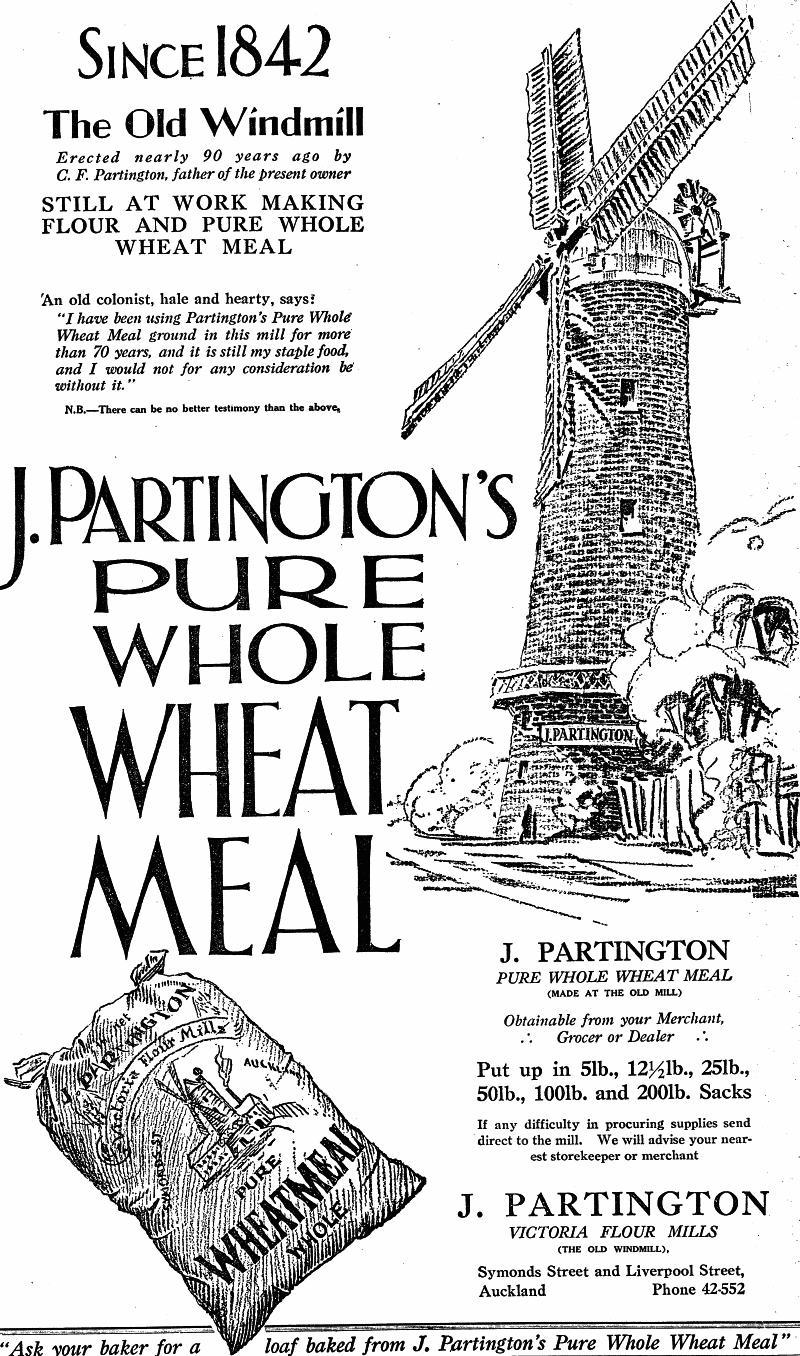
MACHINERY WANTED. ELECTRIC Motor. D.C., 6 to 8 h.p. - The Old Windmill or Phone 42-552.New Zealand Herald, Volume LXXI, Issue 21748, 13 March 1934
Wanted to Buy: COOKING Stove, in good order. -Phone 42-552.New Zealand Herald, Volume LXXVI, Issue 23295, 14 March 1939
TO LET OR LEASE: GARAGE. - Apply Windmill. off Liverpool St. Phone 42-552.
Auckland Star, Volume LXVII, Issue 115, 16 May 1936, Page 12Windmill "Comes to Light."
The demolition of wooden houses facing on to Symonds Street just below the Karangahape Road corner has given a clear view of the windmill, Auckland's old and interesting landmark. For the first time for at least half a century it is possible to see the lower part of the mill from Symonds Street, while from other coigns of vantage, namely, Wakefield Street, Airedale Street and parts of Upper Queen Street, the round brick-lined shaft can be seen as far down as the bottom windows. One of the wooden houses has already disappeared, and when the second and larger one is removed the mill will be even more boldly revealed. From an artistic point of view it is perhaps unfortunate that the clearance in front of the mill is only temporary, but progress is inevitable, and the claims of utility come first. When the new block of the furnishing establishment on Karangahape Road is built, the extension will again obscure the view of the mill from Symonds Street, though the clear space facing on to the other aspects will not be interfered with. In the near future, when the clearance has been completed, and before the new building arises, it might be worth while for the city to secure a photographic record. A painted picture might also be considered by the authorities, and it would be worthy of a place in the Art Gallery, for Auckland's mill has a sentimental as well as a purely utilitarian value. It is certainly unique, and is fondly remembered by many old-timers and by Aucklanders who have made their homes abroad.
A syndicated version of the same photo a few days later has a better scan available: Manawatu Standard, Volume LVI, Issue 146, 22 May 1936, Page 6AUCKLAND'S HISTORIC MILL. - The old windmill as it looks from Symonds Street since the demolition of a house which blocked the view. It will soon be hidden again as a modern structure is to be erected on the site.
AUCKLAND'S HISTORIC MILL. - The old windmill as it looks from Symonds Street since the demolition of a house which blocked the view. It will soon be hidden again as a modern structure is to be erected on the site.
OLD MILL.He was adamant that money would not buy the site: Auckland Star, Volume LXVII, Issue 174, 24 July 1936
FIRE STATION SITE.
OWNER'S OBJECTIONS
OUTSTANDING LANDMARK
The suggestion made that the old windmill site, near the junction of Karangahape Road and Symonds Street, should be acquired for the new headquarters of the Auckland Fire Brigade is strongly opposed by Mr. J. Partington, of the Victoria Flour Mills, who said to-day that he was definitely opposed to selling any of his land in that area, and that no money would tempt him to sell any of his property, particularly the old mill. He regards the old mill as the most outstanding landmark of the city of Auckland, and feels that it should be preserved as such. He has a very strong sentimental feeling for this mill, and feels that the people of Auckland generally would support him in his opposition to the taking of the site for a fire station or any other purpose.
Mr. Partington said that even if the Fire Board undertook to preserve the mill, it would be only a matter of time before it would be put to commercial uses, and in course of time, probably removed or radically altered. It had already been suggested that the old mill would serve as a fine look-out for the purpose of the Fire Brigade. It was easy to see, therefore, that its nature would soon be changed, and that before long the mill would be lost to the people of Auckland.
Another point Mr. Partington raised was that in his opinion the site was quite unsuitable. On one side there was Karangahape Road, on another side Symonds Street, with the Grafton Bridge close at hand. The traffic on those arterial roads was so great that the presence of fire engines would be a positive danger to motorists and pedestrians.
OLD MILL.New Zealand Herald, Volume LXXIII, Issue 22481, 27 July 1936
NOT FOR SALE
MR. PARTINGTON'S STAND.
"MONEY WILL NOT BUY IT."
Unless the Auckland Metropolitan Fire Board can take it under some such legislative authority as the Public Works Act. neither the old mill site nor any of the property surrounding it will be available for the building of a new central fire station as long as its present owner, Mr. J. Partington, is alive.
"If they put a million pounds cash down on that doorstep, their money would not buy a foot of this site." declared Mr. Partington this morning, wagging a finger towards the doorway of the old mill. "Never since I inherited it have I ever sold a foot of this land, and I never shall. It is not a matter of money with me, it is a matter of sentiment, and I shall fight to the last ditch for the old mill."
Aucklanders have a share in Mr. Partington's passionate feeling for the historic old Symonds Street landmark; only in him it is stronger, and, even then, perhaps not so very much stronger, for the mill has been at once the pride and the livelihood of his family for 90 years. When Mr. Partington's father came to New Zealand he brought with him the money for the building of a mill; Sir George Grey himself signed the deeds which made him owner of the site in Symonds Street, then on the outskirts of the infant settlement, which he selected as suitable.Born in Miller's Cottage.
In the miller's cottage, still standing, Mr. Partington was born. As a baby he played round the mill and, no doubt, pestered his father with questions like "What makes those things go round, daddy?" As a youth he learned his father's trade and as an elderly man now he still follows it. During the [???] he had to fight hard for the protection of his beloved mill. From time to time he has bought up neighbouring properties, often at stiff prices, so that they could not be covered with high buildings that would block the wind. He now owns most of the block as far as City Road, and is determined to retain it.
Actually the windmill is not now necessary to his business, as he has electric machinery installed and he uses this the greater part of the time. Whenever the wind is in the right quarter and strong enough, however, he loves to set its sails a-turning. Formerly it had four, but one was snapped off in a gale some years ago and he removed the opposite one in order to restore the balance. Neither from England nor from America has he been able to obtain knot-free pitch pine spars for the centre ribs of new sails, so that two are probably all that the old mill will ever have for the future. With only the two sails, however, it provides a valuable auxiliary to the power plant.Artistic Associations.
Next to Mr. Partington, those who probably love the old mill best are the artists, who find in New Zealand plenty of natural beauty but little of man's work that could by any stretch of the imagination be called picturesque. Now that Nelson Street wharf is pulled down and its fleet of fishing boats scattered, only the ruins of St. Thomas' Church can vie with the old mill in popularity as a subject for sketchbooks.
FIRE STATION SITE
Sir, - The question of using the Old Mill site for the fire station is to me ridiculous as it is quite unsuitable for the following reasons:-First, this frontage faces what is well known, at certain times of the day, to be the busiest corner in New Zealand; secondly, there is a bus stop opposite and a tram safety zone just above that; thirdly the windmill is one of the old colonists' landmarks of Auckland, and its removal would be resented by reasons of its historical connections. If a larger site is necessary, why does not the Fire Board acquire the premises next to the present position in Pitt Street, occupied by the Auckland Gas Company, Limited? This additional area would double their present site, which is, I consider most admirable for the purpose.
R. H. J.
OLD MILL.A public notice was placed in the newspapers asking for signatures on a petition to preserve the mill: Auckland Star, Volume LXVII, Issue 215, 10 September 1936
FIRE BOARD PLANS.
APPEAL TO LOCAL BODIES.
PRESERVATION DESIRED.
Circulars to all local bodies, and a petition for public signature have been prepared by Mr. C. H. M. Mills, on behalf of Mr. J. Partington, who hopes to preserve his old windmill in Symonds Street from being incorporated in the new fire brigade station planned by the Auckland Metropolitan Fire Board.
The site of the old mill is one of three properties which the Fire Board is considering as suitable situations for a new metropolitan fire brigade station, and Mr. T. J. Kingston, chairman of the board, stated this morning that he thought it was the best of the three, although he would not give a definite opinion until it had been inspected by the board's architect. Mr. Kingston said that the site was ideally central for the brigade's purposes, as mileage measurements had shown, and was sufficiently large. Smaller-sites were available, but for a modern central station about an acre and a half of ground was necessary for housing, administrative buildings, and a drill ground. If the mill site were finally selected, the Fire Board would take a strip from Symonds Street through to Liverpool Street, which would include the area on which the mill stood.Statement by Board Chairman.
"Although the board does not wish to hurt Mr. Partington, can the feelings of one man be weighed against the interests of the city?" asked Mr. Kingston. "The board would leave the old mill itself intact. It would not be turned into a watch-tower, though possibly hoses might be hung from it to dry."
As the Auckland Metropolitan Fire Board has power, under the Fire Boards Act, 1920, to take land for its purposes according to the provisions of the Public Works Act, Mr. Partington may put into immediate effect his intention of offering the mill and the surrounding property as a public reserve, so as to save the mill from what he considers desecration. It was built by his father in the early '50's, and he himself was born in the wide-verandahed house that fronts Symonds Street, alongside the right-of-way to the mill. All his life he has battled to keep his mill going. The surrounding properties were sold by his father, but from time to time he has bought them back, sometimes at fantastic prices, so that high buildings that would block the wind from his mill would not be erected on them.Bequest to the City.
It was Mr. Partington's intention to leave the old mill and the adjacent property that he owns to the city, with the proviso that the old mill should be preserved for ever as a Historic landmark. Should the Fire Board force the issue he may take that means of preserving the mill, even though it will be a heavy loss to him. His wish is to end his life there, which he might not be able to do if he takes the only visible way out by handing it over now. So strong, however, is his determination that the old mill shall remain that, after great difficulty he has obtained the necessary spars for the replacement of the two sails that were damaged in a gale some years ago. They will cost him about £400, but he is cheerfully spending that sum to restore the old mill.
The concluding paragraph of the circular letter to local bodies issued by Mr. Wills, on behalf of Mr. Partington, is as follows:—"I am not writing to your board for the purpose of discussing the suitability or otherwise of the proposed site for the fire station or to raise the question of the expense that would be involved, but I am asking for the support of your board in opposing the taking of the old mill or the land surrounding it for any purpose whatsoever. The preservation of the old mill has been Mr. Partington's life work and as his intentions are to benefit the community I have ventured to approach you for your support to help him carry out this laudable object. As the Fire Board has the necessary powers to take the land, it remains for public opinion to protest against the taking of the land, hoping that that will deter the Fire Board from carrying out its present intentions."
THE OLD MILLAuckland Star, Volume LXVII, Issue 215, 10 September 1936
Petitions have been prepared on behalf of Mr. J. Partington, owner of the old mill, urging the preservation for the community of the mill as the most conspicuous link in modern times with the early days of Auckland. Shopkeepers are to be asked to take petitions so that people interested in the preservation of the windmill may have facilities for signing them. Particulars are given in an advertisement.
PUBLIC NOTICES.Many signatures were gathered: New Zealand Herald, Volume LXXIII, Issue 22520, 10 September 1936
PRESERVE THE OLD MILL.
SAFEGUARD AN HISTORIC LANDMARK.
THE SUPPORT OF ALL CITIZENS OF AUCKLAND IS ASKED TO HELP MR. J. PARTINGTON TO PRESERVE FOR THE COMMUNITY THE OLD WINDMILL.
PETITIONS ARE READY FOR SIGNATURE. WILL SHOPKEEPERS AND OTHERS WHO ARE WILLING TO TAKE PETITIONS SO THAT PEOPLE WILL BE ABLE TO SIGN THEM PLEASE RING PHONE 46-605 WHEN PETITION FORMS WILL BE FORWARDED TO THEM.
OTHERS WILLING TO ASSIST ARE ASKED TO COMMUNICATE WITH MR. C. H. M. WILLS, Solicitor, Winstone Buildings, Auckland, C.1.
FIRE STATION SITENew Zealand Herald, Volume LXXIII, Issue 22521, 11 September 1936
OLD WINDMILL PROPERTY
PETITION OF OBJECTION
In an endeavour to secure support for his objections to the use of the Old Windmill property in Symonds Street as a site for a new central fire station, the owner, Mr. J. Partington, through his solicitor, has prepared a petition for public signature, and it is also his intention to circularise local authorities.
Mr. Partington said yesterday that his wish had always been for the preservation of the old windmill as an historic landmark, and he was prepared to "fight the issue to the end." If forced, he might even entertain the idea of leaving the property to the city as a public reserve. A large number of signatures to the petition had already been obtained.
It was stated on behalf of the Auckland Metropolitan Fire Board that no decision had yet been reached in the matter, although a definite statement might be made at the next meeting of the board. Three properties were under consideration.
OLD MILL SITEThe number of signatures continued to rise rapidly to over 1000 in just 1 day: Auckland Star, Volume LXVII, Issue 217, 12 September 1936
A petition has been prepared for public signature in an endeavour by Mr. J. Partington to secure support for his objections to the use of the Old Windmill site for a new central fire station. Shopkeepers and others who are willing to take copies of the petition and make them available for signature are asked to communicate with Mr. Partington's solicitor.
WIDELY SIGNED.The Mayor weighed in with his support: New Zealand Herald, Volume LXXIII, Issue 22523, 14 September 1936
OLD MILL PETITION.
PUBLIC SENTIMENT.
PRESERVATION OF MONUMENT
In the first day that it was circulated, yesterday, over 1000 signatures were appended to the petition addressed to the Auckland Metropolitan Fire Board, urging the board not to acquire for the purposes of a central fire station or any other purpose any of the land and premises generally known as "the old mill" site.
The reasons set out in the petition are that the old mill is an outstanding historical landmark, and should not be destroyed or used for any other purpose, there being no other windmill of its like in Auckland or probably in the Dominion; that even if the board undertook not to touch the old mill, it is known from what happened in other cases, that in time it would be used for some other purpose, and ultimately demolished or altered so as to change its character; that it has been the aim of the owner, Mr. J. Partington, for years past, to acquire all the available land in the vicinity to ensure that large buildings would not be erected thereon to block the people's view of the mill and prevent the mill from getting the wind; and that the site would be most unsuitable for a fire station as the exits would be on to either Karangahape Road or Symonds Street, both very busy and crowded arterial roads, with a busy and dangerous corner at Grafton Bridge, and the proposed site is a residential one.Sixteen Forms Returned.
Of the first hundred petition forms that were issued yesterday morning by Mr. C. H. M. Wills, Mr. Partington's solicitor, 16, each bearing between 40 and 50 signatures, had been returned by this morning, and the demand for more forms had to be met by the printing of another 50. A meeting of waterside workers yesterday afternoon decided to support the petition, and sent one of their number for a petition form. Within 20 minutes he had returned to Mr. Wills' office with the form filled, and asked for another. This he also brought back filled before 5 p.m., and he took away a third. At one Queen Street shop about 135 people signed the petition within a couple of hours yesterday afternoon.
Many of the signatories came from distant suburbs to put their names to the petition. One old couple made a special trip to the city yesterday afternoon from beyond New Lynn. They said that from the farmhouse that they had occupied for half a century or more they could see the mill, and their homestead would not seem to be the same if the mill went. At the old mill itself there has been such a steady stream of people to sign the petition and to see the mill for themselves that Mr. Partington has had difficulty, owing to the number of interruptions, in fulfilling his orders for flour.
Letters to "Auckland Star."
Letters on the subject too numerous to publish have been received by the editor of the "Star." All have been pleas for the preservation of the old mill; not one correspondent has favoured its demolition or the proposal to build a fire station on the site.
The chairman of the Auckland Metropolitan Fire Board, Mr. J. J. Kingston, said this morning that the board had nothing further to say on the subject. The old mill site was only one of three that the board was considering, and no decision had yet been reached. He pointed out, however, that if the present Fire Board did not choose the best possible site for such an expensive building as was contemplated, members of the board would be subjects of criticism for generations to come.
HISTORIC WINDMILLLetters of support were published: New Zealand Herald, Volume LXXIII, Issue 22524, 15 September 1936
PRESERVATION IMPORTANT
ATTITUDE OF THE MAYOR
"Personally I do not take the suggestion seriously - it is absurd to suggest that this historic landmark should disappear," said the Mayor, Mr. Ernest Davis, when questioned as to his views on the possibility of the old windmill in Symonds Street becoming involved in the projected rebuilding scheme of the Auckland Metropolitan Fire Board.
Mr. Davis said that to his way of thinking public sentiment would not for one moment agree to the demolition of the windmill. If he believed that there was any likelihood of the future of the windmill being threatened he would not hesitate to bring the matter to the notice of the City Council, which, he felt confident, would join him in insisting on the preservation of the landmark. He recalled seeing the famous windmill in Potsdam, Germany, which one of the German Emperors had sought to buy and destroy. The owner's refusal to sell had received country-wide support and to-day the mill was one of the national monuments of Germany.
An excellent response by the public followed the circulation on Friday of the first hundred petition forms drawn up on behalf of Mr. J. Partington, owner of the windmill, by his solicitor, Mr. C. H. M. Wills, in an endeavour to secure support for his objections to a proposal to use the property as a site for a new central fire station. Sixteen of the 100 forms issued on Friday morning had been returned by Saturday, each bearing between 40 and 50 signatures, and accompanied by a request for more forms. Waterside workers alone accounted for three forms, while at one city shop well over 100 people signed the petition within two hours. It was estimated that over 1000 signatures were obtained to the petition on Friday and many more were added on Saturday.
OLD WINDMILL SITEDespite the objections, a recommendation was made making the mill site first choice: New Zealand Herald, Volume LXXIII, Issue 22525, 16 September 1936
Sir - The Fire Board's endeavour to secure the site of this old landmark for an up-to-date fire station must be opposed to the limit. The chairman of the board states that this is the most suitable of the sites under consideration, and I can only conclude that they cannot have looked very far for alternative sites. He rightly states that his board is the best judge of the type of site for the purpose, but the ordinary laymen who comprise the citizens of Auckland will want to know before a decision is finally arrived at, what peculiar advantage this mill site has that would necessitate the destruction of a landmark of such historic association with Auckland. This particular locality is among the most dangerous in the city for engines getting in and out quickly, particularly in rush hours, and I do not suppose the board has any assurance that fires will not break out during rush hours. Surely there is abundant suitable land in Grey's Avenue just about the centre of the city's business area, and where it would do away with some of the undesirable hovels in that quarter. Mr. Partington is to be commended for his public-spirited attitude in connection with his property, and I earnestly hope that the ambitions of a lifetime will not be frustrated by the action of the Fire Board. If the public are with him in the matter of saving the mill for Auckland for all time they should insist on the Government setting up a Commission in order that evidence may be taken and all other likely sites investigated:
Vic. JOHNSON
NEW FIRE STATIONNew Zealand Herald, Volume LXXIII, Issue 22525, 16 September 1936
Proposed Sites
Old windmill favoured
ADVANTAGES OF AREA
REQUIREMENTS REVIEWED
A recommendation that the old windmill property in Symonds Street be considered as the first alternative to the Mount Street site as the location 1 for the proposed new metropolitan fire brigade headquarters is contained in a report by the inspector of fire brigades, Mr. R. Girling Butcher. In his report Mr. Butcher deals with the possibilities of these sites and states that a site in Wellington Street which was also considered should not be adopted unless it was impossible for financial or other reasons to acquire either of the other proposed sites.
A conference of local bodies which contribute to the Auckland Metropolitan Fire Board is to be called by the Mayor, Mr. Ernest Davis, to discuss the selection of a new site for the central station. It was stated yesterday by the chairman of the Fire Board, Mr. J. J. Kingston, that no site had yet been decided upon and no decisive action would be taken until the Mayor's conference had been held.Service Requirements
In dealing with the alternative sites Mr. Butcher said it was essential for the effective organisation of the fire protection service of a city such as Auckland that the central station, in addition to being the administrative and training centre of the brigade, should have accommodation for the main striking force, both of plant and personnel. The principal requirements were: -
(1) The station should be situated close to the main business area and if possible centrally so that as many as of the major fire risks - factories, warehouses, bulk stores, office blocks and principal shopping centres - were within easy distance. Consideration must be given both to existing conditions and likely future developments.
(2) Access to the major risk areas should be available by main traffic routes and involving the minimum possible of hill climbing. Experience showed that under existing traffic regulations and with the present limited percentage of horse-drawn vehicles, street sirens were effective in clearing the streets, and intersections subject to traffic congestion could be safely negotiated by the fire engines. For the same reason there was little objection to the station fronting on a main traffic route.Other Essential Features
(3) The site should have sufficient frontage to the main outlet street to accommodate a station and administrative block, having provision for, say, 10 machines, with living quarters for single firemen and auxiliaries and provision for the brigade recreation rooms.
(4) Sufficient land should be available for the erection of at least 20 self-contained married quarters and for a training and recreation area of not less than 50ft. by 150 ft., so that the evolutions required in ordinary street operations could be carried out. A workshop block should be provided in the vicinity of the training area. It was essential that the major portion of the area should be reasonably flat, and it was desirable that the quarters should not be considerably below the station level. An area of from one to one and a-half acres would be necessary, depending on the length of frontage and the shape of the section.
(5) The location should be such as to fit in with the existing organisation of outlying stations. The desirability of locating the station in the vicinity of the dominating Symonds Street - Karangahape Road ridge would be apparent.Position and Area
In stating that the old windmill site was the most suitable position for access to all parts of the city, Mr. Butcher said that it was proposed to take the land right through from Symonds Street to Liverpool Street and to retain the old mill itself as an old Auckland landmark. The site comprised about 1.6 acres, and with some excavation on the Symonds Street frontage could be adapted to advantage. The site was nearer to the centre of the high value district than any of the others
The running time to any portion of the principal business area should not exceed two minutes, and the same applied to the light and heavy industrial districts in the Stanley Street - Strand area. It was also within 2 1/2 minutes run from Broadway, Newmarket, and the high-value areas in the northern part of Mount Eden and Mount Albert boroughs.
Mr. Butcher said that owing to Mr. Partington's refusal, for sentimental reasons, to sell the windmill property, it would be necessary to take the land under the Public Works Act.The Mount Street Site
The Mount Street - St. Paul's Street area could be somewhat more conveniently adapted for fire station purposes than the mill site. Less land would be required than at the mill site, but owing to the additional frontages involved it would probably be more expensive. In Mr. Butcher's opinion this site should be regarded as alternative to the mill site, and, taking all things into consideration, of approximately equal suitability.
Reference is also made to the Wellington Street site. It is stated that the buildings on this land are of little value, but the situation of the land and the getaway leave something to be desired. Its adoption would probably necessitate the development at some future date of a major secondary station in the Parnell area.
New Fire Station PlansNew Zealand Herald, Volume LXXIII, Issue 22526, 17 September 1936
Tentative plans for the use of the old windmill property in Symonds Street as a site for the proposed new fire brigade station have been prepared for the Auckland Metropolitan Fire Board, although no decision has yet been reached for the acquisition of the land. The main building, which will house the engines, with accommodation for single men and provision for offices and board room, is shown occupying the whole of the Symonds Street frontage. Set diagonally across the site are three blocks of buildings which will contain quarters for the married members of the staff, while at the extreme northern corner of the land the residence for the superintendent is placed. The old mill is shown surrounded by grass and garden plots, with a large recreation area to one side. The old brick tower of the mill should still dominate the surroundings.
The Old WindmillNew Zealand Herald, Volume LXXIII, Issue 22527, 18 September 1936
Among those interesting themselves in the preservation of the historic windmill in Upper Symonds Street are the members of the Auckland Historical Society. The council of the society discussed the matter at its last meeting, and passed a resolution that, while expressing no opinion as to the desirability or otherwise of the proposed site for a fire station, it was of opinion that all possible steps should be taken to preserve intact the old mill building. This resolution is to be sent to the Auckland Fire Board. The council also expressed the hope that at some future time the extra two vanes might be added to the mill sails.
A SITE WHICH IS FAVOURED FOR THE PROPOSED NEW HEADQUARTERS OF THE METROPOLITAN FIRE BRIGADE IN AUCKLAND
Of several sites already inspected the old windmill property in Symonds Street is considered the most suitable for quick access to all parts of the city. Left: The Symonds Street frontage showing buildings which will have to be demolished to make room for the new station is the site is acquired. Right: The familiar old windmill owned by Mr. T. Partington. Tenative plans for the erection of the new station on the property allow for the retention of this historic landmark.
BEQUEST TO CITYAn editorial followed the report, concluding that the Fire Board would now have to look elsewhere: Auckland Star, Volume LXVII, Issue 224, 21 September 1936
WINDMILL SITE.
CLAUSE IN WILL.
MR. J. PARTINGTON'S PLANS.
COUNCIL TO BE TRUSTEES.
To leave to the citizens of Auckland, on his death, property that, even disregarding its historical and sentimental value, is estimated to be worth upwards of £100,000, has been the lifelong intention of Mr. J. Partington, owner of the old windmill in Symonds Street.
Clause 3 of Mr. Partington's will, which he has authorised his solicitor, Mr. C. H. M. Wills, to make public, reads: -
"I devise to the Auckland City Council upon trust to be held by it for the benefit of and for the free enjoyment by the citizens of the city of Auckland for ever my windmill, affectionately known by the people of Auckland as 'The Old Windmill,' together with all those pieces of land owned by me and situated in that area bounded by City Road, Liverpool Street, Symonds Street and Karangahape Road, but subject to the following conditions and stipulations, namely:-
"That the old windmill is to be kept in good repair and condition and in good working order as a windmill, and is never to be demolished or destroyed; that the old windmill is never to be utilised, used or adapted for any other purpose than that of a windmill; that all other buildings and erections now standing on the said pieces of land hereby devised to the Auckland City Council upon trust shall be kept in good repair and condition so long as the buildings and erections are capable of being kept in good repair and condition; that if and when any of the buildings and erections have to be demolished or destroyed by reason of being beyond repair or being past reinstatement that no other buildings shall be erected on their sites or in replacement thereof; that the said of land shall be laid out and kept in paths, lawns, gardens and ornamental shrubs and trees, but so that no tree or shrub shall be allowed to attain a greater height than 15ft, or be planted within a distance of 50ft from the old windmill; that the rents and other income derived from the other buildings and erections shall be applied, first, in the maintenance and upkeep of the old windmill, secondly, in the maintenance and upkeep of the other buildings and erections, and thirdly, in carrying out my wishes as set out above; that should the rents and other income be insufficient to enable my wishes to be adequately carried out, then the Auckland City Council shall make good from its own resources any deficiency; that under no circumstances whatsoever shall the said pieces of land or any of them or any portion or part of them ever be sold, exchanged, or alienated, or be leased for any one period greater than five years; that no buildings shall ever be erected on the said pieces of land other than rest rooms and conveniences for the benefit of the people of Auckland, but so that such rest room and conveniences shall not exceed a height of 15ft; that my brother, William Henry Thomas as long as he shall live, shall be entitled to use and occupy, as his home free of all charges and expenses the house together with the furniture and household effects contained therein, now occupied by me as my home; that the property comprised by the said pieces of land shall be designated and known in future as 'Partington Park.'"Properties Bought Back.
This has been Mr. Partington's intention ever since he inherited the property from his father, the builder and owner of the mill. With this vision before him, Mr. Partington has from time to time bought back properties adjacent to the mill that had been included in his father's original Crown grant of land, but had subsequently been sold. Often he has-paid as many thousands of pounds as his father received hundreds for portions of the old family holding.
Had not the Metropolitan Fire Board cast eyes on the site as one of three that might be suitable locations for their proposed new central fire station, no one outside a few of Mr. Partington's closest relations and intimate friends would have known that this was his ultimate intention, that this was why he had from time to time bid almost fantastic prices in the open market to buy surrounding properties on which commercial enterprises wished to erect buildings that would have blocked the wind from his mill and blocked also the public's view of it. Not until his death would the public of Auckland have known that he was preserving the mill, not only for his own pleasure, but to ensure that this historic landmark would be for all time theirs.
Never, but that the old mill was threatened, would he have revealed his intention, for he intends to continue to operate the mill himself and to live in the house alongside it that he has built, until his death, and he feared that, should his intention be made known, privacy might be invaded by thoughtless folk thinking that the property was already theirs. His home and his livelihood are still there, and his they shall remain, he is determined, until his death. Thereafter, they will belong to the citizens of Auckland.
"THE OLD WINDMILL."Other papers around the country picked up on the story of the bequest: Stratford Evening Post, Volume IV, Issue 240, 21 September 1936
Back in the early days of Auckland, when the city was a tiny village, its inhabitants used to regard a walk "away out to the windmill," through the scrub, as quite a journey. From that day "the "old windmill" has been a conspicuous feature on the skyline, and ceaselessly its wheels have revolved to grist the wheat for some portion of the city's requirements, while the city itself has crept farther and farther afield. It has come to be regarded as a permanent feature of the landscape and as one of the strongest links with Auckland's pioneering days. The owner, Mr. Partington, has long cherished an ambition to present the mill and the surrounding acre of ground to the city, and he had so bequeathed it in his will. The suggested acquisition of the property as a site for a central fire station has compelled an announcement of this intention during the lifetime of the owner, who would have preferred that the city should learn of his generosity through the reading of his will. The prospective bequest takes rank with the great Auckland benefactions of the past. It will preserve an outstanding and interesting feature of the landscape for all time, and at the same time it will provide space for a particularly useful park in the heart of the city. The monetary value of the gift is very great, but even greater is its potential value as a breathing space. The Fire Board will no doubt look elsewhere for a site, rather than deny to the people the opportunity of enjoying the use of an area so suitable for its intended purpose.
£100,000 Bequest To Auckland.The Maoris added their support to the idea of preserving the mill: Auckland Star, Volume LXVII, Issue 226, 23 September 1936
Press Association— Copyright. Auckland, September 20
Alarmed by the prospect of the taking of his property as a site for the new central fire station, Mr. J. Partington, owner of the old windmill in Symonds Street, one of Auckland’s best-known landmarks, has authorised his solicitor to announce that provision has been made in his will for the mill and surrounding properties, valued at about £100,000, to be bequeathed to the City of Auckland on the death of the owner.
The Partington family has owned the mill since its erection in the early days of the city and Mr. Partington still operates the plant, living in a house adjacent.
Mr. Partington decided to make public the fact that he was bequeathing the mill to the city only because of recent suggestions that the site might be taken for a fire station.
A few years ago the interior of the mill was extensively damaged by fire but it was repaired and put into operation again. The great sails of the mill can be seen from many parts of the city and suburbs.
TE MIRA HAU.The Northern Advocate ran a photo to accompany their notice of the bequest: Northern Advocate, 23 September 1936
THE OLD WINDMILL.
RESPECTED BY THE MAORIS.
PRESERVATION SUPPORTED.
That innate reverence of the Maori for things ancient and tradition-haunted has been deeply touched by the suggestion that Te Mira Han, as they call the old windmill, might be interfered with or destroyed.
From the Akarana Maori Association the owner of the mill, Mr. J. Partington, has received a letter expressing the sympathy of its members and promising their strongest support for his endeavours to preserve the mill, while the names of many Maoris, some from as far away as the Waikato, are amongst the six-thousand-odd signatures that have been affixed to the petition praying the Auckland Metropolitan Fire Board to look elsewhere for a site for the proposed station.
Mr. George Graham, president of the Akarana Maori Association, stated yesterday that the old mill was mentioned by its Maori name of Te Mira Hau in many little anecdotes of early Auckland that had been preserved in Maori tradition though long since forgotten by the pakeha population. The name itself, he remarked, was a good example of a compound of the Maori and pakeha tongues. There being no word for mill in the original Maori language, the Maoris used the pakeha word, which, owing to the Maori inability to pronounce "l" and the invariable Maori practice of ending all words with vowels, became "mira." "Hau" was pure Maori for "wind," so that the name was an ingenious translation of the pakeha word "windmill," using the Maori word for wind and a Maori adaptation of the pakeha word "mill," which did not exist in the native tongue.Wheat from the Waikato.
The older Maoris of the Waikato knew "Te Mira Hau" well, said Mr. Graham, and would bitterly resent any interference with it. Before the wars in the Waikato disrupted trade, he said, the Maoris there grew large quantities of wheat which was ground by Te Mira Hau. The grain was floated down the Waikato in canoes, portaged overland at Waiuku to the Manukau Harbour, loaded again into canoes and ported across the Manukau to Onehunga, and thence either carted or carried by the owners on their backs to Auckland. Some of it might be sold in the town, but what was needed for home consumption made the return voyage as flour by the same route that it had come.
Unable to sign for himself, one old rangitira last week had a pakeha friend write his name to the petition, he himself affixing his "mark" after it, a procedure precisely similar to that adopted, when the Maori chiefs signed the Treaty of Waitangi. The old rangatira said that Te Mira Hau had always had great mana amongst the Maoris, for, even in the early days, when there was less sympathy and understanding between pakeha and Maori than there is now, did not Te Mira Hau grind wheat impartially for both, and if the grain was of equal quality, turn out as good flour for the Maori as it did for the pakeha? Such fair dealing in the days of hungry landgrabbers and cheating traders, deeply impressed the Maoris and endeared Te Mira Hau to them."Tana" Turns Back.
Shrewd in warfare, the Maoris also fully appreciated the strategic value of the mill as a fortified outpost commanding the ridge from which the city could be overlooked. When the tribal chiefs, resentful of the injustices and indignities that were too often inflicted on them in these early days, talked of attacking and destroying the town, the old mill was always included in their summing up of the strength of the settlement. This old rangatira remarked that his father was one of the war party from Waiheke who, in 1851, landed and danced the war haka on the beach at the foot of Parnell Rise, about where the Maori hostel now stands, threatening to attack the town in vengeance for an insult put on one of their chiefs.
The old mill and its outbuildings were hastily fortified and loop-holed that day, and many women and children who lived nearer to the mill than to the Albert Barracks took refuge there, under the protection of a small detachment of regulars and militia. While they awaited reinforcements from the Hauraki, the Maoris considered the strength of the settlement, whether or not they could destroy it, and it is said that neither the ranks of the regulars and militia drawn upon Constitution Hill nor the guns that jutted from the stone walls of Albert Barracks impressed them nearly as much as did the calm strength of Te Mira Hau, whose arms still revolved against the background of the sky, as if a Maori "taua" was not worthy of notice. Te Mira Hau that day possibly turned the scales for peace and averted a war, for the "taua" withdrew, and after such a fiasco the hotheads that had led the party lost much of their mana and were never again able to lead their people against the pakeha.
A few weeks later, the Fire Board decided to use a site other than the old mill one: New Zealand Herald, Volume LXXIII, Issue 22545, 9 October 1936
BEQUEATHED TO AUCKLAND.—The old windmill in Symonds Street, one of Auckland’s best-known landmarks. The owner, Mr J. Partington, has announced that provision has been made in his will for the bequeathing of the mill and surrounding properties, valued at about £100,000, to the City of Auckland.
NEW FIRE STATIONPartington took out an advert to thank the 6537 people who had signed his petition: Auckland Star, Volume LXVII, Issue 241, 10 October 1936
ANOTHER SITE CHOSEN
PROPERTY IN PITT STREET
OPPOSITE PRESENT BUILDING
DECISION OF THE BOARD
The new central fire station will not be built on the old windmill property in Symonds Street. At a special meeting of the Auckland Metropolitan Fire Board yesterday, it was decided to erect the new station in Pitt Street, opposite the present station.
The chairman of the board, Mr. J. J. Kingston, said the decision to abandon the windmill site was based on the understanding that Mr. J. Partington, the owner, had arranged to hand over the property to the City Council for purposes of a recreation ground, so that the old windmill would be preserved as a historic monument for the city. It was understood the City Council had accepted Mr. Partington's proposal, and, although the Fire Board had not intended to pull down the mill if the site were taken, it was thought that the arrangement proposed by Mr. Partington would be of greater benefit to the city.Features of New Site
The new site selected included the frontage from Pitt Terrace to the Selwyn Shirt Manufacturing Company's factory in Grey's Avenue, and embraced the land behind this factory to the back of Myers Park, although the factory itself was not included. The site also included a small section at present occupied by a terrace of wooden dwellings, on the south side of Pitt Terrace. It was hoped to acquire the necessary property by private negotiation, but, in the event of this failing, it would be taken under the Public Works Act.
THE OLD WINDMILL, SYMONDS STREET.The Council had some discussion on the bequest: Auckland Star, Volume LXVII, Issue 261, 3 November 1936
MY THANKS AND APPRECIATION.
TO THE 6537 PEOPLE WHO KINDLY ASSISTED ME TO SAVE THE OLD WINDMILL from the hands of the Auckland Metropolitan Fire Board by signing the petitions, and to dozens of people who wrote me kindly letters of encouragement and sympathy, as well as to the others who worked so hard in obtaining signatures, interviewing people and generally supporting me in the fight, I express to you my heartfelt thanks and gratitude. I did not realise before how warmhearted the people of Auckland were, nor how deeply attached were they to the Old Windmill.
I am delighted to know that, with their willing assistance, the Old Windmill has been preserved for the people of Auckland for all time.
J. PARTINGTON, Symonds Street.
Old Windmill Site. "I think one should have some official information from the so-called donor," said Mr. E. J. Phelan at last evening's meeting of the Auckland City Council, in asking if there was anything definite about the handing over of the Old Windmill site to the city. The Mayor, Mr. Ernest Davis, said the solicitor of the donor, Mr. Partington, had given him a definite assurance. "I cannot say that I am satisfied," continued the Mayor, "and I will make it my business to look into the matter and to report in due. course."The Auckland Historical Society express gratitude: Auckland Star, Volume LXVII, Issue 264, 6 November 1936
YEAR REVIEWED.The Council received a letter from Partington which helped to clear things up: Auckland Star, Volume LXVII, Issue 282, 27 November 1936
HISTORICAL SOCIETY.
ACTIVITIES IN AUCKLAND
"The council desires to express its gratification on hearing of the intention of Mr. J. Partington to give as a reserve the site of the Old Mill, and rejoices that the historic buildings are now apparently assured of preservation." states the annual report of the council of the Auckland Historical Society, to be presented at the annual general meeting to-night by the president, the Rev. A. B. Chappell, and the secretary, Mr. N. H. Good.
OLD WINDMILL.New Zealand Herald, Volume LXXIII, Issue 22587, 27 November 1936
PRESERVATION PROPOSAL
APPRECIATION OF COUNCIL.
The action of the Mayor, Mr. Ernest Davis, in thanking Mr. J. Partington for his decision to vest in the council as trustee the old windmill and surrounding land for the purpose of preserving the mill for all time, was endorsed by the Auckland City Council last evening.
In a letter, which was before the council last evening, Mr. Partington said it was understood that his intention in the matter of the mill had been fully provided for in his will, and, that until his death the mill and his property would remain absolutely his own. He had had no thought of disclosing his intentions until he was forced to do so by the attempt of the Auckland Metropolitan Fire Board to seize his land and windmill.
"It has been my ambition for years to see that when I am gone the old windmill is preserved and kept and worked as a windmill. I have bought up the surrounding land as opportunity offered to prevent the erection of large buildings, which would block the wind and the view of the old windmill, added Mr. Partington. "You may rest assured that I propose to preserve the old windmill in the manner already indicated, and all that I ask now is to be left in peace without any interference to enjoy my property and to work my windmill as long as I shall live."
The Mayor reported that he had expressed the city's gratitude and thanks to Mr. Partington for the notable addition to the benefactions to the city.
THE OLD WINDMILLThe Fire Board also presented an end of year report, and of course the mill was mentioned: Auckland Star, Volume LXVII, Issue 306, 26 December 1936
MR. PARTINGTON'S GIFT
COUNCIL'S THANKS CONVEYED
"You may rest assured that I propose to preserve the Old Windmill in the manner already indicated, and all that I ask now is to be left in peace without any interference to enjoy my property and to work my windmill as long as I shall live," said Mr. J. Partington, in a letter received by the City Council last night, in which he acknowledged the council's thanks and appreciation for his intention to vest in the City Council as trustee the old windmill and his surrounding land for the purpose of preserving the old windmill for all time. Mr. Partington said that this intention had been fully provided for in his will, it being understood that until his death the windmill and his property should remain absolutely his own. He had no thought of disclosing his intentions until he was forced to do so by the attempt by the Auckland Metropolitan Fire Board to seize his land and windmill. It had been his ambition for years to see that after his death the windmill would be preserved and worked as a windmill. He had bought up the surrounding land as opportunity offered to prevent the erection of large buildings which would block the wind and the view of the old mill.
A copy of a letter sent to Mr. Partington by the Mayor, Mr. Ernest Davis, was also submitted to the council. In this Mr. Davis acknowledged Mr. Partington's formal indication of his testamentary disposition with respect to the old windmill, and said he appreciated the indication that the property would remain Mr. Partington's during his lifetime, which he trusted would be many years. He assured Mr. Partington of the city's willingness to preserve this historic landmark for all time.
"Members of the City Council are associated with me in the thanks now tendered to you for this notable addition to the many benefactions which Auckland City has from time to time received from the public-spirited members of the community," added Mr. Davis.
The action of the Mayor in replying to Mr. Partington was supported and endorsed by the council.
FIRE BOARD YEAR.
NEW STATION SITE.
FEWER CALLS RECEIVED.
CAUSES OF THE OUTBREAKS
The most important development of the Auckland Metropolitan Fire Board's activities during the year was the acquisition of a site opposite the present central station in Hobson Street for the erection of a new modern headquarters station. A number of sites were considered by the board before the Hobson Street area was selected.
A storm of protest was raised when it was announced that the most suitable site was that of the Old Mill in Symonds Street. The protest was not abated when it was stated that the historic mill itself would not be removed. The action of the owner mill, Mr. J. Partington, in presenting the property to the Auckland City Council as a public reserve compelled the board to seek another site. Opposition was also voiced to a proposal to establish the station near the intersection of Wellesley Street and Symonds Street.
FIRE STATION SITE.There was a plan to floodlight the mill as part of the city centenary celebrations: New Zealand Herald, Volume LXXVI, Issue 23278, 22 February 1939
Ever since the building of a new fire station was mooted quite a stream of people have raised objections to various sites suggested for the new buildings. But 'twas ever so, and many good citizens will remember the storm that was raised when the site of the present Grafton Bridge was chosen. Oh, the desecration! And could it not be put-here or there? And the expense! But to-day it is one of Auckland's greatest assets in easing traffic congestion. The authorities concerned bowed to public, or, shall I say, some of the public opinion, in regard to the Old Mill site, which, without a doubt was Auckland's most strategic point for a central fire station. Now in regard to the present site the latest exponent, under the nom de plume of "Taxpayer," bemoans the expense and doesn't like the "contour" of the ground. But he can point out a nice section in the quiet backwater of Ponsonby and "at quite a moderate price." Does "Taxpayer" really think that the matter of a thousand or so pounds will influence the choice of site on which is to be erected a building housing thousands of pounds' worth of equipment and protecting millions of pounds' worth of property? The strategic position as regards first risk is of paramount importance. The traffic problem also worries "Taxpayer." Perhaps he has not been fortunate enough to travel to the Old Country and there see some of London's brigades turning out into traffic that would astonish him, and not protected by the favourable laws as applied to brigades in this country. As a last point, I would indicate to "Taxpayer" that something over a million pounds was spent on the advice of one man at Arapuni, so let him rest easy in mind about the fire station and its site, as the "small body of men" he speaks of is composed of astute business men and experts in their various departments. G.W.D.
THE CENTENNIALAuckland Star, Volume LXX, Issue 257, 31 October 1939
ILLUMINATION PLANS
...
The illumination programme, which like the other proposals is still tentative, includes such landmarks as the Old Mill and Grafton Bridge, and the city's principal public buildings, particularly the Town Hall, the university tower and the railway station. It is believed that with the co-operation of the owners beautiful effects will bo produced.
Auckland's Colourful Story
...
The Old Mill, Auckland's oldest landmark is still working as it was in days when Aucklanders sheltered there from Maori raiders.
There is one relic of those early years, however, that still stands in Auckland, little different in appearance from what it was then. That is the Old Windmill, which by the generosity of its owner, Mr. J. Partington, will eventually pass into the care of the city. Before the wars in the Waikato disrupted trade the Old Mill ground grain both for the Maoris and the pakeha settlers. Te Mira Hau, as it was called by the Maoris, was held in great prestige by them.
At a time in recent date when the mill seemed in danger of demolition to make way for a new central tire station Maoris joined in the* pleas, for its preservation, and it was recalled by one old chief that his father had been a member of the war party that had come from Waiheke Island in 1851 with the intention of attacking the township. They landed and danced a war haka on the beach at the foot of Parnell Rise, about where the Maori hostel now stands. The old mill and its outbuildings were hastily fortified and loopholed, and many women and children who lived nearer to the mill than to the Albert Barracks (where Albert Park is now laid out) took refuge there under the protection of a small body of soldiers.
Neither the ranks of the regulars and militia drawn up on Constitution Hill nor the guns that jutted from the stone walls of the barracks, he said, impressed the war party so much as did the calm strength of Te Mira Hau, whose sails still revolved in the breeze. The preparedness of the settlement led to wiser counsels prevailing among the Maoris and the "taua" withdrew.
That, however, is jumping ahead with the story. The Auckland of 1842 had neither Albert Barracks nor windmill.
WANTED TO SELLA keen eyed, but deficient in their fact checking, writer noticed the ad, and misinterpreted it to signal that the mill was to be demolished. The same issue if the paper as the last of the ads contained an editorial and article both wrongly stating the windmill was under threat of immediate demolition: Auckland Star, Volume LXXV, Issue 94, 21 April 1944, Page 4
...
DEMOLITION JOB, Old Mill, 87, Symonds St. - Machinery Pulleys, all sizes; Shafting, 1in to 3in. Bearings, large and small Cog Wheels, Beltings, V Pulleys, Barrels, large Packing Cases, a Bag Sewing Machine, Platform Scales, Chains, Wire Ropes, large Grindstone, etc., etc. - Ph. 60-092.
THE PASSING OF A LANDMARKThe article filled in more history of the mill: Auckland Star, Volume LXXV, Issue 94, 21 April 1944, Page 6
THE "Old Mill" is under threat of immediate demolition. It is Auckland's oldest landmark - it was erected just a hundred years ago - and it is certainly also the most prominent of all the buildings with a history in New Zealand. It no longer serves any useful purpose, but there are many thousands of Aucklanders who, forgetting the utilitarian awhile, would deeply regret the loss of an old friend if its silhouette no longer waved a friendly greeting from the skyline. The park once suggested as the frame for the old familiar picture has gone with all our yesterdays, but prompt action could still save the old tower itself. It sits over very little ground, its weathered bricks are not worth very much. With a trace of goodwill its frontages could be used, commercially without cloaking it further, and it is sufficiently sturdy to last for many a year - it manfully withstood a sail-high fire a dozen or so years ago without structural weakness. We pay few courtesies to the aesthetic and historic aspects of life, but perhaps there are some who will grieve sufficiently over the prospective loss of an old association to do something about it.
OLD MILL TO GOThe article was also accompanied by a photo of the mill as originally built, before being heightened: Auckland Star, Volume LXXV, Issue 94, 21 April 1944, Page 6
WILL BE DEMOLISHED
BUILT HUNDRED YEARS AGO
Auckland's famous landmark, the old windmill near Grafton Bridge, is to be demolished. Startling news for thousands of Aucklanders who have, with each successive generation, come to regard the mill as an integral part of the city, the first intimation of the planned demolition was contained in a small advertisement last night, in which was listed the machinery in the mill. Included in the list were pulleys, cog wheels, beltings, scales, chains and various other items.
This year the mill becomes 100 years old. It is Auckland's oldest landmark, possibly New Zealand's. Other buildings may be older - Pompallier House, at Russell, and the Treaty House at Waitangi, for example - but no other has become so much a part of a city, or, indeed, the country, as the old mill. All Auckland was stirred when the mill caught fire in 1931 and Aucklanders speculated on the future of the mill when its owner, Mr. Joseph Partington, died on November 18, 1941, aged 83.
On the day of Mr. Partington's death, his solicitor, Mr. C. H. M. Wills, said he had a copy of the will at his office, which would ensure the preservation of the mill as an historic landmark, but subsequent litigation, resulted in the mill being treated as part of the estate which is to be disposed of on behalf of the beneficiaries.Built by Engineer
The mill was built by Mr. C. F. Partington, an engineer and millwright, and was stated to be the only hand-driven mill in Australia or New Zealand. The wall at places is almost three feet thick, clay taken from the site of the building being used to make bricks for the superstructure. Work at the mill ceased early in the century, and the sails were removed, but were restored by the builder's son, Mr. J. Partington, who also raised the height of the mill from 60ft to 80ft.
A storm in 1921 damaged the original four sails beyond repair and these were not replaced owing to the difficulty of obtaining the necessary material.
On the night of the fire, February 16, 1931, damage estimated at £2000 was caused to the mill. The sails blazed against the night sky and drew a crowd of 10,000 people. After the fire, the two wooden sails had become charred skeletons. The ten-storeyed structure, however, had stood up well to the effect of flames and water.
Fifteen tons of machinery were contained in the mill, windpower being used when convenient and an electric auxiliary plant at other times.Restored to Order
Mr. Partington restored the mill to working order and it remained in use to the time of his death. Originally, it was known as the Victoria Flour Mills and Steam Biscuit Factory, and provided early Auckland with flour for many decades. During the Maori wars, flour from the mill supplied the soldiers and residents. A life-long interest in windmills was testified to by the discovery, on Mr. Partington's death, of many books on the subject of mills. More sensational, however, was the discovery, in the two-storeyed house adjoining the mill, of banknotes to the value of £2350. Properties owned by Mr. Partington were valued at some £100,000.
The site owned by Mr. Partington comprised over an acre in the block bounded by City Road, Liverpool Street, Symonds Street and Karangahape Road. In addition, he owned the original Partington homestead, occupied for a number of years by Baroness de Thierry.
Mr. Partington was buried in the old cemetery in Grafton Gully, about two hundred yards from the mill.
Evening Star, Issue 25156, 21 April 1944, Page 2The Old Mill as it was during the latter part of last century before it was increased in height from 60 to 80 feet. It has not had four sails since 1924 when two were damaged by a storm.
AUCKLAND'S WINDMILLThis was followed up by a sort of retraction the next day, laying the blame on the advertiser, not on the lazy journalist who failed to check his story!: Auckland Star, Volume LXXV, Issue 95, 22 April 1944
DEMOLITION OF OLD LANDMARK (P.A.) AUCKLAND, April 21.
Auckland's oldest landmark, the Windmill, near Grafton Bridge, which was built in 1844, and is therefore 100 years old is to be demolished. It was in operation until the death of Mr J. Partington in 1941, having been repaired 10 years previously, following a fire which destroyed the sails. For many years the mill supplied flour for the military and residents of Auckland.
DISPOSAL OF MILLNew Zealand Herald, Volume 81, Issue 24875, 22 April 1944, Page 6
FUTURE NOT CONSIDERED
OLD BUILDINGS ONLY TO GO
Owing to the phrasing of an advertisement in ambiguous terms, a wrong impression has been created concerning the future of the old windmill. The advertisement was headed: "Demolition Job, Old Mill, 87, Symonds St.," but it was explained to-day by Mr. R. King, manager of the Trust Department of the New Zealand Insurance Company, Limited, that the demolition of the actual windmill had not been considered and was, at present not contemplated. The company is managing the estate on behalf of several next-of-kin of the late Mr. Joseph Partington, who became its owners in consequence of a Supreme Court judgment last September.
Such demolition work as was contemplated related only to an old shop and certain other dilapidated buildings adjoining the mill. It was unfortunate, said Mr. King, that the suggestion had been made that the mill itself was to be pulled down. The future of the mill had not been considered by the beneficiaries, but it was possible that they might meet in the near future, as the survey of the boundaries of the property had just been completed. Any decision as to the disposal of the mill would be made by the majority of the beneficiaries and not by the directors of his company. There was no suggestion that the demolition of the mill would be considered by the directors when they meet next week.
Asked whether it was possible that the mill or the site would be offered to a private individual or to the city for preservation as an historic landmark, Mr. King said he was not in a position to make any statement. The property had not been offered for sale, and nothing had been decided as to its sale or the demolition of the mill.
Referring to the advertisement, Mr. King explained that it had been inserted by the contractor who was demolishing the old buildings, which had been sold to him. The machinery and equipment offered for sale had been stored in the old buildings, and not in the mill. There was very little machinery to remove from the mill. "There is really nothing in the wind regarding the mill," Mr. King added.
THE OLD WINDMILL
NO PLAN TO DEMOLISH
"NOT EVEN CONSIDERED"
A report that the old windmill on the Partington estate, Symonds Street, is to be demolished was categorically denied yesterday by Mr. R. King, manager of the trust department of the New Zealand Insurance Company, Limited which is managing the estats on behalf of the six next-of-kin of the late Mr. Joseph Partington, who became its owners as the result of a Supreme Court judgment last September. Mr. King said that the owners had taken steps to demolish an old shop and certain other dilapidated buildings on the property, and to dispose of some old machinery and other chattels. However, the demolition of the windmill was not contemplated and had not even been considered.
Whilst the denial story was published locally, the original demolition story was still being syndicated around New Zealand. Very few of the outlets that published the incorrect story later followed it up with the retraction.
Another series of low key ads were placed for the actual sale of the demolition materials: Auckland Star, Volume LXXV, Issue 104, 4 May 1944, Page 2MACHINERY, Pulleys, 1 to 4in Shafting, Cog Wheels, Cramps, Angle Iron, Rollers, Bolts and Nuts, Winch, Carpenter's Bench, Bricks. - Old Mill, 87, Symonds St.Auckland Star, Volume LXXV, Issue 111, 12 May 1944, Page 2
BRICKS, Angle Iron, Concrete Building Blocks, faced, Roofing Slates, Doors. Sashes, Oregan Steps (different sizes and lengths), Corrugated Iron for fowlhouses. - Old Mill. 89. Symonds St.
New Zealand Herald, Volume 81, Issue 24898, 20 May 1944, Page 4
OLD MILL PLANTNew Zealand Herald, Volume 81, Issue 24898, 20 May 1944, Page 4
TASK OF DEMOLITION
BREAKING UP MILLSTONES
Following the determination of ownership of the Partington estate, Symonds Street, which includes the old windmill, workmen have been engaged for the past three weeks in demolishing the old brick flourmill building and plant, located at the foot of the windmill tower. The plant was operated intermittently for many years by the late Mr. Joseph Partington for the production of wholemeal flour, but it had been disused for a long time before his death.
When Mr. Partington increased the height of the windmill and restored the sails, he utilised wind power by means of bevel gears and a horizontal shaft running through the tower wall to drive machinery in the building next door. He had electric motors for use when wind was lacking.
Disapproval of Modern Methods
Consistently disapproving of modern steel roller mills, he ground all his wheat with millstones, a number of which were found in the building.
Some of the stones were small and possibly had been used in the early days of Auckland when milling was carried on in the base of the windmill tower. The largest pair, weighing together about 15 tons, had never been used, and it was found necessary to break them up by hand for removal. This was a difficult task, because they were composed of a particularly hard, marble-like stone, coloured grey, yellow and pink in bands.
Importation from Europe
People who had known Mr. Partington said that he had imported the stones at heavy cost from the Continent of Europe, and their appearance suggested that they might possibly be of alunite from Hungary, a stone much used for the purpose before roller milling became almost universal.
A large quantity of old shafting and machinery is being removed. The cast iron and a quantity of malleable steel have value for melting down, but ordinary steel cannot be so treated in New Zealand. The workmen have a further task of demolishing a high reinforced concrete silo, formerly used for storing wheat, but this will be easier than dealing with the millstones.
The demolition of the windmill is not contemplated.
DEMOLITION OF OLD MILL PLANT: The old brick flourmill building and plant, located at the foot of Auckland's windmill landmark, are being demolished. The plant was once operated for the production of wholemeal flour. The demolition of the windmill itself is not contemplated.
OLD MILL FOR SALENew Zealand Herald, Volume 81, Issue 24904, 27 May 1944, Page 6
AUCKLAND LANDMARK
PUBLIC TENDERS CALLED
Once again the fate of Auckland's famous landmark, the old windmill near Grafton Bridge, hangs in the balance. Public tenders are to be invited for the purchase of the Partington estate, including the windmill, which was built 100 years ago.
Tenders are to be invited for the purchase of all the late owner's lands fronting Symonds Street, City Road and Liverpool Street, estimated to contain one acre, one rood and six perches, together with all buildings and improvements. Tenders will be considered for the whole area or alternatively for portions of it.
Besides the mill, the estate contains the building known as the "old residence" of Mr. Partington, built of hollow concrete blocks. Adjacent are sundry buildings such as garages and stables. Fronting Symonds Street is a very old house, which is reputed to have once belonged to the Baroness do Thierry.
There are two wooden houses in City Road, and three large wooden houses in Liverpool Street, used as accommodation houses. In the lane leading to the mill are a brick house and a further two wooden houses.
The mill was recently in the news as the result of demolition activities on an old shop and certain other dilapidated buildings adjoining the mill, and an offer for sale of machinery and equipment stored in these old buildings.
OLD WINDMILLThe actual call for tender: Auckland Star, Volume LXXV, Issue 124, 27 May 1944, Page 9
The historic old windmill near Symonds Street, together with the property surrounding it and all buildings are to be offered for sale by tender immediately on behalf of the relatives to whom the Supreme Court last year awarded the estate of the late Mr. Joseph Partington. No conditions will he laid down regarding the mill and in the event of its sale the purchaser may do as he pleases with it, subject, of course, to the city by-laws.
TENDERSAs would be expected for such an advertisement, this was run repeatedly across a number of papers, with just minor punctuation differences between them.
SALE BY PUBLIC TENDER by the Administrator of Estate of JOSEPH PARTINGTON, (Deceased).
Tenders are invited for the purchase of all the deceased's Freehold Lands, situated in the City of Auckland, fronting Symonds Street, City Road and Liverpool Street, and estimated to contain 1 acre 1 rood 6 perches, together with all buildings and improvements thereon.
A unique opportunity of acquiring centrally situated lands and premises of unusual size, in the heart of Auckland.
Tenders will be considered for the whole area or alternatively for any part or parts thereof.
Particulars and Conditions of Tender may be inspected at the Offices of the New Zealand Insurance Company Ltd.. Queen Street, Auckland or of Messrs. Nicholson, Gribbin, Rogerson and Nicholson, Queen Street, Auckland, Solicitors for the Administrator.
The highest or any tender not necessarily accepted.
Tenders close at 5 p.m. on June 16, 1944, at the Office of THE NEW ZEALAND INSURANCE COMPANY, LTD., Trustee Branch. Queen Street, Auckland.
The Old WindmillNew Zealand Herald, Volume 81, Issue 24911, 5 June 1944, Page 4
Sir, - Cannot something be done to prevent the destruction of the fine old windmill? When I sailed up the harbour 63 years ago it was the first familiar sight which gladdened my eyes in the land of my new home, and I have continued to love the old building, and hoped it would never be allowed to be demolished. Surely there is sentiment connected with this building in Auckland to give a hand, even at this late hour, in an effort to save this tine old landmark for future generations to see and enjoy.
I suggest that a public fund be started to purchase the property on which the mill stands.
Up From Somerset.
The Old Windmill
Sir, - I am sure I am one of the many who have read with dismay that Auckland's most lovable and outstanding landmark - the "Old Mill" - is to be destroyed. I see tenders are called for the purchase of the land on which it stands. In all Auckland is there no person who will rescue the grandest landmark any city ever had from destruction? The old windmill has stood there many years, firm and trustworthy, providing the staff of life. It could indeed well be called "Old Faithful." Will not someone intervene by June 16?
Isobel Thoms
OLD WINDMILLNew Zealand Herald, Volume 81, Issue 24913, 7 June 1944
FOR BOY SCOUTS' USE
CREDITMEN'S SUGGESTION
A decision to recommend to the executive that the sum of £20 be offered to the Boy Scouts' Association as the nucleus of a fund to endeavour to purchase the Old Windmill for scouthouse headquarters was made at a meeting of the Auckland Creditmen's Club this afternoon.
The president of the club, Mr. C. A. Arthur, in moving the resolution, said it would be a fitting gesture to mark the fall of Rome, in which the Second New Zealand Division had played a notable part. Some thousands of ex-scouts were in the armed forces and reports indicated that their record was very good.
Such a move as envisaged would not mean that the mill would be bought by the Scouts' Association to resell if it so wished, but it would be held in trust by them for the city.
The Boy Scouts' Association was debarred from canvassing for funds by its constitution, and it was felt that this gesture might encourage them to consider the enterprise of securing the old windmill, the preservation of which must be very near the heart of every Aucklander. While this action was a new departure for the club it was gratefully realised that the Boy Scouts' Association had done, and was doing, a great work in the character training of youth. The motion was seconded by Mr. R. S. Abel and carried unanimously.
OLD WINDMILLNew Zealand Herald, Volume 81, Issue 24918, 13 June 1944, Page 4
PLAN FOR BOY SCOUTS
A recommendation that £20 be offered to the Boy Scouts' Association as the nucleus of a fund to endeavour to purchase the old windmill in Symonds Street as a scouthouse headquarters was made by the Auckland Creditmens Club to its executive at a meeting yesterday. The recommendation was made to mark the capture of Rome in which the New Zealand Division had played so notable a part.
"Over 10,000 ex-scouts are in the armed forces," said the president of the club, Mr. C. A. Arthur, in moving the resolution. While this action was a new departure for the club it gratefully realised that the Boy Scouts Association had done, and was doing, a great work in the character training of youth.
The desire for the preservation of the old windmill was one which must be near to the heart of every Aucklander, continued Mr. Arthur. The Scouts' Association, by its constitution, was debarred from canvassing for funds for any purpose, and it was felt that action of the club might encourage the enterprise of preserving an old landmark for a worthy purpose.
Tenders for the purchase of the windmill close on June 18.
Although no decision has been made by the Boy Scouts' Association Council in regard to the purchase of the windmill, several prominent members of the scout movement are enthusiastic at the prospect of acquiring the landmark for use as a scouthouse headqauarters, as suggested at the Creditmen's Club meeting. It was stated last night that a new scouthouse in place of the present premises in Customs Street was urgently required and the association had decided to seek alternative quarters. It was considered by members of the movement who had discussed the suggestion made at the Creditmen's Club that it would be a popular move if the Boy Scouts could be associated with the preservation of the old windmill, which would be quite suitable for use as a scouthouse.
The Old MillWhilst the Boy Scouts expressed general agreement with the idea, they fatally planned a meeting about it long after the tenders closed: Auckland Star, Volume LXXV, Issue 141, 16 June 1944, Page 6
Sir, - It is difficult to believe the report that Auckland's famous landmark, the old mill, is shortly to he sold, with the result that it may eventually be demolished. All true Auckland-lovers should voice a strong protest against this possible act of vandalism, from earliest days the old mill has been s feature of the Auckland landscape and the subject of many an artist's brush. With sails restored and a garden about its foot, it could again be the city's most picturesque ornament and a joy for many generations to come.
M.M.H.
THE OLD MILLNew Zealand Herald, Volume 81, Issue 24925, 21 June 1944, Page 4
MAY BE SOLD SOON
CITY'S ANCIENT LANDMARK
Will Auckland's most ancient and best known landmark, the Old Mill vanish under the picks and hammers of a demolition gang, or will it be preserved for the city? The question is prompted by the fact that to-day at 5 p.m., tenders close for the purchase of all the freehold lands and buildings in the estate of the late Mr. Joseph Partington.
The buildings - although the advertisement concerning the closing of tenders did not say so - include the historic windmill. There are many thousands who would be sorry to see it go.
In a short letter to the editor a correspondent states that the Old Mill is in an excellent state of preservation, although it was built 100 years ago. The thick walls are of brick, and the interior woodwork of clean heart of rimu.
Would Last Another Century
The correspondent, who knows every inch of the windmill, says that it would last easily another century or more, with care and attention. He asserts, too, that it was the wish of the late proprietor, whose father built the mill, that the name of J Partington should remain over the door for as long as the mill stood.
Unfortunately, there was litigation concerning the property, following the sudden death of Mr. Partington and no conclusive evidence of an intention to make the Old Mill over to the city was forthcoming. Unless the Old Mill is acquired by some public-spirited citizen, or a group representing a combination of subscribers who would present it to the city, Auckland may suffer the loss of this graceful and picturesque landmark, which has adorned the central skyline for longer than any living resident can remember.
It was announced to-day by Sir Joseph Smith, chairman of the Boy Scouts metropolitan committee, that a meeting of the executive of the Scout Council had been held, and it was resolved that "it is the view of the executive that the old mill should be preserved, if possible, for posterity, and also that it would provide an excellent site, centrally situated for scout educational training, administrative purposes and Boy Scout clubrooms."
A full meeting of the Boy Scouts Council is to be held on June 28 to consider this decision.
The Old Mill
Sir, - It is not possible that the old mill should be demolished. The owners, being Aucklanders themselves, and knowing the feeling of the citizens, also remembering the definitely-expressed wish of the late Mr. Partington, would not allow such a calamity. The idea of using it as a scout headquarters is a good one. but I should like to suggest that the old mill would be most appropriate for the Old Colonists' Museum, with perhaps an annex, and a garden. It would be a spot of both beauty and interest for the public.
Auckland
OLD MILL SOLDNew Zealand Herald, Volume 81, Issue 24927, 23 June 1944, Page 2
A TENDER ACCEPTED
NO DECISION AS TO FUTURE
The old windmill, together with property surrounding it in Symonds Street, has been purchased by Seabrook, Fowlds, Ltd. The price has not been revealed, but the consent of the Auckland Land Sales Committee to the sale is required before the transaction is completed.
Mr. R. King, manager of the trust' department of the New Zealand Insurance Company, Ltd., which has administered the estate on behalf of the six next-of-kin whom the Supreme Court last year judged to be its owners, said that the tender of Seabrook, Fowlds, Ltd., had been successful. No conditions were laid down concerning the mill.
The property surrounding the mill includes a number of houses, including the old residence of the late Mr. Joseph Partington.
The Boy Scouts' Association Council wished to purchase the mill, and the executive announced recently that "it is the view of the executive that the old mill should be preserved, if possible, for posterity, and also that it would provide an excellent site, centrally situated, for scout educational training, administrative purposes and boy scout clubrooms."
An offer to pay four-sixths of the cost of the purchase of the mill and of a suitable piece of ground to be agreed upon by the Boy Scouts Association, was made yesterday by Mr Harry T. Goldie and his brother, Mr. C. F. Goldie, and their sisters, Misses E. M. Goldie and V. E. Goldie, who are entitled to four-sixths of the estate. The offer was made to the Boy Scouts' Metropolitan Committee on behalf of the family, who desire the preservation of the mill.
The chairman of the committee, Sir Joseph Smith, said that he was not yet able to make any comment upon the position.
OLD WINDMILLNew Zealand Herald, Volume 81, Issue 24928, 24 June 1944, Page 6
SALE OP PROPERTIES
FIRM'S TENDER ACCEPTED
The old windmill near Symonds Street, which has been a feature of the Auckland skyline for a century, has been sold. It has been purchased in conjunction with the property surrounding it by Seabrook, Fowlds, Limited, of Symonds Street. The price has not been disclosed, but the sale is subject to approval by the Auckland Land Sales Committee.
The mill formed part of the buildings on the freehold lands offered for sale by tender on behalf of the relatives, to whom the Supreme Court last year awarded the estate of the late Mr Joseph Partington. It was Mr. Partington's father who built the mill onginally. The area of the lands offered was 1 acre 3 roods 6 perches and, in addition to the mill, the properties contained a number of houses, including Mr. Partington's old residence. Mr. R. King, manager of the trust department of the New Zealand Insurance Company, Limited, the administrator of the estate on behalf of the six next-of-kin who became its owners as the result of the Supreme Court judgment, stated yesterday that the tender of Seabrook, Fowlds, Limited, had been accepted subject to the Land Sales Committee's approval. No conditions were laid down regarding the mill, which becomes the property of the new owners when the transaction is officially approved.Committee's Approval Needed
Approached yesterday, Mr. J. Seabrook, managing director of Seabrook, Fowlds, Limited, stated that he had been advised that his company was the successful tenderer for the land and buildings which included the mill. Until the transaction had been approved by the Land Sales Committee and his company became the owners of the property he was not in a position to make any further statement.
Earlier this month it was announced that the executive of the Boy Scouts' Association Council had resolved that "it is the view of the executive that the old mill should be preserved, if possible, for posterity, and also that it would provide an excellent site, centrally situated for scout educational training, administrative purposes and Boy Scout clubrooms."Goldie Family's Offer
To give effect to the intention and wishes of the Goldie family for the preservation of the historic mill it was announced on behalf of the family yesterday that Mr. Harry T. Goldie and his brother. Mr. C. F. Goldie, and their sisters, Misses E. M. Goldie and V. E. Goldie, who are entitled to four-sixths of the estate, had informed the chairman of the Boy Scouts' metropolitan committee that they are prepared to pay at least four-sixths of the cost of the purchase by the Boy Scouts' Association of the old mill and a suitable piece of ground to be agreed upon.
The chairman of the committee, Sir Joseph Smith, said last night that he had no comment to make upon the position at this juncture.
The Old MillAuckland Star, Volume LXXV, Issue 160, 8 July 1944, Page 2
Sir, - I. have been surprised by the seeming lack of interest in the fate of the old mill. Thousands of pounds are spent by our civic authorities every year in making Auckland's landscape more attractive. Surely a feature of it as picturesque and unique as the mill can be included in the budget, especially as there is, to my mind, an aspect more important than the aesthetic, namely, the educative. The mill is, or should be, a reminder of the primitive and hard conditions our pioneers had to contend with and of the qualities they displayed in that struggle. I cannot imagine any community in the land from which they came sacrificing so potentially valuable an aid to tradition.
N. A. Campbell
CONCRETE, 40yds, broken up; free for carting immediately; also a few 4x2 Doors, Windows. - Old Mill, Symonds St.The price was revealed via the application to the land sales registry: Auckland Star, Volume LXXV, Issue 164, 13 July 1944
Sale of Old MillNew Zealand Herald, Volume 81, Issue 24944, 13 July 1944, Page 4
With a price of £24,177, consent to the sale of the old windmill near Symonds Street and other property has been applied for with the Auckland Registry of the Land Sales Court. The vendor is the Trust Department of the New Zealand Insurance Co., Ltd., as administrator of the estate of the late Mr. Joseph Partington, the purchasers being Seabrook, Fowlds, Ltd., of Symonds Street.
OLD WINDMILLThe Land Sales committee met to consider the sale months later: Auckland Star, Volume LXXV, Issue 239, 9 October 1944, Page 6
SALE OF PROPERTIES
PRICE TOTALS £24,177
An application has Been lodged with the Auckland registry of the' Land Sales Court for consent to the sale of the old windmill near Symonds Street and other property. The vendor is the trust department of the New Zealand Insurance Company, Limited, as administrator of the estate of the late Mr. Joseph Partington, the purchasers being Seabrook, Fowlds, Limited, of Symonds Street. The price is £24,177.
The application covers the area of the windmill property and land in Manukau Road and Williamson Street. The property was offered for sale by tender last month on behalf of the relatives, to whom the Supreme Court last year awarded the estate of the late Mr. Partington. Seabrook, Fowlds, Limited, was the successful tenderer, subject to the approval of the Auckland Urban Land Sales Committee. No conditions were laid down regarding the mill, which becomes the property of the new owners when the transaction is approved.
SALE AT £24,000The committee's work was continued on a second day: Auckland Star, Volume LXXV, Issue 240, 10 October 1944, Page 2
CONSENT SOUGHT
OLD WINDMILL PROPERTY
Application for consent to the sale of the old windmill property in Symonds Street was heard before the Auckland Urban Sales Committee this morning. The vendor was the New Zealand Insurance Company, Ltd., acting for the estate of the late Mr. Joseph Partington, and the purchaser Seabrook, Fowlds, Ltd.
The area of the property is one and a quarter acres, with frontages to Symonds Street, City Road and Liverpool Street. Buildings on the property include the old windmill, a concrete house, seven wooden houses, a brick cottage and a number of smaller buildings. The price for which consent was asked was £24,177. Mr. Martin appeared for the vendor and Mr. Stanton for the purchaser.
Because of the unique features of the property there was no sound basis for a comparison, Mr. Martin stated. It was a large area in the city, it had frontages to three streets, and it was centrally situated. The situation was recognised by the valuers, who had divided the property into nine lots for valuation purposes. The property had been valued at £20,749 by Mr. C. Webb for the vendor, but this figure was based on the valuations of the lots into which the property had been divided, whereas the sale under consideration was of the property as a whole.Tenders For Property
He submitted that the truest and best indications of the value were the tenders for the property received from the owners of the two adjoining properties. They were two large firms and it must be assumed they knew values. The Maple Furnishing Company tendered £22,051 for the property, and Seabrook Fowlds, Limited £24,177. The property, added counsel, had a special commercial value because of the two adjoining owners being prospective and competing buyers.
The Crown valuer, Mr. W. Chilcott, valued the property at £19,820. Both the Crown valuation and Mr. Webb's valuation of the old mill was £300.
The Crown representative, Mr. J. E. Ankin stated that there had been a number of requests by persons wishing to make representations before the committee for the preservation of the old windmill. It had been explained to them that the committee's duty was solely to adjudicate on values.
In order to facilitate matters the application was heard lot by lot. Evidence in respect of eight lots was heard before the committee adjourned at 1 p.m.
OLD MILL SALEThe report in the Herald carried the valuations of the individual lots: New Zealand Herald, Volume 81, Issue 25020, 10 October 1944, Page 7
SUBMISSIONS BY CROWN
Question of tendering
Further evidence in connection with the application for consent to the sale of the old windmill property in Symonds Street was heard before the Auckland Urban Land Sales Committee yesterday afternoon. The vendor was the New Zealand Insurance Company, Ltd., acting for the estate of the late Mr. Joseph Partington (Mr. Martin), and the purchaser Seabrook, Fowlds, Ltd. (Mr. Stanton).
Submissions along the lines of his statement at the opening of the hearing were made by counsel for the vendor. After referring to Mr. Martin's statement that the tenders for the property could be regarded as sales, the Crown Representative, Mr. J. E. Aubin, submitted that because of the brake of the Land Sales Committee upon the amount of a sale, tendering for property to-day was not nearly so indicative of the true value as a sale by auction. In the case of tendering, the tenderers were largely groping in the dark, whereas in a sale by auction the bidder could see how the market was going.
He added that, furthermore, any tenderer to-day must bear in mind the fact that he must put in a tender which had a reasonable chance of being the highest tender, thereby enabling him to be the purchaser in the agreement. He also submitted that the property could be bought more cheaply as a whole than in individual lots.
The committee reserved its decision.
OLD MILL SITEThe committee decided that the sale price was too high! I'm not sure what the purpose of such a decision was - perhaps to avoid price inflation. (I had rather assumed that the committee was trying to avoid the sale price being too low - thus depriving the relevant authorities of tax income which may apply to sales, or rates later applied to the properties based on their value). Auckland Star, Volume LXXV, Issue 241, 11 October 1944, Page 3
OFFER OF OVER £24,000
CONSENT TO SALE SOUGHT
Consent to the sale of the old mill property in Symonds Street to Seabrook, Fowlds, Ltd. (Mr Stanton), for £24,177, was sought by the New Zealand Insurance Co., Ltd. (Mr Martin), as trustees in the estate of the late Joseph Partington, before the Auckland Urban Land Sales Committee yesterday. The area of the land is one acre and a-quarter, with frontages to Symonds Street, City Road and Liverpool Street.
Mr Martin said that the property was unique for its size, central position and three frontages. It was being sold as a whole, and it was therefore contended that, the purchase price more fairly represented the value than did the valuations, since these had been reached by dividing the property into lots. The vendors' valuer, Mr C. Webb, fixed a price of £20,748, and the Government valuer, Mr \Y. Chilcott, a price? ot 119,820. When tenders were callod the Maple Furnishing Co. ottered £22.051, and the present purchasers the £24.177 to which consent was sought. It was submitted that those neighbouring firms bad a proper appreciation of the market value of the property, and since their tenders were binding if accepted they were as sufficient as actual sales for evidence.
The Crown representative. Mr J. E. Aubin, said that representations had been made to him by a number of people who desired to be heard regarding the preservation of the old mill. They were told the committee adjudicated by values only.
The chairman, Mr W. R. Tuck, said he also had been approached on the subject. The matter did not come within the jurisdiction of the committee.
Nine separate blocks were included in the estate, comprising the mill, seven wooden houses, one concrete house, one brick cottage and a number of outbuildings.
The vendors' valuations, with those for the Crown in parentheses, were as follows: - 89 Symonds Street, £3535 (£3230); 89A Symonds Street, £3792 (£3445); 4 City Road, £4547 (£4575); 6 City Road, £2422 (£2310); 13 Liverpool Street, £1057 (£965); 9 and 11 Liverpool Street, £3117 (£3280); 4 and 6 Mill Street, £733 (£715); 8 Mill Street, £639 (£550); 3 Mill Street, £847 (£750). Both valuers put the value of the mill at £300.
Mr Martin pointed out that in several of the valuations no provision had been made for the gradual increase in the valuation of properties. Valuations made for death duty as at November, 1941, showed an increase in some cases, and a proportionate rise was not shown from 1941 to 1944. He submitted that increases should have been made in some of the Crown valuations.
Mr Chilcott said the valuations were made in June, 1944, as for November, 1941, the date of death. In some cases they were too high.
Mr Aubin said the sale of the property as one block would lower rather than raise the price. There were surveys to be made and maintenance on several old buildings to be considered.
Decision was reserved.
SALE AT £20,250Another report helpfully laid out the options that now applied: New Zealand Herald, Volume 81, Issue 25022, 12 October 1944, Page 4
OLD WINDMILL PROPERTY
Consent to the sale of the old windmill property in Symonds Street at £20,250, has been given by the Auckland Urban Land Sales Committee. Application for consent to sale was heard before the committee on Monday. The vendor was the New Zealand Insurance Company, Ltd., acting for the estate of the late Mr. Joseph Partington, and the purchaser Seabrook, Fowlds, Ltd. The price at which consent was asked was £24,177. The area is one and a quarter acres, and contains a number of dwelling houses and other buildings, besides the old windmill.
OLD MILL PROPERTY
BASIC VALUE £20,250
Reserved decision on the application for consent to the sale of the old mill property in Symonds Streets was given by the Auckland Urban Land Sales Committee yesterday. The committee fixed the basic value at £20,250. Consent had been sought by the New Zealand Insurance Co., Ltd. (Mr Martin), as trustees in the estate of the late Mr Joseph Partington, to the sale for £24,177 to Seabrook, Fowlds, Ltd. (Mr Stanton). The area of the land is one acre and a-quarter, with frontages to Symonds Street, City Road and Liverpool Street.
The position now is that the vendors have three courses open to them. They may agree to sell at the basic value; they may appeal to the Land Sales Court against the decision of the committee; or they may withdraw the property from sale.
WORTHY OF CITY
SECOND BEST SITE
TRIBUTES BY SPEAKERS
The opinion that in view of what had since happened, it was most unfortunate that the site of the old mill, off Symonds Street, had not been taken for the new city fire station, was expressed by the Minister of Internal Affairs, Mr. Parry, when officially opening the city fire headquarters in Pitt Street this afternoon.
The mill site, said Mr. Parry, had been favoured by most of the brigade officers and members of the board. In 1930 when a new station was decided on there was considerable agitation about the site, alternative sites being at Mechanics Bay, Mount Street, Khyber Pass, the old Dock site at Princes Wharf, an area near Victoria Park, and the old railway station. At that time the owner of the mill, the late Mr. Partington, undertook that if the site was not made use of he would present the mill property to the city as an historical monument.
More than 10 years ago, said Mr. Parry, reports made by the Inspector of Fire Brigades showed the necessity for a new station. The old building which was an excellent one in its day, was designed for the horsedrawn fire engines and for a total staff of eight men. It had been added to from time to time as the city progressed and as the brigade increased. It had been found necessary to convert some of the married accommodation for the use of firemen on duty. An inspection which he had made a number of years ago showed that nothing could be done to bring the station up to modern requirements.Difficulties Experienced
Mr. Parry said he considered the present site was the next best after the old mill area. It had been most unfortunate that difficulties delayed the completion of the building. The site difficulty was the first, followed by possession. The war and the shortage of materials and labour caused still further delays, with the result that the new building, which it was hoped in 1936 to open within a year, had taken eight years to complete. Whatever the delays, the result was the provision of a headquarters station worthy of the city and comparable with that in any city in the world. It not only provided efficiently for the accommodation of the plant and equipment for the protection of the city, but provided amenities for the firemen, both married and single, of a very high standard and in line with modern ideas of the dignity of labour.
...
THE OLD WINDMILLAuckland Star, Volume LXXV, Issue 297, 15 December 1944, Page 3
RE-ERECTION PROPOSED
A proposal to dismantle the old windmill and re-erect it on another site, preferably the hilltop behind the War Memorial Museum, was submitted to the City Council last night by the Karangahape Road Business Promotion Society. In a letter, the society suggested that the mill, as a link with early Auckland, should be preserved, and that the new owners of its site should be asked to make the building available to the city, free of charge, for removal and re-erection.
The society thought that it was the council's duty to undertake the work on behalf of the citizens, and that if the council was not able or not prepared to set aside the necessary funds a public subscription should be sponsored.
The letter was referred to the Parks Committee for a report.
OLD MILL'S FATE
STILL UNDER DEBATE
LATEST PLAN DEFERRED
If the Old Mill on Auckland's skyline ever finds rest as a duly recognised and protected memorial, its interest as a pioneer structure and landmark may be secondary to its more recent history of litigation and debate. The latest proposal - that the owners of the property be asked if they are prepared to sell the mill on its present site to the Auckland City Council was referred back to the parks committee last night after a prolonged discussion.
This new burst of interest in an old topic originated with a proposal by Karangahape Road businessmen that the mill be acquired and reerected on a suitable site. The parks committee suggested that the mill would have no interest or value away from its present site, and several councillors considered this the correct view. Mr. F. N. Ambler led the opposition to this opinion, quoting the Logan Campbell house in Cornwall Park, Captain Cook's house in Australia, and various other memorials now located far from their original sites as examples. Mr. A. St. C. Brown considered that the old milling machinery might have some interest - in the Old Colonists' Museum."It Isn't So Old"
Newest interesting contribution to the question was the statement of the city engineer, Mr. A. J. Dickson, that the Old Mill "wasn't so old." Only the lower section was left of the pioneer structure, he said. The top portion was comparatively new, having been added after the fire. To shift the mill would require brick by brick demolition and reerection, with an estimated 25 per cent loss or more of the present bricks. It wasn't impossible, but it was impracticable. Some strengthening would be necessary to maintain it where it at present stood. It would also need restoration of its four sails, two of which had been removed.
The Mayor, Mr. Allum, and others, pointed out that the council had had an opportunity to acquire the mill and surrounding property some time ago and had turned it down for what it considered a good reason.
Other councillors considered that in the light of developments it would be an embarrassment to the present owners to ask them to make a decision to sell the mill on its present site when they had bought the property thinking the council was no longer interested. In any case, a five or six-storey building might be erected which would make a new skyline feature, shutting off the Old Mill from sight.
Mr. Ambler remained firm in his contention that the Old Mill was unique, and should be preserved, and that the cost of removal was secondary to that consideration.
No immediate answer to the problem was forthcoming last night
THE OLD MILLA correspondent uses the moniker E.S. write to the paper: New Zealand Herald, Volume 82, Issue 25102, 16 January 1945, Page 4
The proposal before the City Council to remove the Old Flour Mill to another site is not only a foolish waste of money, but as an experienced old builder allow me to say it is impracticable. The engineer pointed out that there is a loss of 20 per cent in pulling down and rebuilding brickwork. The engineer must have been thinking of ordinary brickwork. In this case I doubt if you could save 20 per cent of the bricks, and all the mortar would have to be new. I have closely inspected this mill. The late Mr. Partington took me up through the dark, musty, fusty hole to the top. The bricks were burned on the site before the Maori War; they are quite different to the present-day brick. Why should good material and labour be wasted when houses are so scarce and the city rates so high? The proposal should receive short shrift by the council.
OLD AUCKLAND BUILDER.
The Old WindmillA slightly different version of the same message was sent to another paper: Auckland Star, Volume LXXVI, Issue 13, 16 January 1945, Page 4
Sir, - The fate of the windmill in Symonds Street is, I believe, not decided yet. I am only one of the many citizens who love the old landmark and would quote Deuteronomy, xix., 14: "Thou shalt not remove thy neighbour's landmark, which they of old time have set in thine inheritance." E.S.
THE OLD WINDMILLOne reply was simply not following the spirit of the suggestion: New Zealand Herald, Volume 82, Issue 25105, 19 January 1945, Page 4
The fate of the old windmill in Symonds Street is, I believe, not decided yet. I am only one of the many citizens who love the old landmark, unfortunately we cannot do anything to save it, but I would greatly appreciate it, if you, through the medium of your letter column would publish a little message to the owners and those in authority, which I have copied from "the Book of Books.". "Thou shalt not remove thy neighbour's landmark, which they of old time have set in thine inheritance, which thou shalt inherit in the land." E.S.
The Old WindmillAuckland Star, Volume LXXVI, Issue 18, 22 January 1945, Page 4
Sir, - It is rather funny to see an ancient Hebrew regulation brought up by "E.S." in support of retaining the old windmill. The "landmark" referred to in Deut., xviiii., 14, and in several other Old Testament passages, was a small pile of stones, the only visible division between my land and the other fellow's land. To remove these stones so easily shifted was equivalent to stealing a bit from your neighbour. Hence the mosaic curse on their removal.
Let "E.S." cherish a sentimental affection for the old windmill - and let him retain that blot on the Auckland landscape (if he can) - but let him not quote in its support an ancient law made to prevent land-grabbing. It betrays a curious kink of the mind. I sometimes think the Bible suffers more at the hands of its friends than its enemies.
Common Sense.
THE OLD MILLAuckland Star, Volume LXXVI, Issue 22, 26 January 1945, Page 4
OUTSTANDING RELIC
BUSINESSMEN'S CONCERN
Concern at the possibility of the disappearance of the old mill, one of Auckland's oldest and most conspicuous landmarks, had been expressed by the executive meeting held in November, says a statement issued by Mr. G. C. Moses, president of the Karangahape Road Business Promotion Society.
In view of the fact that the property on which the mill stands had changed owners it seemed certain that the mill would be dismantled, the statement continues. Even if it were not so the mill would become so surrounded by tall commercial buildings as to lose its value to future generations. Feeling that probably the oldest link in Auckland with the early colonists should be preserved as a monument to their courage and endurance, the executive, on November 9, last, had written to the Mayor suggesting that the city should obtain possession of the mill and re-erect it elsewhere as a memorial to the early citizens. It had been suggested to the council that if it was not prepared or not able to set aside the necessary funds for this proposal it should sponsor a public subscription for that purpose. There was no doubt whatever that any amount asked for would be readily found by Auckland citizens.
At the same time, said Mr. Moses, the society had written to the new owner, Seabrook, Fowlds, Ltd., asking whether it would be prepared to present the old mill to Auckland for dismantling and re-erection. The firm had advised that it would be pleased to accede to the request and make the building available free of charge for removal when legal formalities of the purchase of the property had been completed. It now rested entirely with Auckland citizens to see that this outstanding link with the past be preserved. The City Council had advised on November 24 that the society's suggestion had been referred to the parks committee for a report.
"I should like to point out to those who, for financial reasons, oppose the scheme, that this is almost our sole link with the very early days of Auckland and in the opinion of my society, should be preserved for all time," says Mr. Moses. "It is astounding to me that some people either cannot or will not look beyond the money value of an article. If the people of England had taken the same view what would have happened to the hundreds of ancient monuments which are carefully preserved throughout Britain?
"The statement of the city engineer that a proportion of the re-erection would have to be done in new material, does not, in my opinion, affect the position in the least. If 90 per cent of the re-erection were new material the mill would still be a memorial to those who established Auckland and for many years fought for their existence. It is surprising to me that the Old Colonists' Association has not taken this matter up and urged the council to preserve what must be to them the very closest link with the early days."
THE OLD MILLNew Zealand Herald, Volume 82, Issue 25134, 22 February 1945, Page 6
The Karangahape Road Businessmen's Society is to be commended for its plea for preservation of the old mill, our oldest link with Auckland's past. It is indeed a vital matter to those who have any reverence for the history of their own country, and I feel sure that if subscription lists were opened to secure funds for the expenses in connection with the removal and reerection of the old mill, the response would be good. Of course could the old mill have remained on its original site, it would have been the best arrangement, but as Mr. Moses points out even if it were permitted to do so, in course of time tall business buildings would hide it from sight. Therefore the best plan is to raise funds for dismantling and re-erecting the mill on one of our breezy hillsides or on the slopes of the Domain, provide it with a full suit of sails, and let it stand there against the sky, an enduring monument to our old pioneers and the days that are gone. Wake up, citizens of Auckland, and cast off your apathy. Apathy lost us our unique St. John's Lake, blew a still more unique little sugar loaf island into smithereens, cut down historic groups of trees, is even now demolishing the pines on Mt. Victoria. Don't let it rob us of the old mill.
ISABEL M. CLUETT.
The Old WindmillAuckland Star, Volume LXXVI, Issue 46, 23 February 1945, Page 6
"I have never seen them, but I believe that the rollers in the old windmill came from near the same village in England as I did," said Mr T. Bloodworth at a meeting of the Auckland Institute and Museum Council yesterday. The council was considering a resolution to be forwarded to the City Council in favour of preserving the windmill as an historic relic of early Auckland. Several members said they thought that the building was of value only if it were left on its present site. A resolution was passed that the council was of the opinion that the windmill should be preserved because of its historical value and association witn the early days of the city.
FATE OF OLD MILLNew Zealand Herald, Volume 82, Issue 25135, 23 February 1945, Page 6
CITY COUNCIL DISCUSSION
A recommendation that no action be taken in the matter of the dismantling, removal and re-erection of the Old Mill, off Symonds Street, was made at last night's meeting of the City Council by the finance committee. The city engineer. Mr. A. J. Dickson, reported that the cost of demolishing and rebuilding the mill would possibly be between £3000 and £4000. This figure was not a considered estimate and should be looked upon as a minimum, he said.
Mr. F. N. Ambler moved that steps should be taken by the council to preserve the mill on a suitable site and that a public subscription should be opened to this end.
Mr. A. St. Clair Brown said the mill was burnt out and had no sails. Its reconstruction would merely result in a replica of the original mill. "Why should we be the father of an old ruin?" he asked.
Mr. Ambler's motion was lost and the matter was referred back to the committee.
THE OLD MILLNew Zealand Herald, Volume 82, Issue 25137, 26 February 1945, Page 4
FATE STILL UNDECIDED
QUESTION OF REMOVAL
The fate of the old windmill in Symonds Street was again discussed by the City Council last night when a recommendation by the Finance Committee and a report by the city engineer, Mr A. J. Dickson, were received. After a long discussion the question was referred back to the Finance Committee.
The Finance Committee recommended that no action be taken by the council to acquire the mill either for preservation on its present site or for removal elsewhere. This recommendation was made following a proposal by the Karangahape Road Business Promotion Society that the mill should be preserved as a memorial to the city's pioneers. The society had suggested that it be acquired bv the city, dismantled and re-erected elsewhere. If the council was unwilling or unable to provide the necessary funds, the society proposed that a public subscription should be sponsored. The society had later advised that the new owners of the mill were prepared to make it available for removal free of cost.
Mr Dickson said the work of demolition would be very much more costly than normal demolition because of the deisire to preserve the existing materials. Even so, possibly 30 per cent of the bricks would require replacing and it was likely that other structural elements would need renewal. Two sails would also have to be restored. The cost of the work, exclusive of the land for a site, would be possibly between £3000 and £4000, although that should be regarded as a minimum.
Mr F. N. Ambler moved that the council should take steps immediately to preserve the mill and to that end it should open a subscription list.
Mr Ambler's motion was lost and the matter was referred back to the committee.
LETTERS TO THE EDITORNew Zealand Herald, Volume 82, Issue 25139, 28 February 1945, Page 6
The Old Windmill
Sir, - Your account of the City Council's deliberations with reference to this link with early-Auckland has made me think that the idea of public subscription, as outlined by Mr Ambler, might work. The un-public-spirited council does not, apparently, realise the immense public value of this, one of Auckland's finest, most picturesque and oldest buildings.
My call is to the public-minded citizens to contribute toward a fund to purchase the mill. The fund would, according to Mr Dickson, have to be between £3000 and £4000. Assuming that one-half of Auckland's population would give, this would mean a donation of about sevenpence per person. Surely Aucklanders can afford that in order to preserve our old mill.
Law Clerk.
LETTERS TO THE EDITORNew Zealand Herald, Volume 82, Issue 25140, 1 March 1945, Page 4
Preservation of the Mill
Sir, - The preservation of the old mill may seem an unprofitable matter for the unimaginative business men who conduct the city's affairs, but when Auckland has attained the dignity of greater age, every stick and stone erected in the early days will be venerated as a precious relic of pioneering times. The opinions of sensitive citizens of the future on the decision of 1945 will not make nice reading for the descendants of our present rulers.
H.S.
The Old MillNew Zealand Herald, Volume 82, Issue 25145, 7 March 1945, Page 6
Sir, - The suggestion that the old mill should he dismantled and re-erected in the Domain near the museum is an excellent one. The mill is our city's chief museum-piece, for it has watched the growth of Auckland from her birth. It has, too, welcomed and farewelled all our Governors from Hobson, who has slept in its shadow for over a century.
From the site proposed our earliest "lighthouse" would continue to give welcomed landfall to shipping entering the glorious Waitemata from all the Seven Seas. It would view again an old Friend and neighbour, Acacia Cottage - first home in the embryo city of the Father of Auckland, Sir John Logan Campbell - which has been removed from Shortland Street to Cornwall Park.
The removal and re-erection of the mill presents no serious difficulty. Smeaton's Eddystone Lighthouse, the third to be erected, was built of granite. After a century of service and on the completion of its successor, it was dismantled under great difficulties, removed section by section and reassembled on the Hoe at Plymouth.
Wi Mateni.
The Old WindmillNew Zealand Herald, Volume 82, Issue 25145, 7 March 1945, Page 6
Sir, - It is nothing less than a tragedy that this wonderful old landmark should be ruthlessly destroyed. The present owners have acquired the property in the open market when the City Council neglected its opportunities and it would be quite wrong for pressure such as that provided under the Public Works Act to be exercised against them; but I sincerely hope that they - all being public-spirited and highly respected citizens - will "stretch a point" and offer the mill to the City Council upon reasonable conditions. I have confidence that any inconvenience to themselves will not be allowed to deter them from conferring a great benefit upon the city in which they have achieved their prosperity.
There is a suggestion that the mill should be moved to another site, and, if nothing better can be done, this may be worth while, though it does seem a catastrophe to spend a large sum of money and at the same time seriously to depreciate the value of this building as a relic and reminder of bygone days. Whatever happens, this unique monument of the past must be preserved for our great and growing city in which we all take a justifiable pride. If a public subscription is required I am sure the funds would be made available immediately.
E. Earl Vaile.
OLD WINDMILLAuckland Star, Volume LXXVI, Issue 57, 8 March 1945, Page 6
THE COST_OF REMOVAL
SUBSCRIPTIONS SUGGESTED
Public interest in the preservation of the old windmill in Symonds Street will be put to the test shortly if a recommendation to come before the next meeting of the City Council is adopted. It is understood that the finance committee of the council will recommend that a public subscription be opened for the purpose of raising sufficient funds to meet the cost of moving the mill to a new site.
The proposal is in line with a suggestion made by Mr F. N. Ambler and others at the last meeting of the council that the public should be given an opportunity of deciding the mill's fate. At the time the council was debating a finance committee recommendation that no action be taken to acquire the mill either for preservation on its present site or for removal elsewhere. The recommendation was made following a report by the city engineer, Mr A. J. Dickson, who estimated that the cost of removal, exclusive of the amount for a new site, would be at least £3000 or £4000.
Opposing the recommendation, Mr Ambler contended that even if the council was not prepared to meet the cost the public should be given the chance to do so and thus preserve a valuable link with early Auckland. His proprosal to open a subscription list was defeated on that occasion and the matter was referred back to the finance committee.
It is stated that several people are willing to contribute substantial amounts toward the cost of removal. Among suggested sites to which the mill might be moved are the Domain and Parnell Park.
THE OLD MILLNew Zealand Herald, Volume 82, Issue 25146, 8 March 1945, Page 4
RE-ERECTION PROPOSED
It would be recommened to the City Council that, in view of public sentiment regarding the future of the old windmill off Symonds Street a public subscription be opened to raise funds for the demolition and re-erection of the structure, said Mr. F. N. Ambler, a member of the council's finance committee yesterday. It was felt that the council would be failing in its duty if it did not open such a subscription, he added.
Suggested sites for the re-erection of the mill were the Domain and Parnell Park. If the Parnell Park site were selected the mill would be in a commanding position on the skyline. A suitable explanatory plaque was visualised, together with the publication of a brochure for sale at the mill setting out its significance.
Mr. Ambler said it was a pity the mill could not be retained on its original site, but many similar landmarks had been transferred without decreasing the point of public interest. An instance was Captain Cook's cottage in Yorkshire, which had been considered of sufficient importance to be demolished brick by brick and re-erected in Melbourne.
Much support for the proposed subscription had already been forthcoming, said Mr. Ambler. The Karangahape Road Businessmen's Association had intimated its intention of opening a subscription also.
The Old MillNew Zealand Herald, Volume 82, Issue 25148, 10 March 1945, Page 6
Sir, - Now that the fate of Auckland's picturesque and loved old windmill is in question, the time is ripe for Aucklanders, through the city fathers, to copy the fine example of the northern progressive countries of Europe and make arrangements for an open-air folk museum. During the summer of 1939, in the company of hundreds of tourists, I visited the fascinating and intensely interesting folk museums in Oslo (Norway), Stockholm (Sweden) and Aarhus (Denmark). In the latter we tourists were welcomed by the burgomaster and then conducted by a university professor round the "old city" which had been re-erected in a park, thus preserving the historical and picturesque in a modern and progressive city in Denmark. The cost of upkeep is most probably met by the entrance fees, and saies of photographs which are not obtainable elsewhere.
Old Aucklander.
The Old MillNew Zealand Herald, Volume 82, Issue 25149, 12 March 1945, Page 4
Sir, - it is refreshing to learn that we have still a few public-spirited citizens like Mr E. Earle Vaile who are interested in the preservation of old landmarks and links with the old pioneering days. A public subscription for the old mill should be opened immediately and surely the required amount would be forthcoming. Surely building firms and potteries could donate materials for the reconstruction of the mill and some of the larger trade unions allocate some of their surplus funds to this worthy cause.
Clifford H. Edgerley.
THE OLD WINDMILLNew Zealand Herald, Volume 82, Issue 25150, 13 March 1945, Page 4
There are many signs that a growing number of Auckland people desire to see the century-old windmill in Newton preserved for posterity as a relic of the city's pioneering days. The business people of Karangahape Road proposed to the City Council some months ago that the mill should be removed and reerected on some appropriate site, either at the council's expense or with funds which it was hoped to obtain by public subscription. A decision was deferred, and the matter will come up again this week. It has been estimated by the city engineer that the cost of removal and re-erection, including the replacement of two missing sails, may be between £3000 and £4000, but possibly more. The hilltop in the Domain, behind the War Memorial Museum, has been suggested as a site. Perhaps the estimate might be reduced if it were decided to reerect the mill in its original form, without the cylindrical upper portion of the tower, which was added only about 30 years ago, when the sails were restored after a long period of disuse, in order to overtop the neighbouring buildings. The project is justifiable partly on aesthetic grounds, since a windmill on a hill always pleases the eye, but a more compelling reason is sentiment - the worthy desire to preserve a small piece of early Auckland. Stone and brick buildings dating from the forties are now very few, and with one notable exception, St. Andrew's Presbyterian Church, those that remain are of little interest, architectural or other. The windmill tower, made of bricks burned on the spot, is capable of being re-erected elsewhere. If those who wish it to be saved are willing to subscribe the necessary funds, the City Council should give the proposal its blessing and do all it can to assist. Since New Zealand's centenary the historical sense has grown, and no means of fostering it should be neglected.
The Old WindmillAuckland Star, Volume LXXVI, Issue 64, 15 March 1945, Page 3
Sir, - There has been some correspondence about the old windmill. May I suggest that a "plot" be taken for its re-erection at the Symonds Street Cemetery. Its bricks and mortar would in time no doubt be as well cared for as the "bones" of our pioneers. Should any of your readers care to look over the walls, let them be prepared for a shock. Shortage of labour is the excuse, and yet next door hundreds of pounds were spent on improving the corner. The "city fathers" remind me of the old lady who, when told that her soldier son was made a gunner, said he always did say that he was Gonner Do Something.
THE OLD WINDMILLNew Zealand Herald, Volume 82, Issue 25152, 15 March 1945, Page 4
MOVEMENT FOR PRESERVATION
In referring to the movement to preserve for all time the old windmill in Symonds Street as a relic of the pioneering days of Auckland, Mr. F N. Ambler, chairman of the health committee of the City Council, said this morning that the finances committee would bring down the following recommendation to the meeting of the City Council to-night: -
"(1) That in order to give the public an opportunity of expressing their support for the re-erection or rebuilding of the Symonds Street windmill on a site to be provided by the City Council a subscription list be opened at the Town Hall.
"(2) Not later than six months after the subscription list has been opened a meeting of subscribers be called to make recommendations to the council as to the disposal of the funds, the council's decision, however, to be final."
"If the finance committee's recommendation is adopted," said Mr. Ambler, "it is proposed to call a public meeting of those interested with a view to setting up a committee to further the object."
The Old WindmillAuckland Star, Volume LXXVI, Issue 64, 16 March 1945, Page 7
Sir, - Kindly permit me to compliment you on your able Saturday leader on the above. My father, who, with his two brothers, arrived here in 1863 to take part in the Maori War, reminded me that this old landmark then stood alone, surrounded by scrub. If, apart from ordinary sentiment, we set out to conserve this, as a tribute alone to those who actually helped secure a country to live in, surely the effort is well justified. Causes of less importance have secured substantial support. Indeed, it is a wonder the Old Colonists' Association has not moved in this direction.
A. CUMMINGS.
CIVIC AFFAIRSNew Zealand Herald, Volume 82, Issue 25153, 16 March 1945, Page 6
In order to give the public an opportunity of expressing their support for the re-erection of the Symonds Street windmill on a site to be provided by the council, it was decided, on the recommendation of the finance committee to open a subscription list and later to call a meeting of subscribers to make recommendations to the council.
THE OLD WINDMILLAuckland Star, Volume LXXVI, Issue 65, 17 March 1945, Page 11
"To give the public an opportunity of expressing their support for the reerection or rebuilding of the Symonds Street windmill on a site to be provided by the City Council" a subscription list to raise funds for the project is to be opened at the Town Hall, according to a decision of the council last night. It was further decided that, not later than six months after the list had been opened, a meeting of subscribers would be called to make recommendations to the council as to the disposal of the fund. The council's decision, however, will be final.
OLD WINDMILL, SYMONDS STREET.Auckland Star, Volume LXXVI, Issue 65, 17 March 1945, Page 4
A Public Meeting of those interested in the preservation of this monument of old Auckland will be held in the Council Chambers. Town Hall, Auckland, at 4 p.m. cm WEDNESDAY, the 21st March. 1945.
P. N. AMBLER, E. EARLE VAILE.
THE OLD MILLNew Zealand Herald, Volume 82, Issue 25154, 17 March 1945, Page 6
(To the Editor)
May a plea be made for the preservation of the old mill just where it stands? Surely something can be done to arouse the national spirit for a campaign throughout the country for the preservation of this stalwart old relic of our early pioneers. A small periphery of a few feet around the tower and a narrow front entrance of a few feet front say Symonds Street would be sufficient. That the old mill will be obscured and surrounded by tall buildings in the near future should not be a reason against its preservation on its present site but rather otherwise. Many years ago when visiting London I was told to visit a very old church at Smithfield, so ancient that it went back to the time of that king who when heavily bereaved the poet wrote "he never smiled again." A friend and I early one morning found Smithfield but not the church until, asking a policeman, we were directed to a small gate in the square that led to our objective. Now that famous old church, visited by thousands of tourists every year, was originally in open fields, but was practically obscured by business premises and warehouses. The old mill is on a site which in its heyday caught all the winds that blew and would fitly illustrate how a mighty city grew from small but staunch beginnings, honest work, individual effort and endeavour. Its workmanship is of the kind that would last a thousand years like the old church. Our farmers, millers, grain growers, merchants, yachtsmen, seamen and the whole community north, south, east and west, should be given an opportunity to help to preserve the finest existing relic of early Auckland.
AULD LANG SYNE
OLD MILL FUNDAuckland Star, Volume LXXVI, Issue 68, 21 March 1945, Page 4
DONATION RECEIVED
RESPONSE FROM REMUERA
A cheque for £50 was forwarded to the editor of the Herald yesterday by Mr and Mrs Paul Cropper, of 1 St. Vincent Avenue, Remuera, with instructions that it should be held for payment into any fund which may be officially opened to cover the cost of removing and rebuilding the old mill in Symonds Street.
In a covering letter the donors state that like many other Auckland citizens, they have a real affection for this old landmark and fully agree with correspondents to the Herald who have suggested that if a public subscription list were opened it would rapidly reach any sum necessary.
"We would support the proposed site in Parnell Park, near the rose garden," the letter adds. "It seems to us that in the Domain the War Memorial Museum and the old mill would detract from one another."
The cheque will be paid into the subscription list which has been opened at the Town Hall to give the public an opportunity of expressing their support for the re-erection or rebuilding of the mill on a site to be provided by the City Council.
Auckland Should Value Relics Of The PastAuckland Star, Volume LXXVI, Issue 68, 21 March 1945, Page 4
By FRANK A. CARTER
"HOW much cheaper for us to preserve our city's heritage before destruction, than it will be for our grandchildren to make good the restoration of famous landmarks when the landmarks have disappeared." This observation was made to me by a friend as we drove past Partington's old mill in Symonds Street. That many Aucklanders are of the same opinion is shown by the frequent appeals in the correspondence column for steps to be taken to ensure that this most notable of our landmarks shall not know the ring of a demolition gangs' picks. When the bricks are tumbling and the mortar is floating away in dust, it will be too late to make a decision, and another "mellower," of the kind preserved in all great cities, will be no more. Auckland has already lost most of its visible links with the past, and is the poorer because of it. Poorer, because the day will come when young New Zealanders will not know the close affinity with the Mother Country, and they will search in vain for relics and monuments of their forbears. The mass will say that this or that old building is an eyesore, that tumbledown, insanitary and out of date places should be removed from the face of a modern city, but the same mass will linger in the shade of a lofty, but ancient, memorial, will read with unmistakable poignancy the inscription to a dead poet, and will kneel in all humility upon the worn timbers of an antiquated parish church.
...
Upon the canvas of time, all things fade that have not a close attachment to humanity, and no things have closer attachment than those wrought by the hands of man. The attachment old residents have for Partington's mill is understandable; it played a part in their early lives, and a part in the early life of the colony.
THE OLD WINDMILL?New Zealand Herald, Volume 82, Issue 25157, 21 March 1945, Page 6
Surely Mr. Ambler must have had his tongue in his cheek when he, with his usual forcible manner, induced the City Council to take notice of his suggestion to preserve a windmill a part of which is about 30 years old and may not last much longer than that period again. If the late owner of the mill had been a benefactor to Auckland like Sir John Logan Campbell there may have been something in Mr. Ambler's proposal. Let those who wish to subscribe to a really worthy fund perpetuate the memory of those who have given their lives in this dreadful war for Auckland and New Zealand.
N. SEXfOiV
The Oldest WindmillNew Zealand Herald, Volume 82, Issue 25157, 21 March 1945, Page 8
Sir, - The oldest windmill in Auckland is situated in St. Andrew's Road, Epsom. This mill, which is well over 100 years old, is built of stone and is more entitled to be preserved than the one in Symonds Street. If the citizens of Auckland wish to preserve historical windmills, why not remove the top and sails from the one in Symonds Street and erect them on Auckland's oldest mill in St. Andrew's Road, which is at present minus top and sails, and so preserve both. The cost would be considerably less and a dual purpose would be served.
H. J. Butcher.
THE OLD WINDMILLAuckland Star, Volume LXXVI, Issue 69, 22 March 1945, Page 3
QUESTION OF REMOVAL
PUBLIC MEETING TODAY
A public meeting of those interested in the preservation of the old windmill in Symonds Street will be held in the Town Hall council chamber this afternoon. The meeting has been arranged as a result of the recent decision of the City Council to give the public an opportunity of expressing their support for the re-erection of the mill on a site to be provided by the council.
In terms of the council's decision, a subscription list to provide funds for the project has been opened at the Town Hall. Apart from a sum of £50 from Remuera donors forwarded through the Herald, only three donations totalling £4 have been received. It is understood, however, that several large amounts have been promised.
CITY OF AUCKLAND.New Zealand Herald, Volume 82, Issue 25158, 22 March 1945, Page 7
PRESERVATION OF OLD WINDMILL, SYMONDS STREET.
Public subscriptions will be received at the City Treasurer's Office, Town Hall, Auckland, for the re-erection or rebuilding of the Symonds Street windmill on a site to be provided by the Auckland City Council.
It is the intention not later than six months after the subscription list has been opened, to call a meeting of subscribers to make recommendations to the Council as to the disposal of the funds, but the Council's decision in this matter is to be final.
Subscribers to the fund are, therefore, requested to ensure that when making their donation, they give their address so that a notice of the meeting above referred to may be forwarded.
T. W. M. ASHBY, Town Clerk.
OLD WINDMILLNew Zealand Herald, Volume 82, Issue 25160, 24 March 1945, Page 6
PRESERVATION CAMPAIGN
For the purpose of saving the old mill in Symonds Street as "a monument to old Auckland," an Old Windmill Preservation Society was formed at a public meeting in the Town Hall council chamber yesterday. The meeting, which was convened by Messrs F. N. Ambler and E. Earle Vaile, was attended by about 20 persons.
An attempt will be made by the society to obtain sufficient funds by public subscription to meet the cost either of acquiring the mill on its present site or of erecting it elsewhere. Toward this objective Mr Ambler, who presided, said that about £500 had already been promised and he was confident much more would be forthcoming. A committee was appointed to conduct an appeal for funds. The Mayor. Mr J. A. C. Allum, said the City Council wanted to know the extent of public interest in the fate of the mill and that could best be ascertained by asking them to subscribe something toward the cost of preservation. The measure of public support would determine how far the council would go in the matter.
Mr Ambler said be believed there was a large body of public opinion in favour of preserving the mill. Apart from opening a subscription list at the Town Hall, it was intended to solicit donations by circular letter.
Mr Vaile was elected president of the society and the town clerk, Mr T. W. M. Ashby, was appointed secretary.
The Old WindmillNew Zealand Herald, Volume 82, Issue 25163, 28 March 1945, Page 6
Sir, - Why so much hue and cry about the old windmill when today many workers are without homes and many crowded into pokey little rooms? It is a crime to spend a large sum of money (even if it is publicly subscribed) on such an enterprise.
Your correspondent A. Cummings states that the windmill is an historic landmark, reminding one of the Maori War, during which his ancestors helped to secure a country to live in. In that case the mill must also be of interest to the Maori people who fought for their country then, just as they are fighting for our country today. I would suggest that A. Cummings should take a look at the average Maori dwelling of today.
If a landmark is so necessary, instead of the old windmill why not build a model house showing every modern convenience and labour-saving device? This could, be opened to public inspection when Maori and pakeha alike could catch a glimpse of what they are entitled to.
P. W. Miller. Papakura.
The Old WindmillAuckland Star, Volume LXXVI, Issue 98, 27 April 1945, Page 4
Sir. - I am not one of those who affect to despise money and utilitarian values, but the contents of Mr P. W. Miller's letter surprise me. Let him look at the noble monuments to the dead in the last war which stands in front of the Grammar School. Is it not an infinitely finer memorial to those heroes than a block of model flats or any other building erected for our own use and benefit? In an even deeper sense this old windmill is a unique monument to the band of pioneer heroes who founded this great and fair city for it is irreplaceable. Once destroyed it is gone forever. If the citizens of Auckland permit this vandalism they prove themselves of all sentiment and of all appreciation of the difficulties, dangers and distresses endured by the founders of this our great city of Auckland.
Finally, I refer our friend to St. Mark, xiv., verses 3 to 9 and enclose my cheque toward the retention of the mill. Let those who want a model house to look at demonstrate the genuineness of their contention by putting up the necessary funds.
E. Earle Vaile.
Old Mill RestorationAuckland Star, Volume LXXVI, Issue 101, 1 May 1945, Page 8
A concentrated campaign to raise funds for the demolition and re-erection of the old windmill, off Symonds Street, would shortly be launched, said Mr. F. N. Ambler, a member of the City Council's finance committee, this morning. The campaign would be held in conjunction with the public subscription list now open at the city treasury, he added. Letters setting out the desirability of retaining the mill would be posted to city business firms, slides would be shown in all picture theatres and radio broadcasts would be given by the director of the Auckland Institute and Museum, Dr. G. Archey, the Mayor, Mr. Allum, and other prominent citizens.
WHY PRESERVE THE "OLD WINDMILL"?New Zealand Herald, Volume 82, Issue 25194, 5 May 1945, Page 9
It is an interesting relic of old Auckland - nearly as old as Auckland itself. It dominates the land and sea approaches to Auckland. There is something about the "old Windmill" that is very personal to every Aucklander - it is something of the very soul of the city and should be preserved for all time.
The City's Pioneers knew and loved the "old Windmill" - it gave them bread and sustained them in the early days of strife and trial. Won't you help save the old Windmill?
We believe that there are many Auckland citizens of to-day who want to subscribe to the fund now being raised to preserve the old Windmill.
May the good and proverbial common sense of Aucklanders prevail and save our fine historical and I beautiful link with the past - "the old Windmill."
Send donations to THE OLD WINDMILL PRESERVATION FUND, C/o Town Clerk, Town Hall, Auckland.
AUCKLAND'S 'OLD WINDMILL'New Zealand Herald, Volume 82, Issue 25208, 22 May 1945, Page 4
We are living through a period of destruction! All Europe has had its cities destroyed, its ancient churches and monuments thrown down. War, when it gets going, is an unreasonable, or unreasoning process - it is, it has to be, ruthless. Hitler gave us the phrase totalitarian war: an avalanche of ruthless destruction of peoples and places - of everything that stands in the way.
Now I suggest, nay, I urge, that as our soldiers are now hurling back totalitarian war, we at home should protect ourselves against totalitarian progress. Progress we must have, and to get it we must get rid of obsolete and outworn machinery. Similarly we must clear away derelict housing areas lest they become slums.
But sometimes a city finds it has only one example left of an interesting piece of obsolete machinery or old fashioned type of building. Something with a grace and dignity that stir the imagination and capture the affection of the people. They don't want it destroyed - they want to keep it. The people of Auckland want to keep the Old Windmill - and they are right. Their affection for the Windmill is a tribute to their discernment of beauty in structure and a demonstration of their proper pride in their city and its history.
We are right to regard the Windmill as a monument in our city. It is something we show our visitors - we know it interests and pleases them. It is something pleasantly unusual and attractive that they will remember about Auckland. It is something that we remember about our city when we go away - and it is one of the first smiles of welcome that greet our return. We shall miss it if we let it disappear.
But the Windmill is more than a pleasant adornment. It is something more abiding and valuable.
It tells us of that earlier Auckland and of its way of life; of the tilling of open fields, of hayricks and harvest fields, of corn to the mill and flour to the bakery. It reminds us of coaches and horses on the road, of the ring of blacksmiths' anvils, of the stately sails on the harbour.
It is the one thing left of the daily life of early Auckland, and the one thing that speaks to us of the way our grandfathers and grandmothers lived and worked and laid the foundations of our city.
It reminds us of their strenuous lives - of their hard times, their struggles and privations. We remember that they were young, and experienced struggles and anxieties and, facing them bravely, surmounted them.
We should keep our Windmill as a reminder of the pioneer days - it is good for us today to recall what we owe to the city pioneers. A feeling of gratitude to them is part of our pride in Auckland - and summons us to develop and adorn it and to preserve its mementoes of the past.
Ladies and Gentlemen, we can keep this graceful dignified monument in our city to interest our visitors, to recall our history and to be a welcoming beacon to returning Aucklanders. We ask you therefore to support the effort to preserve it by sending as liberal a subscription as you can afford to the Windmill Preservation Fund at the Town Hall. Afterward you will be glad you helped to save the Old Windmill.
- Advt.
Preservation of WindmillAuckland Star, Volume LXXVI, Issue 126, 30 May 1945, Page 3
The support of the Auckland University College Council in the preservation of the old windmill as a memento of the pioneers was sought yesterday in a letter from the Old Windmill Preservation Society, which was received at a meeting of the council. After some discussion on whether the council was concerned as a body, it was decided to inform the society that the council felt that the question was a matter for individual members.
ONEHUNGA BOROUGH COUNCILAuckland Star, Volume LXXVI, Issue 133, 7 June 1945, Page 7
The monthly meeting of the Onehunga Council was held with the Mayor, Mr. A. Garside, presiding. ... Old Windmill. - The council declined a request to make a donation to the old windmill preservation fund.
THE OLD MILLAuckland Star, Volume LXXVI, Issue 133, 7 June 1945, Page 8
RECONSTRUCTION PLAN
OVER £1000 RAISED
Aucklanders have contributed over £1000 towards the demolition and re-erection of the old windmill, off Symonds Street. The campaign to raise funds for this purpose was opened last April, following representations to the City Council by Mr. F. N. Ambler, a member of the council.
At the start of the campaign, 5000 circulars appealing for support were distributed by the Old Windmill Preservation Society. In a further circular which has been prepared, the chairman of the society, Mr. E. Earle Vaile, states that the response had not been as brisk as was anticipated, possibly on account of the distracting influence of VE celebrations.
Mr. Ambler said this morning that it was now definite that the mill could not be retained on its present site. Visits to possible alternative sites had been made by a sub-committee of the society comprised of Dr. Gilbert Archey, Professor R. Knight, Mr. J. Barr, Mr. Vaile and himself, in company with the town clerk, city engineer and parks superintendent. No announcement as to the most likely spot for the re-erection of the mill was possible at this juncture, he said.
When it was considered that sufficient money had been raised to finance the reconstruction of the mill, added Mr. Ambler, a meeting of subscribers would be called. The recommendations resulting from this meeting would then be submitted to the council.
MT. ROSKILL ROAD BOARDNew Zealand Herald, Volume 82, Issue 25223, 8 June 1945, Page 8
The monthly meeting of the Mount Roskill Road Board was held, with the chairman, Mr. C. M. McCullough, presiding. ... Old Windmill Preservation. = It was decided not to make a donation to this appeal.
OLD WINDMILLNew Zealand Herald, Volume 82, Issue 25233, 20 June 1945, Page 8
Although the campaign to raise funds toward the re-erection of the old windmill has been in operation since April, so far Aucklanders have contributed only a little over £1000. The campaign was opened following representations to the City Council by one of its members, Mr F. N. Ambler, and 5000 circulars appealing for support were distributed by the Old Windmill Preservation Society. In a further circular, the chairman, Mr E. Earle Vaile, states that the response has not been as brisk as was anticipated, possibly owing to the distracting influence of V-E celebrations.
THE OLD WINDMILLNew Zealand Herald, Volume 82, Issue 25234, 21 June 1945, Page 4
POSSIBLE FUTURE SITE
PARNELL PARK SUGGESTED
Parnell Park is likely to be chosen as the future site of the old windmill in Symonds Street if sufficient funds are raised to meet the cost of removal. Toward an estimated expenditure of between £3000 and £4000 for this work, the Old Windmill Preservation Society has raised £1135 since it was formed in March.
The society has appointed a sub-committee to consider suitable sites and its recommendation's will be submitted later to a meeting of subscribers. The final decision will rest with the City Council, however, but it is understood that there is a strong opinion favouring Parnell Park both among members of the council and subscribers. It has been suggested that the mill should be erected near the park kiosk directly overlooking Mechanics' Bay.
Preservation of MillAuckland Star, Volume LXXVI, Issue 146, 22 June 1945, Page 7
A sentimental attachment to the old windmill in Symonds Street by an elderly Auckland resident has inspired the gift of £50 toward the cost of removing and re-erecting the structure. The donor is the widow of a business man formerly prominent in the affairs of the city. He came to New Zealand as a young man and landed at Auckland almost penniless. His first job was to balance the books of the then owner of the mill and for his services he received half a sovereign.
OLD MILL NOT WANTEDNew Zealand Herald, Volume 82, Issue 25235, 22 June 1945, Page 6
A suggestion that the old windmill off Symonds Street be reerected in Parnell Park, providing sufficient funds can be raised to meet removal costs, has not met with the approval of the Parnell branch of the Auckland Citizens and Ratepayers' Association. At the annual meeting of the branch this week a resolution was passed asking the executive to oppose the re-erection of the windmill in any part of the park, it being pointed out that the area was already somewhat restricted. The meeting was attended bv the Mayor, Mr. Allum, and the president of the association, Mr. J. B. Donald.
THE OLD WINDMILLNew Zealand Herald, Volume 82, Issue 25238, 26 June 1945, Page 4
NOT WANTED AT PARNELL
Opposition to the re-erection of the Symonds Street windmill in Parnell Park was expressed at the annual meeting the Parnell branch of the Auckland Citizens and Ratepayers' Association. The meeting was attended bv the Mayor, Mr T. A. C. Allum, and the president of the association, Mr J. B. Donald.
A resolution was passed asking the executive to take urgent steps to oppose the re-erection of the windmill in any part of the park. It was pointed out that the area was already somewhat restricted.
The Old WindmillNew Zealand Herald, Volume 82, Issue 25239, 27 June 1945, Page 6
Sir, - I notice that there is an objection to placing the old windmill in Parnell Park. Looking across the Waitemata from Devonport last Sunday I saw the windmill, but in its present position it is not outstanding.
An idea occurred to me that two memorials might be combined: Remove the tomb of Governor Hobson to the summit of Mount Hobson and rebuild the windmill on the same site. Then for all time those who enter Auckland would see a memorial to a great man and also to the pioneer builders of Auckland.
Civis.
The Old WindmillNew Zealand Herald, Volume 82, Issue 25242, 30 June 1945, Page 6
Sir, - Will no one lift a finger to stop such vandalism as the removal and re-erection of the old windmill? As it is, it at least has tradition, but move it and it will stand as a naked and purposeless monument.
Old Friend
The Old WindmillNew Zealand Herald, Volume 82, Issue 25247, 6 July 1945, Page 6
Sir, - I think "Old Friend" is not fully seized of the facts of the case. The land upon which the old mill stands belongs to private people, who refuse to let it remain there, but have given a handsome subscription toward its removal. However, the most serious objection to the retention of the mill on its present site is that that area has been zoned for six-storey buildings. It is very likely that such buildings will be erected and entirely obscure the mill. A glance will show that the present buildings of only three storeys entirely block the view from Karangahape Road.
We hope to secure a good open site near by, so that distant observers will not know that the mill has been moved. Anyhow, it is a case of now or never. If steps are not promptly taken to preserve this monument, it will disappear forever past recall. I would therefore urge all old friends who have forgotten to send in their cheques to help in the preservation of their old friend to lose no time in posting the necessary scraps of paper to the city treasurer, Town Hall. E. Earle Yaile.
The Old WindmillAuckland Star, Volume LXXVI, Issue 160, 9 July 1945, Page 4
Sir, - As a country visitor to Auckland, I would not like to see the old windmill taken away to the suburbs. Part of the old Symonds Street cemetery either side of the street would be a very suitable site, where it could be seen from the little park at the corner of Karangahape Road. As Mr Vaile says, it is now or never. All who wish it preserved should act promptly.
A Country Friend.
THE OLD WINDMILLNew Zealand Herald, Volume 82, Issue 25251, 11 July 1945, Page 6
Your correspondent "V.B." bases the opposition to the preservation of the old windmill on very bad premises. They are quite false. The old windmill would be an ornament to any park, but its location has not yet been determined. A vote of subscribers is to be taken and it is quite likely that a site close to the present one will be selected. The mill, surrounded by a garden of native vegetation and further adorned by a large Maori whare, will always be reminiscent of old New Zealand and prove to be one of the principal sights and attractions of our city. The other monuments to which your correspondent makes reference are not in any way comparable to the old windmill. They are quite modern and in no way reminiscent of the past, whereas the old mill is an outstanding feature in all old pictures of the young and growing town of Auckland, and is held in affectionate regard by all old Aucklanders. The suggestion to destroy this ancient monument and use the materials for building a creche is on the same lines as a proposal to tear down "The Monument" in London and build flats for the feckless.
E. EARLE VAILE.
The Old WindmillAuckland Star, Volume LXXVI, Issue 163, 12 July 1945, Page 4
Sir, - The old windmill could be removed to high ground in a prominent position and converted for sight-seeing. The view of the city and surroundings from the top would attract thousands, a small charge for expenses being made. The lower portion could be occupied by a caretaker, who would collect subscriptions. The fund collected should be considerable. In Brisbane, a similar old windmill is used as an observatory and offices.
H.A.B.
THE OLD MILLNew Zealand Herald, Volume 82, Issue 25254, 14 July 1945, Page 6
Why not erect the Old Mill in Logan Campbell Park in the open space adjacent to the Campbell cottage? The interior of the windmill, with its heavy grinding wheels, massive beams and solid construction should be of sufficient interest to merit an admission charge for inspection. This should soon cover the deficit between estimated removal costs and the total of citizens' donations. On the return of peace when the Drive and tea kiosk are re-opened the Old Mill would add much aesthetically to an uncommonly fine reserve and as the years go by would become an increasingly profitable source of revenue.
R. BRIALEY.
THE OLD WINDMILLNew Zealand Herald, Volume 82, Issue 25257, 18 July 1945, Page 6
PLAN FOR REMOVAL
NO IMMEDIATE ACTION
While subscriptions are still being invited, action to have the old windmill in Symonds Street removed and reerected on another site as a memorial to the city's pioneers will probably be postponed until the time is more appropriate. The sum of £1250 has been collected toward the cost of removal and it is stated that many more amounts have been promised.
Mr F. N. Ambler, who has taken a prominent part in the campaign to preserve the mill, said yesterday that it would be unthinkable to contemplate immediate removal when labour was so urgently needed for housing and other purposes. Subscriptions were still being sought, but it was also realised that there were several other funds to which public subscriptions were being invited and which had an urgent claim.
How far the City Council will go to assist the project has yet to be decided. As the Mayor, Mr J. A. C. Allum. said some time ago, the measure of this assistance would be determined by the amount of public interest in preserving the mill shown through contributions toward the cost of removal. He added yesterday that when the council knew where contributors wished the mill to be placed the cost would be ascertained and a decision made as to whether it was a practicable proposition.
If the scheme is carried through the most likely site for the mill will be Parnell Park. A recent suggestion receiving attention, however, is that it be placed in a portion of the cemetery property in Upper Symonds Street, near East Street.
Old Windmill for ObservatoryNew Zealand Herald, Volume 82, Issue 25306, 13 September 1945, Page 4
Sir, - H.A.B. mentions that in Brisbane an old windmill is used as an observatory and offices. It strikes me that this would be a very suitable use for the old windmill and would gain more support for its preservation, and remind us of how windmills have been used in the war in Europe as observation posts.
I understand that quite a good telescope is housed in a shed in the grounds or the old Grammar School in Lower Symonds Street and there has been a desire to find a more suitable home and location. Auckland is worthy of something more dignified.
The corner of Upper Symonds Street and East Street or in Parnell Park do not appeal to me as being suitably elevated positions, bub Observatory Hill at the back of the museum would be an ideal situation for both the windmill and an observatory. Then the old name of Observatory Hill would take on a new significance.
De Bruno.
The Old WindmillAuckland Star, Volume LXXVI, Issue 218, 14 September 1945, Page 6
Possible sites on which to re-erect the old windmill in Symonds Street will be inspected on Friday afternoon by members of the City Council Parks Committee, the Old Windmill Preservation Society, and others interested. Sites to be visited include Parnell Park, the reserve at the corner of Symonds Street and Wakefield Street, the reservoir property at the top of Symonds Street and Beckham Place, off Grafton Road between Park Road and Carlton Gore Road.
OLD MILL'S FUTUREAuckland Star, Volume LXXVI, Issue 219, 15 September 1945, Page 4
POSSIBLE SITES VISITED
An inspection of areas suggested by the Old Windmill Preservation Committee, as being suitable sites for the re-erection of the old mill, off Symonds Street, was made this afternoon by the City Council parks committee.
The areas set down for inspection were Parnell Park, the reserve on the corner of Symonds Street and Wakefield Street, Beckham Place, and reservoir property at the top of Symonds Street. The committee also took the opportunity of visiting an area in Parnell, the acquisition of which for a reserve has been considered.
Removal Of Old MillNew Zealand Herald, Volume 82, Issue 25308, 15 September 1945, Page 8
About £1500 has been subscribed toward the cost of moving the old mill from its present site off Symonds Street to an alternative site. This was stated by Mr. F. N. Ambler, a member of the Old Windmill Preservation Society, during yesterday's inspection of possible future sites for the mill. Many more donations would be made when a site had been selected, he added. The inspecting party, which included members of the City Council's Parks Committee, favoured two particular areas — Beckham Place, off Grafton Road, and Parnell Park. Final decision, it was stated, rested with the City Council.
THE OLD MILLNew Zealand Herald, Volume 82, Issue 25328, 9 October 1945, Page 4
PLAN FOR REMOVAL
POSSIBLE SITES VISITED
Two localities were particularly favoured by members of the City Council Parks Committee and Town Hall officials as future sites for the old Symonds Street windmill when they made a tour of inspection yesterday. One was in Beckham Place, off Grafton Road, and the other was Parnell Park. Accompanying the inspecting party was Mr E Earle Vaile, president of the Old Windmill Preservation Society.
The Beckham Place site is a former residential property which the Council acquired several years ago, The house has been removed and the grounds are overgrown, although they include a few attractive trees. A square with sides of 130ft, the property adjoins the council reserve in Grafton Gully and commands a fine view of the gully, Grafton Bridge, and the city and harbour beyond.
Some members of the inspecting party also thought a site in Parnell Park to be suitable. This was the level lawn between the kiosk and Point Campbell, where the windmill would directly overlook the harbour and the North Shore.
The party also visited suggested sites at the corner of Symonds Street and Wakefield Street, and on the reservoir property at the top of Symonds Street. The question of a site will probably be considered at an early date by subscribers to the cost of moving the mill, but a final decision will be made by the City Council.
Mr F. N. Ambler, who has been active in the movement to preserve the mill, said yesterday that about £l500 had been subscribed toward the cost of removal and re-erection. He believed that many more donations would be made when a site had been chosen.
A detailed study of the mill has recently been made by two architectural students of Auckland College, Messrs G. Chambers and F. D. Choate. They have discussed their findings with Professor C. R. Knight and have forwarded details to Mr Ambler. They report that there will probably be ample bricks to face the tower completely on re-erection, that many forgings and castings lying in and around the mill could be collected for use in reconstructing the sails, and that most timbers are sound, although in a few parts rot is starting.
Old Windmill's HistoryAuckland Star, Volume LXXVI, Issue 240, 10 October 1945, Page 6
A request for information concerning the early history of Auckland's old windmill was made vesterday bv the town clerk, Mr T. W. M. Ashby. So far, he said, in spite of extensive inquiries, the earliest reference that had been found dealing with the mill was a print, dated 1852, which showed it already erected. It had been stated that the mill was earlier built of bricks imported from Sydney, but nothing definite was known on this point. In view of proposals to move the old mill, said Ashby, he was desirous of gaining all information possible about its early days.
INFORMATION SOUGHTAuckland Star, Volume LXXVI, Issue 242, 12 October 1945, Page 6
MILL'S EARLY HISTORY
Information regarding the early history of the old mill, off Symonds Street, is sought by the town clerk, Mr. T. W. M. Ashby, honorary secretary of the Old Windmill Preservation Society, which has proposed that the mill should be removed from its present site and erected elsewhere. It is understood that an alternative site has been agreed to and will be discussed at tomorrow afternoon's meeting of the City Council.
According to information forwarded to Mr. Ashby, the mill was built in 1850 by Mr. H. White, who also built the Auckland mental hospital; the Shortland Street Post Office and the former Wesleyah Church (now the Lands and Deeds Office). As it is intended to publish a brochure on the mill, further information is desired so that the historical background of the mill may be filled-in.
BECKHAM PLACE RESERVENew Zealand Herald, Volume 82, Issue 25331, 12 October 1945, Page 8
SUGGESTED SITE FOR MILL
The opinion that, subject to the city engineer, Mr. A. J. Dickson, reporting favourably on the stability of the land for foundations, Beckham Place reserve, off Grafton Road, would be the most suitable site for the re-erection of the old windmill, was expressed by the City Council's Parks Committee at yesterday's meeting of the council.
On the suggestion of Mr. H. C. P. Burton, the committee's recommendation that the Old Windmill Preservation Society be informed that the council was agreeable to the site being used for the purpose was referred back so that any objections held by residents in the vicinity of Beckham Place might be considered.
THE OLD WINDMILLAuckland Star, Volume LXXVI, Issue 260, 2 November 1945, Page 7
SUGGESTED NEW SITE
BECKHAM PLACE RESERVE
A suggestion that the Beckham Place reserve off Grafton Road would be the most suitable site for the re-erection of the old windmill was placed before the City Council by the Parks Committee at yesterday's meeting. Alternative sites which had been considered, it was stated, had been Parnell Park, the reserve at the corner of Symonds Street and Wakefield Street, and the reservoir property at the top of Symonds Street.
The committee's report stated that members had inspected the various sites, and it was unanimously agreed that the two most suitable ones were Beckham Place reserve and Parnell Park. After careful consideration, the committee was of the opinion that, subject to the city engineer reporting favourably on the stability of the land for foundations, the council's property in Beckham Place was the most suitable site for the re-erection of the mill. It therefore recommended that the Old Windmill Preservation Society be informed that the council would agree to the site being used for this purpose.
Reporting on the society's activities, Mr F. N. Ambler said that some £1500 had already been raised, and there were many promises of assistance.
Mr H. P. Burton said that residents in the vicinity of Beckham Place might object to having the mill placed alongside them, and he moved that the committee's recommendation be referred back so that any objections might be considered before the council passed any binding resolution. The council accordingly referred the matter back to the Parks Committee.
Objection to the contemplated reerection of the Old Mill (Symonds Street) on the reserve fronting Beckham Place was expressed in a petition from householders in Beckham Place and Grafton Road. It was stated that if the windmill were erected on the highest ground in the reserve it would interfere with views, particularly harbour views. The nine signatories to the petition were only those householders who had views over the proposed site for the mill, but it was understood that other houseowners in the area were averse to the proposal.New Zealand Herald, Volume 82, Issue 25349, 2 November 1945, Page 8
The matter was referred to the Parks Committee for a report.
NOT WANTEDNew Zealand Herald, Volume 82, Issue 25354, 8 November 1945, Page 6
THE OLD WINDMILL
A petition from nine residents of Beckham Place and Grafton Road, asking the City Council not to grant permission for the erection of the old windmill in the reserve fronting Beckham Place, was received by the City Council last night. The petition claimed that if the windmill were erected on the highest ground of the reserve it would interfere with sea and harbour views, it was stated that the signatories to the petition were only those householders who had views over the proposed site for the mill, but it was understood that other house owners in the area were opposed to the scheme.
The petition was referred to the Parks Committee for a report.
The Old WindmillNew Zealand Herald, Volume 82, Issue 25356, 10 November 1945, Page 6
Sir, - Now that opposition is being raised by the residents of Beckham Place to the re-erection of the old windmill at the head of Grafton Gully, I suggest that the more suitable position would be the now levelled-off reserve at the corner of Symonds Street and Karangahape Road. To my mind, this is the spot and atmosphere for this old landmark. Very little removed from its present site, it would be revealed in all its beauty to the many thousands who pass daily. Erected on this reserve, it would once more become the distinguished landmark that it was to early Aucklanders.
Son of Pioneers.
The Old WindmillAuckland Star, Volume LXXVI, Issue 29, 10 December 1945, Page 6
Sir, - Could not the old windmill be re-erected near Mr Savage's memorial? It would enhance the view for ships arriving and be a great thrill for any New Zealanders arriving back.
Maorilander.
OLD WINDMILLNew Zealand Herald, Volume 82, Issue 25382, 11 December 1945, Page 4
LIKELY TO DISAPPEAR
HIGH COST OF REMOVAL
Plans for demolishing the old windmill off Symonds Street and reerecting it on another site are likely to be dropped, due to the heavy expense involved in carrying out the work. As it has been stated that the mill cannot be retained on its present site, indications are that Auckland will lose its famous landmark at an early date.
At the beginning of the year the city engineer. Mr. A. J. Dickson, estimated that the cost of demolishing and rebuilding the mill would be between £3000 and £4000. With the object of raising funds for this purpose the Old Windmill Society was set up in April and a public subscription list opened. By June over £1000 had been subscribed.
New estimates of the cost of the work involved had been obtained, said Mr. F. N. Ambler, a member of the City Council and of the Windmill Preservation Society, this afternoon. These showed that the original estimates were almost trebled. In the circumstances it was thought that the project would be abandoned and the donations refunded to the subscribers.
Mr. Ambler added that a meeting of the society would be held in the New Year to discuss the matter and to decide upon future action.
THE OLD WINDMILLNew Zealand Herald, Volume 82, Issue 25385, 14 December 1945, Page 6
REMOVAL COST PROHIBITIVE
Owing to greatly increased estimates of the cost of removing the old windmill from Symonds Street and re-erecting it elsewhere, the plan is likely to be discarded, and as the structure can not remain indefinitely on its present site it will probably be demolished at an early date. The original cost of dismantling the mill and re-erecting it on a site to be chosen was estimated at £3000. The Old Windmill Society was set up last April and funds amounting to £1400 were collected.
Mr F. N. Ambler, a member of the society and of the City Council, said yesterday that new estimates had been obtained and these placed the cost at almost three times as much as was originally calculated. In the circumstances it was expected that the scheme would not be pursued further and donations would he returned. The future plans of the society will be decided at a meeting next week.
SCHEME ABANDONEDAs a topical landmark, it appears that the mill got as extra boost as subject for the local student artists: New Zealand Herald, Volume 82, Issue 25388, 18 December 1945, Page 7
OLD MILL PRESERVATION
COST PROVES PROHIBITIVE
In view of the unexpectedly large expense disclosed in the latest engineering reports, the City Council decided at its meeting last night to take no further action to preserve the old windmill off Symonds Street. It was resolved to advise the present owners accordingly and to refund gross subscriptions to the donors.
A report from the city engineer, Mr A. J. Dickson, stated that surveys showed that the cost of dismantling the mill, preparing foundations and reerecting it, would be £8420.
The town clerk. Mr T. W. M. Ashby, reported that steps had been taken to collect funds and cash receipts totalled £1390. Taking a most sanguine view of the position, the council could not expect to receive more than £2000 by way of donations. It therefore appeared that subscriptions should be refunded.
SCHOOL OF ART ANNUAL EXHIBITIONAuckland Star, Volume LXXVI, Issue 300, 19 December 1945, Page 6
It is apparent from a survey of the paintings and drawings in the annual exhibition of the Elam School of Art that students have been encouraged to follow paths of self-expression. Sound academic principles are evident in their work, hut it is clear that teachers have kept such training within its fundamental limits as a means to an end, and the result of the policy is a happy one. ... The standard of pen, pencil and etching work is surprisingly high, and, although some of the exhibits in this section appear to be merely competently executed exercises, there are others where the students, while keeping within the definite limitations of their medium, have taken fullest advantage of the opportunity to realise their own very original ideas. Some of this year's entries bear a local historical interest, for they are studies of the old windmill off Symonds Street.
Final decision as to the future of the old windmill off Symonds Street will be made at a meeting of subscribers to the Old Windmill Preservation Fund to be held in the New Year. Notices of the date of the meeting will be sent to subscribers in due course.New Zealand Herald, Volume 82, Issue 25389, 19 December 1945, Page 8
OLD WINDMILL SOCIETYA suggestion to keep essential parts for display at Western Springs (site of the present day MOTAT museum): Auckland Star, Volume LXXVI, Issue 306, 27 December 1945, Page 4
A meeting of subscribers to the fund for the preservation of the old windmill off Symonds Street will be held this afternoon to decide what action, if any, should be taken in view of the recent decision of the City Council. At its meeting last week the council received a report indicating that the cost of shifting the mill would be about £8500. The town clerk. Mr T. W. M. Ashby, reported that a public subscription list had raised only £1390, and it therefore appeared that subscriptions should be refunded. The council decided to take no further action to preserve the old mill.
THE OLD WINDMILLOtago Daily Times, Issue 26056, 21 January 1946, Page 4
In regard to the Old Windmill I would like to offer the following suggestion: If it has to be removed, why not have the essential parts re-erected near to the old pumping station at Western Springs? The site has good foundations on rock and there is ample room on council property available. The very fine beam engine is already being preserved there as an exhibit for future generations. A nucleus of a mechanical museum is there, and it can well be afforded by a city such as Auckland. The district already has attractions for visitors and the more attractions there are the better each will pay, as one helps another. In regard to immediate expense the mill, if removed, has to have removal costs met anyway and what could be simpler than to store the parts at Western Springs until sufficient funds accrue, if necessary? I understand that sufficient money is to hand to cover this preliminary work and the rest could be incorporated in the general expenses of, say, some memorial scheme, which would be an asset to our city and of lasting use and interest. F. RALPH YATES.
Old Windmill Society
Although Auckland enthusiasts collected £1300 for the preservation of the historic windmill off Liverpool street which is threatened with destruction because of building operations, the estimated cost of its removal to another site was found to be £8000, and a meeting of the Old Windmill Preservation Society last week decided that the subscriptions must be returned. The chairman told the 10 members who attended that the new owners of the property had been most generous, having offered £250 to the cost of removal, and they had now promised to give due notice before commencing demolition. "That will be the final opportunity the public will have of saving what is Auckland's only real historical monument," he said, "and they may yet repent and make a final effort when notice of demolition is given."
OLD MILL’S ENDThe demolition actually took place in 1950, and was well documented by the press, but those issues are of too recent a vintage to have been digitized by Papers Past yet.
TENDERS FOR DEMOLITION
Auckland's most picturesque landmark, the 103-year-old windmill in Symonds street, will soon be dismantled. Tenders for the work have been invited by the Auckland City Council and the salvaged materials will be put into storage to await the time when a replica will he erected elsewhere.
The mill was built by Mr. C. F. Partington and supplied flour for Auckland from the city's earliest days. It was later owned by his son. Mr. Joseph Partington, who died in 1941. Three years later it was bought, together with the property surrounding it, by Seabrook, Fowlds. Ltd.
| Last generated 15/09/2026 | Text and images © Mark Berry, 1997-2026 - |
 (
(