Search: Google images eBay wikipedia YouTube
tower mill
function:Corn mill 1803
-
| opening times | charges | website | notes |
|---|---|---|---|
Opening times 10:30-16:30
Easter: (1-12 April) Wed to Sun + Bank holidaySpring: (18 April-31 May) Weekends and Bank holidays onlySummer: (3 June-6 Sept) Wed to Sun + Bank holidayAutumn: (12 Sept-11 Oct) Weekends onlyBUT CLOSED 24 June - 10 July 2026
Please verify before visiting |
free | http://www.lythamwindmill.co.uk/ |


Entry in Mills Archive database - #1465 - Tower mill, Lytham (has photos)
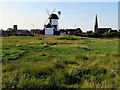
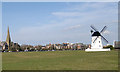
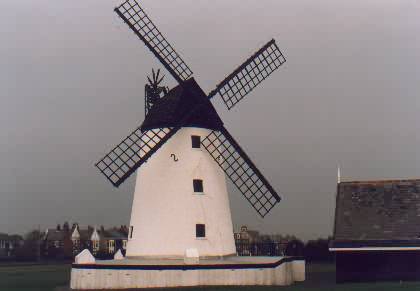
Lytham Mill is a well-known landmark, prominently situated close to the sea front. There was a windmill in Lytham as early as 1327. In the 17th century a post mill stood between Lytham Hall and St Cuthbert's church; by 1787, according to William Yate's map of Lancashire, there were two mills in this area. The present tower mill was built on a new site in 1805 when Richard Cookson applied to the Squire of Lytham for a plot of land on which to erect a windmill.
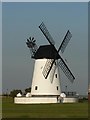
The mill continued working, latterly under William Swann, until New Year's Day 1919 when it caught fire and was burnt out. Two years later the mill was given to the people of Lytham and restored as a landmark. It was extensively repaired in the late 1980s and now carries four common sails and a skeleton fantail, and bits and pieces of machinery have been fitted. The mill is open as a local museum but does not work.
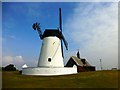
The windmill is built in the distinctive Lancashire style, a white-painted tower mill of four storeys with a black boat-shaped cap. Early illustrations show the mill as it was originally designed, with common sails and hand-winding gear at the rear of the cap. Late in the 19th century these features were replaced by a fantail and patent sails. The guide book indicates that the walled mound enclosing the mill's base was not built until ten years after the windmill's construction. It conveniently prevented animals and other users of the surrounding green from straying into the path of the turning sails. The distinctive building next to the mill is an old lifeboat station, now a museum.
Lytham windmill is looked after by the Lytham Heritage Group.


 (W B Muggeridge plate glass negative)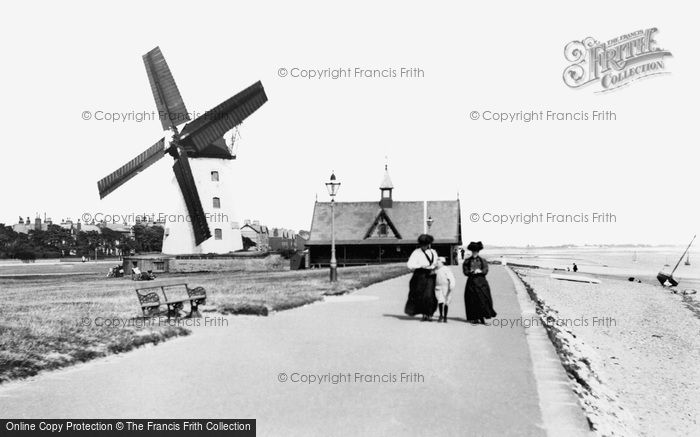


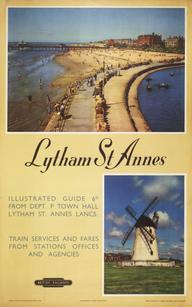 Lytham St. Annes
 Lytham, Lancashire, 19th century.
 East Beach, Lytham St Anne's, Lancashire, 1890-1910. The windmill, lifeboat station and promenade at East Beach in Lytham. A group of pedestrians pose for the camera, smartly dressed for a seaside walk. The windmill burnt down in 1919 and was not restored until 1982.
 The east promenade, Lytham St Anne's, Lancashire, 1890-1910. An early car stands to the left of the photograph with a number of pedestrians to the right in turn of the 20th century dress. The windmill in the distance burnt down in 1919 and lay derelict until 1982.
 The beach, Lytham St Anne's, Lancashire, 1890-1910. Looking east from Lytham Pier with a small fairground in the foreground and the windmill and lifeboat station in the distance. The fairground includes an early carousel and some swings.
 The promenade at Lytham St Anne's, Lancashire, 1890-1910. Holidaymakers stroll along the promenade including a woman in an early wheelchair. A pram stands to the right of the photograph whilst the windmill and lifeboat station can be seen in the distance.
 Lytham_Windmill.jpg


| Last generated 15/09/2026 | Text and images © Mark Berry, 1997-2026 - |
 (
(