Search: Google images eBay wikipedia YouTube
NGR: ST462352Tower mill function:Corn mill
-
The following information and images were provided by Steve Dennis, when he was living in the property. The two accounts complement each other, though they both cover that it was the rector G M Evans who was responsible for the conversion, and that he also preserved the Westonzoyland church roof - which was presumably more sympathetically done than the mill conversion. I've not seen the insides of this mill, though these accounts do suggest it has a charm of its own, despite the loss of milling heritage that the conversion represents.
From an unidentified document
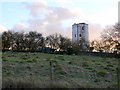
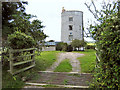
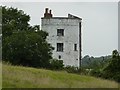
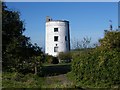
The earliest record of a windmill at Walton is 1342, [detailed in 'Building a Post Windmill in 1342' in Transactions of the Newcomen Society Volume XXXIV(1961-62) pages 151-154 by Ian Keil], but it is not clear whether it occupied the site of the present mill. The earliest certain record for a windmill on the site dates from the mid-seventeenth century. It would therefore have been possible for Monmouth, as legend has it, to have spent a night here after the Battle of Sedgemoor in 1689, though not in the present structure. The mill or mills on the site prior to c1730 would probably have been of the 'post mill' type, where the whole structure revolves to bring the sails round into the wind, rather than of the stone 'tower mill' type, where only the thatched/wooden roof revolves and of which the present structure is an example. Records describe the rebuilding of a stone tower mill in 1741, its purchase in 1792 by the Marquis of Bath, and further repairs between 1793 and 1797. The stone inscribed 'IT 1792' now over the sitting room mantelpiece probably refers to the acquisition of the mill by the Marquis. The windmill continued in use until c1900, when it was abandoned and fell into decay. In 1926 the Rev G M Evans, rector of Westonzoyland, who converted it into a holiday house, bought it and its present appearance dates from that time. When Evans bought the mill it was half-derelict. He put in concrete floors, roof and staircase, and raised the height of the tower by a parapet. He inserted windows in the 3' 0" thick walls and built on a sun porch with a balcony above. Evans employed the architect who had carried out the repairs to Westonzoyland church roof, and to this we owe the ecclesiastical quality of the interior woodwork with its chamfered corners and curious fish shaped latches on the doors.Extract from a local paper, November 1971
The Windmills Of Somerset
On Street Hill, we have our own Walton Windmill, which alas, has no sails although it is still a familiar landmark on the Polden Ridge. The Rev. G. M. Evans, then Vicar of Westonzoyland, who purchased it from the Marquis of Bath, converted Walton Windmill into a dwelling house in 1926. The preservation of the splendid late mediaeval roof of Westonzoyland Church, threatened by death watch beetle was, also due to Mr Evans' timely intervention.
Walton Windmill, together with the surrounding acre of land, is now a fenced-in "island" on Ivythorn Hill, the rest of which is National Trust land.
The last miller to grind corn at Walton Windmill was Charles Philips who rented it and ran a baker's shop near Walton Church. He was the grandfather of Jack Cavell and Len Bird, of Clarks Building Department. Before Charles Philips' time a certain Mr Crane was the miller. He lived in the Mill House opposite (now Miss Fisher's firm) and baked his bread there.
The mill remained derelict for many years, the sails gradually falling apart, until the Rev. G. M. Evans made his conversion into a splendid weekend residence nearly fifty years ago.
On one of the small landings in the stone spiral staircase hangs a faded picture of Walton Windmill, complete with sails. The late Miss C. L. Butt, formerly of Elmhurst House, Street, gave this picture to the owner in 1951.
The round table in the dining room is made from some of the original timber, which came from the machinery of the mill.
Walton Windmill has always had its own water supply. A spring situated some fifty yards from the mill provided the miller with water, although nowadays the mill is on the main water supply.
The mill in 1970

View from the 3rd floor of the mill

Taken on a digital camera during a huge electrical storm - May 98


Entry in Mills Archive database - #1750 - Tower mill, Walton
| Last generated 15/09/2026 | Text and images © Mark Berry, 1997-2026 - |
 (
(